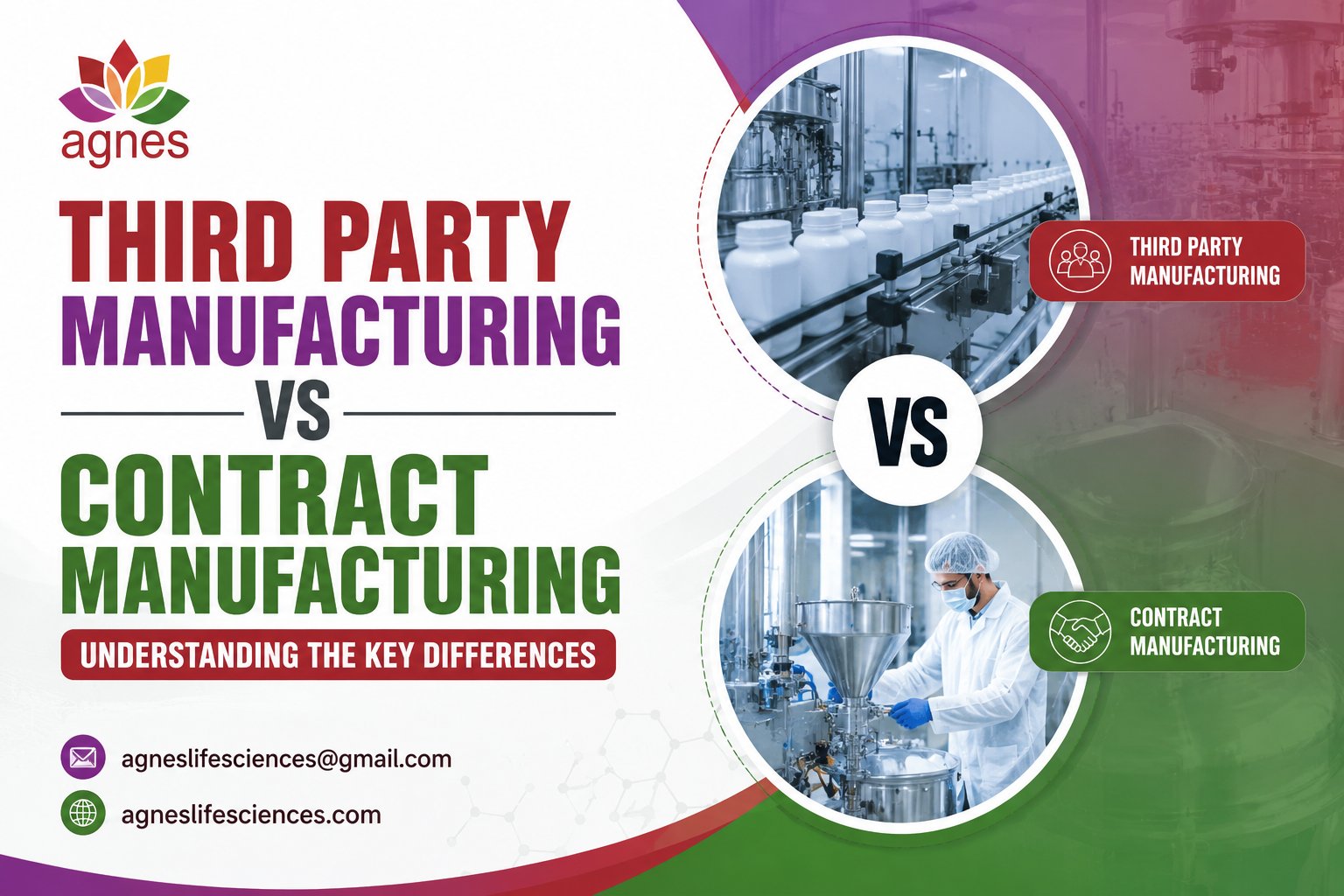
The pharmaceutical industry relies heavily on manufacturing partnerships to meet growing market demand while maintaining high standards of quality and compliance. Among the most common business models are third-party manufacturing vs. contract manufacturing, two terms that are often used interchangeably but have distinct meanings depending on the nature of the business agreement.
For pharmaceutical companies, startups, healthcare distributors, and entrepreneurs exploring PCD Pharma franchise opportunities, understanding these manufacturing models is essential for making informed business decisions. This guide explains the differences, benefits, and factors to consider when choosing the right manufacturing approach.
What is third-party manufacturing?
Third-party manufacturing is a business arrangement in which a pharmaceutical company outsources the production of its products to an independent manufacturer. The hiring company owns the brand name, decides the product specifications, and handles marketing and distribution, while the manufacturer is responsible for producing the medicines according to the agreed quality standards.
This model is widely preferred by businesses that want to launch their own pharmaceutical products without investing in expensive manufacturing facilities.
Key Features of Third-Party Manufacturing
- Products are marketed under the client’s brand.
- The manufacturer provides production facilities and technical expertise.
- Lower capital investment compared to setting up a manufacturing plant.
- Faster product launch and scalability.
- Compliance with regulatory and quality standards.
What is Contract Manufacturing?
Contract manufacturing is a broader outsourcing model where a manufacturer produces pharmaceutical products based on a contractual agreement. Depending on the contract, the manufacturer may handle additional responsibilities such as formulation development, packaging, labelling, quality testing, documentation, and regulatory support.
Unlike standard third-party manufacturing, contract manufacturing often involves a deeper and more strategic collaboration between both parties.
Key Features of Contract Manufacturing
- Customised manufacturing agreements.
- May include research and product development.
- Support for packaging, regulatory documentation, and quality assurance.
- Long-term business partnerships.
- Greater flexibility for specialised products.
Third-Party Manufacturing vs Contract Manufacturing: Major Differences
Although both models involve outsourcing production, they differ in terms of scope and business involvement.
| Aspect | Third-Party Manufacturing | Contract Manufacturing |
|---|---|---|
| Scope | Primarily product manufacturing | Manufacturing plus additional services |
| Product Development | Usually provided by the client | May be handled by the manufacturer |
| Packaging Support | Limited or optional | Often included |
| Regulatory Assistance | Basic manufacturing compliance | Comprehensive regulatory support |
| Business Relationship | Transaction-based | Long-term strategic partnership |
| Flexibility | Suitable for standard products | Suitable for customized requirements |
Advantages of Third-Party Manufacturing
Third-party manufacturing offers several advantages for pharmaceutical businesses looking to expand without large investments.
Cost-Effective
Businesses can avoid the high costs associated with establishing manufacturing facilities, purchasing machinery, and hiring production staff.
Faster Market Entry
With an experienced manufacturer handling production, companies can introduce products to the market much more quickly.
Focus on Core Business
Organisations can dedicate more resources to marketing, sales, branding, and customer acquisition instead of manufacturing operations.
Scalability
Production volumes can be increased or decreased based on market demand without major infrastructure changes.
Advantages of Contract Manufacturing
Contract manufacturing provides broader operational support that can benefit companies developing specialised pharmaceutical products.
Access to Technical Expertise
Experienced manufacturers often provide formulation support, quality improvement, and process optimisation.
Regulatory Compliance
Reliable contract manufacturers maintain documentation and manufacturing practices that align with national and international pharmaceutical regulations.
Improved Product Quality
Established quality control systems help ensure consistency, safety, and product reliability.
Operational Efficiency
Businesses can streamline supply chain management by working with a single partner for manufacturing, packaging, and quality assurance.
Which Manufacturing Model is Right for Your Business?
The right choice depends on your business goals, investment capacity, and operational requirements.
Third-party manufacturing is generally suitable if you:
- Want to launch products under your own brand.
- Need affordable manufacturing solutions.
- Already have defined product formulations.
- Plan to focus primarily on sales and distribution.
Contract manufacturing may be a better option if you:
- Require formulation development or product customisation.
- Need assistance with packaging and regulatory documentation.
- Prefer a long-term manufacturing partnership.
- Are introducing innovative or specialised pharmaceutical products.
Factors to Consider Before Choosing a Manufacturing Partner
Regardless of the manufacturing model, selecting a reliable pharmaceutical manufacturer is critical. Consider the following factors:
- Manufacturing certifications such as WHO-GMP and ISO compliance.
- Quality assurance and testing procedures.
- Production capacity and scalability.
- Product portfolio and formulation expertise.
- Transparent pricing and communication.
- Timely delivery and supply chain reliability.
- Strong industry reputation and customer support.
A dependable manufacturing partner helps ensure consistent product quality and supports long-term business growth.
Why Choose Agnes Life Sciences?
When evaluating manufacturing partners, experience, quality standards, and transparency are essential. Agnes Life Sciences offers comprehensive pharmaceutical manufacturing solutions with a strong focus on quality, regulatory compliance, and customer satisfaction.
The company manufactures a wide range of pharmaceutical formulations while maintaining stringent quality control processes. Whether businesses require third-party manufacturing services or customised manufacturing support, Agnes Life Sciences is committed to delivering reliable solutions that meet industry standards.
Conclusion
Understanding third-party manufacturing vs. contract manufacturing enables pharmaceutical businesses to select the outsourcing model that best aligns with their objectives. While third-party manufacturing is ideal for companies seeking cost-effective production under their own brand, contract manufacturing provides a broader partnership with additional services such as formulation development, packaging, and regulatory support.
Both models offer significant advantages when partnered with a trusted manufacturer that prioritises quality, compliance, and timely delivery. By carefully assessing business requirements and selecting an experienced manufacturing partner, companies can improve operational efficiency, strengthen their market presence, and achieve sustainable growth in the competitive pharmaceutical industry.