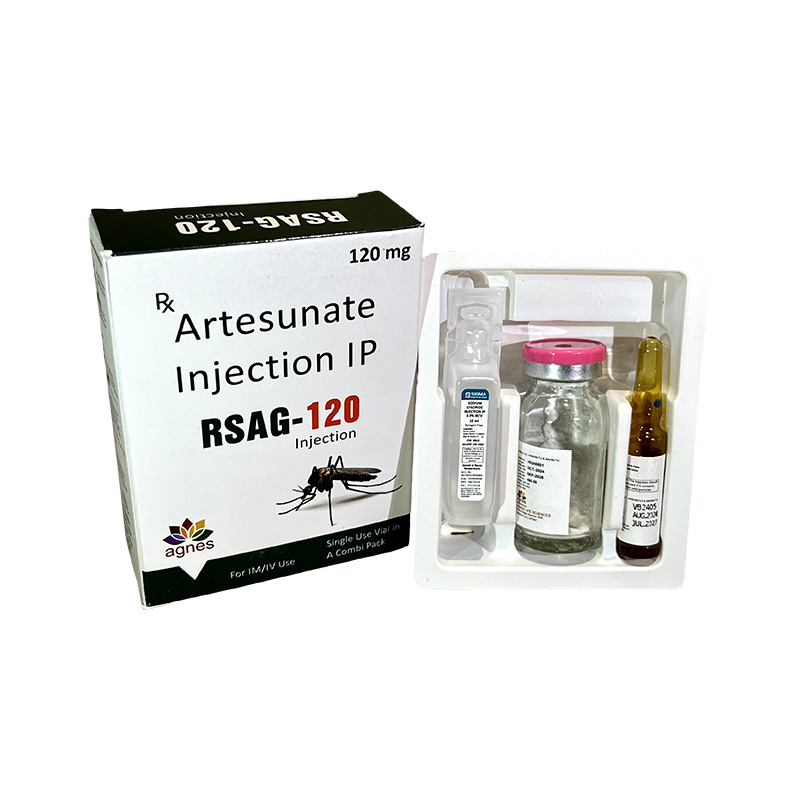
RSAG-120
COMPOSITION
Artesunate 120 mg (Injection)
Category
Antimalarial
| Packing |
|---|
SKU
2d2b207385b9
Categories AGNES, INJECTABLES, Injection
ENQUIRY
Indications
RSAG-120 is an injectable antimalarial medicine used in hospital emergencies and ICUs to treat severe malaria. It contains Artesunate — a medicine derived from Artemisinin, which comes from a plant called Artemisia annua.
Artesunate is currently the fastest-acting and most effective treatment available for severe malaria, and the World Health Organisation (WHO) recommends it as the first-choice treatment for life-threatening malaria cases worldwide. In India, where malaria still affects millions of people every year, especially in states like Odisha, Jharkhand, Chhattisgarh, and the Northeast, this injection plays a vital role in saving lives. It is prescribed for:
Severe Malaria (Plasmodium falciparum): The most serious and life-threatening form of malaria is caused by Plasmodium falciparum — a parasite that can multiply rapidly in the blood and block small blood vessels in the brain, kidneys, and lungs.
When malaria reaches this severe stage, the patient may be unconscious, having seizures, breathing heavily, or showing signs of organ failure. In these situations, oral medicines are simply not fast enough or safe enough. RSAG-120 goes directly into the bloodstream and starts attacking the parasite within minutes.
Cerebral Malaria: When the falciparum parasite blocks blood vessels in the brain, it causes cerebral malaria — one of the most dangerous complications of the disease. Patients may become unconscious, have fits, or stop responding. Artesunate injection is the treatment of choice in these cases because it works fast and gets into the brain quickly.
Severe Malaria with Organ Complications: Severe malaria can damage multiple organs at once — the kidneys stop working, the lungs fill with fluid, the liver shows signs of failure, and the blood loses its ability to clot properly. RSAG-120 is used in ICU settings to rapidly clear the parasite load from the blood before these complications become irreversible.
ICU and Emergency Malaria Management: When a patient comes to the emergency department in a critical condition with confirmed or highly suspected severe malaria, RSAG-120 is started immediately — even before all test reports come back in some cases — because the speed of treatment directly affects survival.
Multi-Drug Resistant Malaria: Some areas in India and Southeast Asia have seen Plasmodium falciparum develop resistance to older antimalarials like Chloroquine and even some Artemisinin-based combinations. Artesunate injection, especially when used as part of a carefully chosen combination, remains one of the most effective tools in managing these resistant cases under specialist supervision.
WHO-Recommended First-Line Treatment for Severe Malaria: This is not just a local recommendation — globally, the WHO replaced Quinine with injectable Artesunate as the first-choice treatment for severe malaria after large trials showed that Artesunate saved significantly more lives. RSAG-120 brings this internationally recommended standard of care to patients in India.
Malaria in Pregnancy with Severe Symptoms: Severe malaria is particularly dangerous during pregnancy — it can rapidly cause miscarriage, premature labour, and maternal death. Artesunate is used in these emergencies under careful medical supervision when the clinical situation demands it.
Prevention of Malaria Progression: In patients who have moderate-to-severe malaria and are at high risk of deteriorating, early use of RSAG-120 helps bring the parasite count down quickly — stopping the disease from progressing to its most dangerous stage.
Artesunate is currently the fastest-acting and most effective treatment available for severe malaria, and the World Health Organisation (WHO) recommends it as the first-choice treatment for life-threatening malaria cases worldwide. In India, where malaria still affects millions of people every year, especially in states like Odisha, Jharkhand, Chhattisgarh, and the Northeast, this injection plays a vital role in saving lives. It is prescribed for:
Severe Malaria (Plasmodium falciparum): The most serious and life-threatening form of malaria is caused by Plasmodium falciparum — a parasite that can multiply rapidly in the blood and block small blood vessels in the brain, kidneys, and lungs.
When malaria reaches this severe stage, the patient may be unconscious, having seizures, breathing heavily, or showing signs of organ failure. In these situations, oral medicines are simply not fast enough or safe enough. RSAG-120 goes directly into the bloodstream and starts attacking the parasite within minutes.
Cerebral Malaria: When the falciparum parasite blocks blood vessels in the brain, it causes cerebral malaria — one of the most dangerous complications of the disease. Patients may become unconscious, have fits, or stop responding. Artesunate injection is the treatment of choice in these cases because it works fast and gets into the brain quickly.
Severe Malaria with Organ Complications: Severe malaria can damage multiple organs at once — the kidneys stop working, the lungs fill with fluid, the liver shows signs of failure, and the blood loses its ability to clot properly. RSAG-120 is used in ICU settings to rapidly clear the parasite load from the blood before these complications become irreversible.
ICU and Emergency Malaria Management: When a patient comes to the emergency department in a critical condition with confirmed or highly suspected severe malaria, RSAG-120 is started immediately — even before all test reports come back in some cases — because the speed of treatment directly affects survival.
Multi-Drug Resistant Malaria: Some areas in India and Southeast Asia have seen Plasmodium falciparum develop resistance to older antimalarials like Chloroquine and even some Artemisinin-based combinations. Artesunate injection, especially when used as part of a carefully chosen combination, remains one of the most effective tools in managing these resistant cases under specialist supervision.
WHO-Recommended First-Line Treatment for Severe Malaria: This is not just a local recommendation — globally, the WHO replaced Quinine with injectable Artesunate as the first-choice treatment for severe malaria after large trials showed that Artesunate saved significantly more lives. RSAG-120 brings this internationally recommended standard of care to patients in India.
Malaria in Pregnancy with Severe Symptoms: Severe malaria is particularly dangerous during pregnancy — it can rapidly cause miscarriage, premature labour, and maternal death. Artesunate is used in these emergencies under careful medical supervision when the clinical situation demands it.
Prevention of Malaria Progression: In patients who have moderate-to-severe malaria and are at high risk of deteriorating, early use of RSAG-120 helps bring the parasite count down quickly — stopping the disease from progressing to its most dangerous stage.
Uses
RSAG-120 works by releasing a substance called dihydroartemisinin inside red blood cells that have been infected by the malaria parasite. The malaria parasite lives inside red blood cells and feeds on haemoglobin. As it breaks down haemoglobin, it produces a substance called heme.
Artesunate reacts with heme and creates toxic compounds that destroy the parasite from the inside. Because this happens so quickly and across all stages of the parasite’s life cycle, Artesunate brings down the number of parasites in the blood far faster than any other antimalarial available today.
Rapid Action Against Severe Malaria: Artesunate begins killing the malaria parasite within minutes of being given.
Studies have shown that within 24 hours of starting treatment, Artesunate reduces the parasite count in the blood by more than 90% in most patients. No other antimalarial works this fast.
Effective Against Plasmodium falciparum: Falciparum malaria is responsible for almost all malaria deaths. Artesunate is specifically very effective against this species and is the only injectable antimalarial recommended as first-line treatment for this form of the disease.
ICU and Emergency Use: Because it is given directly into the bloodstream and acts within minutes, it is the ideal medicine for ICU patients and emergencies where every hour matters. A patient with cerebral malaria or malaria-related organ failure cannot wait for an oral medicine to be absorbed through the gut.
Works Against Multi-Drug Resistant Strains: While resistance to Artesunate is emerging in some parts of the world, when used correctly — at the right dose, for the right duration, and as part of combination therapy — it remains one of the strongest weapons against even resistant malaria parasites.
WHO-Recommended Treatment: The recommendation from WHO is clear and based on solid clinical evidence — Artesunate injection reduces malaria deaths significantly compared to the previously used Quinine injection. It causes fewer side effects, works faster, and improves survival rates in patients with severe malaria.
Clears Parasite Load Quickly: The faster the parasite count in the blood falls, the less damage it does to organs. RSAG-120 brings down the parasite count so rapidly that it reduces the risk of complications developing or worsening — giving the patient’s body a chance to recover.
Artesunate reacts with heme and creates toxic compounds that destroy the parasite from the inside. Because this happens so quickly and across all stages of the parasite’s life cycle, Artesunate brings down the number of parasites in the blood far faster than any other antimalarial available today.
Rapid Action Against Severe Malaria: Artesunate begins killing the malaria parasite within minutes of being given.
Studies have shown that within 24 hours of starting treatment, Artesunate reduces the parasite count in the blood by more than 90% in most patients. No other antimalarial works this fast.
Effective Against Plasmodium falciparum: Falciparum malaria is responsible for almost all malaria deaths. Artesunate is specifically very effective against this species and is the only injectable antimalarial recommended as first-line treatment for this form of the disease.
ICU and Emergency Use: Because it is given directly into the bloodstream and acts within minutes, it is the ideal medicine for ICU patients and emergencies where every hour matters. A patient with cerebral malaria or malaria-related organ failure cannot wait for an oral medicine to be absorbed through the gut.
Works Against Multi-Drug Resistant Strains: While resistance to Artesunate is emerging in some parts of the world, when used correctly — at the right dose, for the right duration, and as part of combination therapy — it remains one of the strongest weapons against even resistant malaria parasites.
WHO-Recommended Treatment: The recommendation from WHO is clear and based on solid clinical evidence — Artesunate injection reduces malaria deaths significantly compared to the previously used Quinine injection. It causes fewer side effects, works faster, and improves survival rates in patients with severe malaria.
Clears Parasite Load Quickly: The faster the parasite count in the blood falls, the less damage it does to organs. RSAG-120 brings down the parasite count so rapidly that it reduces the risk of complications developing or worsening — giving the patient’s body a chance to recover.
Dosage & Storage
Dosage: The dose is calculated strictly by the treating doctor based on the patient’s body weight. The standard dosing for severe malaria is given at 0, 12, and 24 hours, then once daily until the patient can take oral medicine. The total number of doses and duration depend on the patient’s response and clinical condition.
How It Is Given: As an intravenous (IV) injection or infusion by a qualified doctor or nurse in a hospital or ICU. It can also be given as an intramuscular (IM) injection in some situations when IV access is not immediately available — particularly in rural or field settings before the patient is transferred to a hospital.
Preparation: RSAG-120 comes as a powder that needs to be dissolved in the provided sodium bicarbonate solution first, and then diluted further in a suitable IV fluid before administration. The preparation steps must be followed exactly as instructed — the order of mixing matters.
Dosage for Children: In children, the dose is calculated per kilogram of body weight. Children actually receive a higher mg/kg dose than adults in severe malaria, as data shows they need it for adequate treatment response. Storage: Store the dry vial at room temperature between 15°C and 30°C in a cool, dry place away from direct sunlight and moisture.
Protect from Light: Keep the vial in its original carton. Artesunate can degrade when exposed to light.
After Reconstitution: Use the prepared solution immediately. Do not store the mixed solution — it must be given as soon as it is prepared.
Keep Out of Reach: Store safely away from children and pets at all times.
How It Is Given: As an intravenous (IV) injection or infusion by a qualified doctor or nurse in a hospital or ICU. It can also be given as an intramuscular (IM) injection in some situations when IV access is not immediately available — particularly in rural or field settings before the patient is transferred to a hospital.
Preparation: RSAG-120 comes as a powder that needs to be dissolved in the provided sodium bicarbonate solution first, and then diluted further in a suitable IV fluid before administration. The preparation steps must be followed exactly as instructed — the order of mixing matters.
Dosage for Children: In children, the dose is calculated per kilogram of body weight. Children actually receive a higher mg/kg dose than adults in severe malaria, as data shows they need it for adequate treatment response. Storage: Store the dry vial at room temperature between 15°C and 30°C in a cool, dry place away from direct sunlight and moisture.
Protect from Light: Keep the vial in its original carton. Artesunate can degrade when exposed to light.
After Reconstitution: Use the prepared solution immediately. Do not store the mixed solution — it must be given as soon as it is prepared.
Keep Out of Reach: Store safely away from children and pets at all times.
Directions For Use
Emergency and Hospital Use Only: RSAG-120 is strictly for use inside a hospital, ICU, or emergency department by trained medical professionals. It is never for home use under any circumstances.
Never Self-Administer: This injection must always be prepared and given by a qualified doctor or nurse. The preparation involves a specific mixing process that must be done correctly.
Follow the Mixing Steps Exactly: First dissolve the powder in the sodium bicarbonate solution provided, then dilute in a suitable IV fluid. Do not skip or reverse these steps. The solution must be mixed properly before giving — an incorrectly prepared solution should not be used.
Check the Solution: After preparation, the solution should be clear. If it appears cloudy or has visible particles, do not use it. Inform the nurse or pharmacist.
Give the Full Course: Even when the patient starts to feel better after the first one or two injections — which can happen quickly with Artesunate — it is critical to complete the full prescribed course of injections. Stopping early allows the remaining parasites to survive and can lead to the malaria coming back, sometimes with worse complications.
Follow-Up Oral Treatment: Once the patient is stable and able to swallow medicines, the doctor will switch to an oral artemisinin-based combination therapy (ACT) to complete the full treatment course. This step is important and must not be skipped.
Monitor During Treatment: Patients receiving RSAG-120 are closely monitored for parasite count, kidney function, blood counts, and blood sugar levels throughout the course. Do not ignore any changes in the patient’s condition during treatment.
Missed Dose: If a scheduled dose is delayed, inform the treating doctor immediately. The timing of doses in severe malaria treatment matters — follow the schedule as closely as possible.
Never Self-Administer: This injection must always be prepared and given by a qualified doctor or nurse. The preparation involves a specific mixing process that must be done correctly.
Follow the Mixing Steps Exactly: First dissolve the powder in the sodium bicarbonate solution provided, then dilute in a suitable IV fluid. Do not skip or reverse these steps. The solution must be mixed properly before giving — an incorrectly prepared solution should not be used.
Check the Solution: After preparation, the solution should be clear. If it appears cloudy or has visible particles, do not use it. Inform the nurse or pharmacist.
Give the Full Course: Even when the patient starts to feel better after the first one or two injections — which can happen quickly with Artesunate — it is critical to complete the full prescribed course of injections. Stopping early allows the remaining parasites to survive and can lead to the malaria coming back, sometimes with worse complications.
Follow-Up Oral Treatment: Once the patient is stable and able to swallow medicines, the doctor will switch to an oral artemisinin-based combination therapy (ACT) to complete the full treatment course. This step is important and must not be skipped.
Monitor During Treatment: Patients receiving RSAG-120 are closely monitored for parasite count, kidney function, blood counts, and blood sugar levels throughout the course. Do not ignore any changes in the patient’s condition during treatment.
Missed Dose: If a scheduled dose is delayed, inform the treating doctor immediately. The timing of doses in severe malaria treatment matters — follow the schedule as closely as possible.
Precautions
Before starting RSAG-120, the doctor must know the following:
Allergy to Artesunate or Artemisinin: Do not use if the patient has had any known allergic reaction to artesunate, artemether, or any other artemisinin-based medicine. Full allergy history must be shared before treatment begins.
Post-Artesunate Haemolysis: This is an important and well-documented phenomenon — some patients develop a delayed drop in haemoglobin (red blood cell destruction) about 2 to 3 weeks after completing a course of injectable artesunate.
This is called post-artesunate delayed haemolysis. Patients and their families should be informed to watch for signs of anaemia — unusual paleness, weakness, or breathlessness — and to get a blood test done if these symptoms appear after the treatment is over.
Pregnancy: Severe malaria in pregnancy is a medical emergency and is genuinely life-threatening for both the mother and the baby. In this situation, the risk of not treating is far greater than any risk from the medicine. Artesunate injection is used in pregnancy for severe malaria — but only under careful specialist supervision and after a proper assessment.
Kidney and Liver Problems: Patients with existing kidney or liver disease should be monitored closely during treatment. Severe malaria itself can affect these organs, and the medical team will watch for any worsening during and after the treatment course.
Blood Sugar Monitoring: Severe malaria can cause very low blood sugar (hypoglycaemia) — especially in children and pregnant women. This is a known complication of both the disease and some antimalarial treatments. Blood glucose should be checked regularly during treatment.
Blood Count Monitoring: Regular blood tests, including haemoglobin, platelet count, and parasite count should be done during and after the course to track recovery and catch any complications early.
Other Medicines: Tell the doctor about all medicines the patient is currently taking. Some antimalarials should not be combined with Artesunate, and the medical team needs the full picture to plan the safest treatment.
Allergy to Artesunate or Artemisinin: Do not use if the patient has had any known allergic reaction to artesunate, artemether, or any other artemisinin-based medicine. Full allergy history must be shared before treatment begins.
Post-Artesunate Haemolysis: This is an important and well-documented phenomenon — some patients develop a delayed drop in haemoglobin (red blood cell destruction) about 2 to 3 weeks after completing a course of injectable artesunate.
This is called post-artesunate delayed haemolysis. Patients and their families should be informed to watch for signs of anaemia — unusual paleness, weakness, or breathlessness — and to get a blood test done if these symptoms appear after the treatment is over.
Pregnancy: Severe malaria in pregnancy is a medical emergency and is genuinely life-threatening for both the mother and the baby. In this situation, the risk of not treating is far greater than any risk from the medicine. Artesunate injection is used in pregnancy for severe malaria — but only under careful specialist supervision and after a proper assessment.
Kidney and Liver Problems: Patients with existing kidney or liver disease should be monitored closely during treatment. Severe malaria itself can affect these organs, and the medical team will watch for any worsening during and after the treatment course.
Blood Sugar Monitoring: Severe malaria can cause very low blood sugar (hypoglycaemia) — especially in children and pregnant women. This is a known complication of both the disease and some antimalarial treatments. Blood glucose should be checked regularly during treatment.
Blood Count Monitoring: Regular blood tests, including haemoglobin, platelet count, and parasite count should be done during and after the course to track recovery and catch any complications early.
Other Medicines: Tell the doctor about all medicines the patient is currently taking. Some antimalarials should not be combined with Artesunate, and the medical team needs the full picture to plan the safest treatment.
Side Effects
Dizziness
Weakness
Fever
GI upset
Rare allergic reaction
Weakness
Fever
GI upset
Rare allergic reaction
Medical Disclaimer
The information given here is for general understanding and educational purposes only. It does not replace the advice of a qualified doctor or the clinical judgement of a trained medical professional. RSAG-120 is a prescription-only injectable medicine meant exclusively for use in a hospital, ICU, or emergency clinical setting under the direct supervision of a licensed medical professional.
Agnes Life Sciences does not claim that this or any of its products can diagnose, treat, cure, or prevent any disease. For proper diagnosis and the right treatment plan, always consult your doctor directly.
Agnes Life Sciences does not claim that this or any of its products can diagnose, treat, cure, or prevent any disease. For proper diagnosis and the right treatment plan, always consult your doctor directly.
Indications
RSAG-120 is an injectable antimalarial medicine used in hospital emergencies and ICUs to treat severe malaria. It contains Artesunate — a medicine derived from Artemisinin, which comes from a plant called Artemisia annua.
Artesunate is currently the fastest-acting and most effective treatment available for severe malaria, and the World Health Organisation (WHO) recommends it as the first-choice treatment for life-threatening malaria cases worldwide. In India, where malaria still affects millions of people every year, especially in states like Odisha, Jharkhand, Chhattisgarh, and the Northeast, this injection plays a vital role in saving lives. It is prescribed for:
Severe Malaria (Plasmodium falciparum): The most serious and life-threatening form of malaria is caused by Plasmodium falciparum — a parasite that can multiply rapidly in the blood and block small blood vessels in the brain, kidneys, and lungs.
When malaria reaches this severe stage, the patient may be unconscious, having seizures, breathing heavily, or showing signs of organ failure. In these situations, oral medicines are simply not fast enough or safe enough. RSAG-120 goes directly into the bloodstream and starts attacking the parasite within minutes.
Cerebral Malaria: When the falciparum parasite blocks blood vessels in the brain, it causes cerebral malaria — one of the most dangerous complications of the disease. Patients may become unconscious, have fits, or stop responding. Artesunate injection is the treatment of choice in these cases because it works fast and gets into the brain quickly.
Severe Malaria with Organ Complications: Severe malaria can damage multiple organs at once — the kidneys stop working, the lungs fill with fluid, the liver shows signs of failure, and the blood loses its ability to clot properly. RSAG-120 is used in ICU settings to rapidly clear the parasite load from the blood before these complications become irreversible.
ICU and Emergency Malaria Management: When a patient comes to the emergency department in a critical condition with confirmed or highly suspected severe malaria, RSAG-120 is started immediately — even before all test reports come back in some cases — because the speed of treatment directly affects survival.
Multi-Drug Resistant Malaria: Some areas in India and Southeast Asia have seen Plasmodium falciparum develop resistance to older antimalarials like Chloroquine and even some Artemisinin-based combinations. Artesunate injection, especially when used as part of a carefully chosen combination, remains one of the most effective tools in managing these resistant cases under specialist supervision.
WHO-Recommended First-Line Treatment for Severe Malaria: This is not just a local recommendation — globally, the WHO replaced Quinine with injectable Artesunate as the first-choice treatment for severe malaria after large trials showed that Artesunate saved significantly more lives. RSAG-120 brings this internationally recommended standard of care to patients in India.
Malaria in Pregnancy with Severe Symptoms: Severe malaria is particularly dangerous during pregnancy — it can rapidly cause miscarriage, premature labour, and maternal death. Artesunate is used in these emergencies under careful medical supervision when the clinical situation demands it.
Prevention of Malaria Progression: In patients who have moderate-to-severe malaria and are at high risk of deteriorating, early use of RSAG-120 helps bring the parasite count down quickly — stopping the disease from progressing to its most dangerous stage.
Artesunate is currently the fastest-acting and most effective treatment available for severe malaria, and the World Health Organisation (WHO) recommends it as the first-choice treatment for life-threatening malaria cases worldwide. In India, where malaria still affects millions of people every year, especially in states like Odisha, Jharkhand, Chhattisgarh, and the Northeast, this injection plays a vital role in saving lives. It is prescribed for:
Severe Malaria (Plasmodium falciparum): The most serious and life-threatening form of malaria is caused by Plasmodium falciparum — a parasite that can multiply rapidly in the blood and block small blood vessels in the brain, kidneys, and lungs.
When malaria reaches this severe stage, the patient may be unconscious, having seizures, breathing heavily, or showing signs of organ failure. In these situations, oral medicines are simply not fast enough or safe enough. RSAG-120 goes directly into the bloodstream and starts attacking the parasite within minutes.
Cerebral Malaria: When the falciparum parasite blocks blood vessels in the brain, it causes cerebral malaria — one of the most dangerous complications of the disease. Patients may become unconscious, have fits, or stop responding. Artesunate injection is the treatment of choice in these cases because it works fast and gets into the brain quickly.
Severe Malaria with Organ Complications: Severe malaria can damage multiple organs at once — the kidneys stop working, the lungs fill with fluid, the liver shows signs of failure, and the blood loses its ability to clot properly. RSAG-120 is used in ICU settings to rapidly clear the parasite load from the blood before these complications become irreversible.
ICU and Emergency Malaria Management: When a patient comes to the emergency department in a critical condition with confirmed or highly suspected severe malaria, RSAG-120 is started immediately — even before all test reports come back in some cases — because the speed of treatment directly affects survival.
Multi-Drug Resistant Malaria: Some areas in India and Southeast Asia have seen Plasmodium falciparum develop resistance to older antimalarials like Chloroquine and even some Artemisinin-based combinations. Artesunate injection, especially when used as part of a carefully chosen combination, remains one of the most effective tools in managing these resistant cases under specialist supervision.
WHO-Recommended First-Line Treatment for Severe Malaria: This is not just a local recommendation — globally, the WHO replaced Quinine with injectable Artesunate as the first-choice treatment for severe malaria after large trials showed that Artesunate saved significantly more lives. RSAG-120 brings this internationally recommended standard of care to patients in India.
Malaria in Pregnancy with Severe Symptoms: Severe malaria is particularly dangerous during pregnancy — it can rapidly cause miscarriage, premature labour, and maternal death. Artesunate is used in these emergencies under careful medical supervision when the clinical situation demands it.
Prevention of Malaria Progression: In patients who have moderate-to-severe malaria and are at high risk of deteriorating, early use of RSAG-120 helps bring the parasite count down quickly — stopping the disease from progressing to its most dangerous stage.
Uses
RSAG-120 works by releasing a substance called dihydroartemisinin inside red blood cells that have been infected by the malaria parasite. The malaria parasite lives inside red blood cells and feeds on haemoglobin. As it breaks down haemoglobin, it produces a substance called heme.
Artesunate reacts with heme and creates toxic compounds that destroy the parasite from the inside. Because this happens so quickly and across all stages of the parasite’s life cycle, Artesunate brings down the number of parasites in the blood far faster than any other antimalarial available today.
Rapid Action Against Severe Malaria: Artesunate begins killing the malaria parasite within minutes of being given.
Studies have shown that within 24 hours of starting treatment, Artesunate reduces the parasite count in the blood by more than 90% in most patients. No other antimalarial works this fast.
Effective Against Plasmodium falciparum: Falciparum malaria is responsible for almost all malaria deaths. Artesunate is specifically very effective against this species and is the only injectable antimalarial recommended as first-line treatment for this form of the disease.
ICU and Emergency Use: Because it is given directly into the bloodstream and acts within minutes, it is the ideal medicine for ICU patients and emergencies where every hour matters. A patient with cerebral malaria or malaria-related organ failure cannot wait for an oral medicine to be absorbed through the gut.
Works Against Multi-Drug Resistant Strains: While resistance to Artesunate is emerging in some parts of the world, when used correctly — at the right dose, for the right duration, and as part of combination therapy — it remains one of the strongest weapons against even resistant malaria parasites.
WHO-Recommended Treatment: The recommendation from WHO is clear and based on solid clinical evidence — Artesunate injection reduces malaria deaths significantly compared to the previously used Quinine injection. It causes fewer side effects, works faster, and improves survival rates in patients with severe malaria.
Clears Parasite Load Quickly: The faster the parasite count in the blood falls, the less damage it does to organs. RSAG-120 brings down the parasite count so rapidly that it reduces the risk of complications developing or worsening — giving the patient’s body a chance to recover.
Artesunate reacts with heme and creates toxic compounds that destroy the parasite from the inside. Because this happens so quickly and across all stages of the parasite’s life cycle, Artesunate brings down the number of parasites in the blood far faster than any other antimalarial available today.
Rapid Action Against Severe Malaria: Artesunate begins killing the malaria parasite within minutes of being given.
Studies have shown that within 24 hours of starting treatment, Artesunate reduces the parasite count in the blood by more than 90% in most patients. No other antimalarial works this fast.
Effective Against Plasmodium falciparum: Falciparum malaria is responsible for almost all malaria deaths. Artesunate is specifically very effective against this species and is the only injectable antimalarial recommended as first-line treatment for this form of the disease.
ICU and Emergency Use: Because it is given directly into the bloodstream and acts within minutes, it is the ideal medicine for ICU patients and emergencies where every hour matters. A patient with cerebral malaria or malaria-related organ failure cannot wait for an oral medicine to be absorbed through the gut.
Works Against Multi-Drug Resistant Strains: While resistance to Artesunate is emerging in some parts of the world, when used correctly — at the right dose, for the right duration, and as part of combination therapy — it remains one of the strongest weapons against even resistant malaria parasites.
WHO-Recommended Treatment: The recommendation from WHO is clear and based on solid clinical evidence — Artesunate injection reduces malaria deaths significantly compared to the previously used Quinine injection. It causes fewer side effects, works faster, and improves survival rates in patients with severe malaria.
Clears Parasite Load Quickly: The faster the parasite count in the blood falls, the less damage it does to organs. RSAG-120 brings down the parasite count so rapidly that it reduces the risk of complications developing or worsening — giving the patient’s body a chance to recover.
Dosage & Storage
Dosage: The dose is calculated strictly by the treating doctor based on the patient’s body weight. The standard dosing for severe malaria is given at 0, 12, and 24 hours, then once daily until the patient can take oral medicine. The total number of doses and duration depend on the patient’s response and clinical condition.
How It Is Given: As an intravenous (IV) injection or infusion by a qualified doctor or nurse in a hospital or ICU. It can also be given as an intramuscular (IM) injection in some situations when IV access is not immediately available — particularly in rural or field settings before the patient is transferred to a hospital.
Preparation: RSAG-120 comes as a powder that needs to be dissolved in the provided sodium bicarbonate solution first, and then diluted further in a suitable IV fluid before administration. The preparation steps must be followed exactly as instructed — the order of mixing matters.
Dosage for Children: In children, the dose is calculated per kilogram of body weight. Children actually receive a higher mg/kg dose than adults in severe malaria, as data shows they need it for adequate treatment response. Storage: Store the dry vial at room temperature between 15°C and 30°C in a cool, dry place away from direct sunlight and moisture.
Protect from Light: Keep the vial in its original carton. Artesunate can degrade when exposed to light.
After Reconstitution: Use the prepared solution immediately. Do not store the mixed solution — it must be given as soon as it is prepared.
Keep Out of Reach: Store safely away from children and pets at all times.
How It Is Given: As an intravenous (IV) injection or infusion by a qualified doctor or nurse in a hospital or ICU. It can also be given as an intramuscular (IM) injection in some situations when IV access is not immediately available — particularly in rural or field settings before the patient is transferred to a hospital.
Preparation: RSAG-120 comes as a powder that needs to be dissolved in the provided sodium bicarbonate solution first, and then diluted further in a suitable IV fluid before administration. The preparation steps must be followed exactly as instructed — the order of mixing matters.
Dosage for Children: In children, the dose is calculated per kilogram of body weight. Children actually receive a higher mg/kg dose than adults in severe malaria, as data shows they need it for adequate treatment response. Storage: Store the dry vial at room temperature between 15°C and 30°C in a cool, dry place away from direct sunlight and moisture.
Protect from Light: Keep the vial in its original carton. Artesunate can degrade when exposed to light.
After Reconstitution: Use the prepared solution immediately. Do not store the mixed solution — it must be given as soon as it is prepared.
Keep Out of Reach: Store safely away from children and pets at all times.
Directions For Use
Emergency and Hospital Use Only: RSAG-120 is strictly for use inside a hospital, ICU, or emergency department by trained medical professionals. It is never for home use under any circumstances.
Never Self-Administer: This injection must always be prepared and given by a qualified doctor or nurse. The preparation involves a specific mixing process that must be done correctly.
Follow the Mixing Steps Exactly: First dissolve the powder in the sodium bicarbonate solution provided, then dilute in a suitable IV fluid. Do not skip or reverse these steps. The solution must be mixed properly before giving — an incorrectly prepared solution should not be used.
Check the Solution: After preparation, the solution should be clear. If it appears cloudy or has visible particles, do not use it. Inform the nurse or pharmacist.
Give the Full Course: Even when the patient starts to feel better after the first one or two injections — which can happen quickly with Artesunate — it is critical to complete the full prescribed course of injections. Stopping early allows the remaining parasites to survive and can lead to the malaria coming back, sometimes with worse complications.
Follow-Up Oral Treatment: Once the patient is stable and able to swallow medicines, the doctor will switch to an oral artemisinin-based combination therapy (ACT) to complete the full treatment course. This step is important and must not be skipped.
Monitor During Treatment: Patients receiving RSAG-120 are closely monitored for parasite count, kidney function, blood counts, and blood sugar levels throughout the course. Do not ignore any changes in the patient’s condition during treatment.
Missed Dose: If a scheduled dose is delayed, inform the treating doctor immediately. The timing of doses in severe malaria treatment matters — follow the schedule as closely as possible.
Never Self-Administer: This injection must always be prepared and given by a qualified doctor or nurse. The preparation involves a specific mixing process that must be done correctly.
Follow the Mixing Steps Exactly: First dissolve the powder in the sodium bicarbonate solution provided, then dilute in a suitable IV fluid. Do not skip or reverse these steps. The solution must be mixed properly before giving — an incorrectly prepared solution should not be used.
Check the Solution: After preparation, the solution should be clear. If it appears cloudy or has visible particles, do not use it. Inform the nurse or pharmacist.
Give the Full Course: Even when the patient starts to feel better after the first one or two injections — which can happen quickly with Artesunate — it is critical to complete the full prescribed course of injections. Stopping early allows the remaining parasites to survive and can lead to the malaria coming back, sometimes with worse complications.
Follow-Up Oral Treatment: Once the patient is stable and able to swallow medicines, the doctor will switch to an oral artemisinin-based combination therapy (ACT) to complete the full treatment course. This step is important and must not be skipped.
Monitor During Treatment: Patients receiving RSAG-120 are closely monitored for parasite count, kidney function, blood counts, and blood sugar levels throughout the course. Do not ignore any changes in the patient’s condition during treatment.
Missed Dose: If a scheduled dose is delayed, inform the treating doctor immediately. The timing of doses in severe malaria treatment matters — follow the schedule as closely as possible.
Precautions
Before starting RSAG-120, the doctor must know the following:
Allergy to Artesunate or Artemisinin: Do not use if the patient has had any known allergic reaction to artesunate, artemether, or any other artemisinin-based medicine. Full allergy history must be shared before treatment begins.
Post-Artesunate Haemolysis: This is an important and well-documented phenomenon — some patients develop a delayed drop in haemoglobin (red blood cell destruction) about 2 to 3 weeks after completing a course of injectable artesunate.
This is called post-artesunate delayed haemolysis. Patients and their families should be informed to watch for signs of anaemia — unusual paleness, weakness, or breathlessness — and to get a blood test done if these symptoms appear after the treatment is over.
Pregnancy: Severe malaria in pregnancy is a medical emergency and is genuinely life-threatening for both the mother and the baby. In this situation, the risk of not treating is far greater than any risk from the medicine. Artesunate injection is used in pregnancy for severe malaria — but only under careful specialist supervision and after a proper assessment.
Kidney and Liver Problems: Patients with existing kidney or liver disease should be monitored closely during treatment. Severe malaria itself can affect these organs, and the medical team will watch for any worsening during and after the treatment course.
Blood Sugar Monitoring: Severe malaria can cause very low blood sugar (hypoglycaemia) — especially in children and pregnant women. This is a known complication of both the disease and some antimalarial treatments. Blood glucose should be checked regularly during treatment.
Blood Count Monitoring: Regular blood tests, including haemoglobin, platelet count, and parasite count should be done during and after the course to track recovery and catch any complications early.
Other Medicines: Tell the doctor about all medicines the patient is currently taking. Some antimalarials should not be combined with Artesunate, and the medical team needs the full picture to plan the safest treatment.
Allergy to Artesunate or Artemisinin: Do not use if the patient has had any known allergic reaction to artesunate, artemether, or any other artemisinin-based medicine. Full allergy history must be shared before treatment begins.
Post-Artesunate Haemolysis: This is an important and well-documented phenomenon — some patients develop a delayed drop in haemoglobin (red blood cell destruction) about 2 to 3 weeks after completing a course of injectable artesunate.
This is called post-artesunate delayed haemolysis. Patients and their families should be informed to watch for signs of anaemia — unusual paleness, weakness, or breathlessness — and to get a blood test done if these symptoms appear after the treatment is over.
Pregnancy: Severe malaria in pregnancy is a medical emergency and is genuinely life-threatening for both the mother and the baby. In this situation, the risk of not treating is far greater than any risk from the medicine. Artesunate injection is used in pregnancy for severe malaria — but only under careful specialist supervision and after a proper assessment.
Kidney and Liver Problems: Patients with existing kidney or liver disease should be monitored closely during treatment. Severe malaria itself can affect these organs, and the medical team will watch for any worsening during and after the treatment course.
Blood Sugar Monitoring: Severe malaria can cause very low blood sugar (hypoglycaemia) — especially in children and pregnant women. This is a known complication of both the disease and some antimalarial treatments. Blood glucose should be checked regularly during treatment.
Blood Count Monitoring: Regular blood tests, including haemoglobin, platelet count, and parasite count should be done during and after the course to track recovery and catch any complications early.
Other Medicines: Tell the doctor about all medicines the patient is currently taking. Some antimalarials should not be combined with Artesunate, and the medical team needs the full picture to plan the safest treatment.
Side Effects
Dizziness
Weakness
Fever
GI upset
Rare allergic reaction
Weakness
Fever
GI upset
Rare allergic reaction
Medical Disclaimer
The information given here is for general understanding and educational purposes only. It does not replace the advice of a qualified doctor or the clinical judgement of a trained medical professional. RSAG-120 is a prescription-only injectable medicine meant exclusively for use in a hospital, ICU, or emergency clinical setting under the direct supervision of a licensed medical professional.
Agnes Life Sciences does not claim that this or any of its products can diagnose, treat, cure, or prevent any disease. For proper diagnosis and the right treatment plan, always consult your doctor directly.
Agnes Life Sciences does not claim that this or any of its products can diagnose, treat, cure, or prevent any disease. For proper diagnosis and the right treatment plan, always consult your doctor directly.