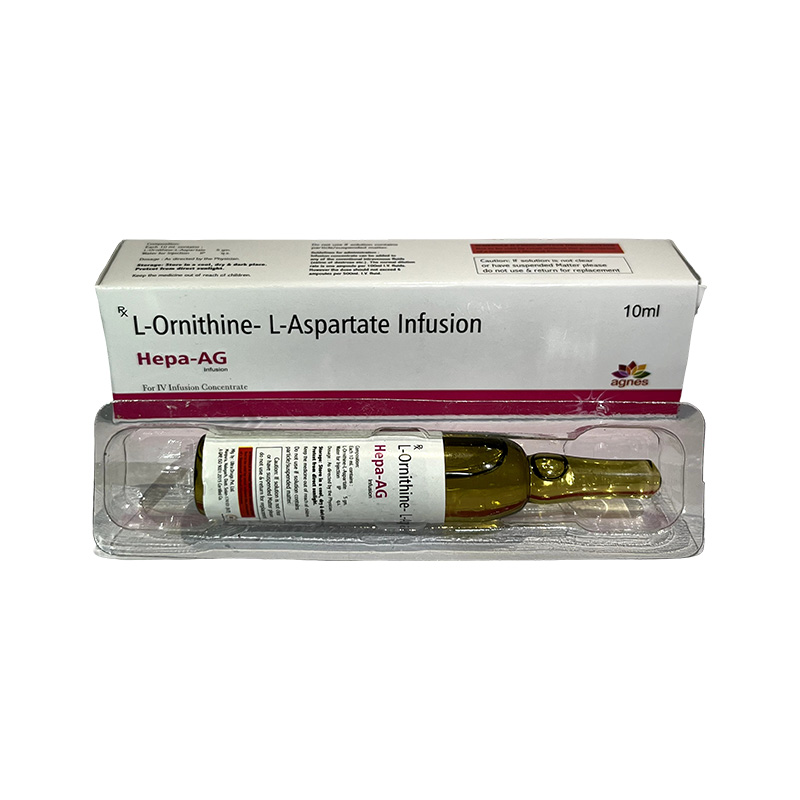
HEPA-AG
COMPOSITION
L-Ornithine-L-Aspartate 5 gm (10ml Inj)
Category
Hepatoprotective, Amino Acid Supplement
| Packing |
|---|
SKU
efde96cd1fe8
Categories AGNES, INJECTABLES, Injection
ENQUIRY
Indications
HEPA-AG is a liver support injection that helps the body deal with high ammonia levels in the blood — a problem that comes up when the liver is damaged or not working properly. The liver is responsible for converting ammonia into urea, which then gets removed through urine.
When the liver is weak — because of cirrhosis, hepatitis, fatty liver, or any other condition — ammonia starts building up. At high levels, ammonia affects the brain. HEPA-AG is used to bring that ammonia down and protect the liver while it recovers. It is prescribed for:
Hepatic Encephalopathy: This is a serious condition where a damaged liver cannot clear ammonia from the blood fast enough, and the excess ammonia starts affecting brain function. Patients may feel confused, be drowsy, have trouble speaking clearly, or in severe cases, lose consciousness. HEPA-AG is used in both the prevention and treatment of this condition — it is one of the most important uses of this injection in hospital settings across India.
High Ammonia Levels in the Blood (Hyperammonaemia): Whenever the liver is not functioning properly — for any reason — ammonia tends to build up. HEPA-AG directly helps the liver convert that excess ammonia into urea so it can be safely removed from the body.
Liver Detoxification Support: The liver has hundreds of jobs. One of the biggest is detoxifying the blood — removing waste products and harmful substances. When the liver is under stress, HEPA-AG provides amino acid support that helps it carry out this detox work more effectively.
Cirrhosis of the Liver: In patients with cirrhosis—where healthy liver tissue has been replaced by scar tissue over time—the liver’s ability to process ammonia and other toxins is severely reduced. HEPA-AG helps manage this by taking some of the ammonia-clearing load off the damaged liver.
Fatty Liver Disease (NAFLD/NASH): A very common condition in India today — linked to poor diet, obesity, and diabetes. In patients with fatty liver, the liver cells are under constant stress. HEPA-AG supports the liver during this period and helps improve its metabolic function over time.
Liver Damage from Alcohol: Chronic alcohol use is one of the leading causes of liver damage in India. In patients with alcohol-related liver disease, HEPA-AG helps reduce ammonia levels and gives the liver better tools to begin recovery.
Post-Hepatitis Liver Recovery: After a viral hepatitis infection — whether hepatitis A, B, or E — the liver often needs time and support to recover fully. HEPA-AG provides that support during the recovery period.
Liver Function Support During Serious Illness: In critically ill patients or those on multiple medicines that put stress on the liver, HEPA-AG is used as a supportive treatment to help maintain liver function and reduce the toxic load on the organ.
When the liver is weak — because of cirrhosis, hepatitis, fatty liver, or any other condition — ammonia starts building up. At high levels, ammonia affects the brain. HEPA-AG is used to bring that ammonia down and protect the liver while it recovers. It is prescribed for:
Hepatic Encephalopathy: This is a serious condition where a damaged liver cannot clear ammonia from the blood fast enough, and the excess ammonia starts affecting brain function. Patients may feel confused, be drowsy, have trouble speaking clearly, or in severe cases, lose consciousness. HEPA-AG is used in both the prevention and treatment of this condition — it is one of the most important uses of this injection in hospital settings across India.
High Ammonia Levels in the Blood (Hyperammonaemia): Whenever the liver is not functioning properly — for any reason — ammonia tends to build up. HEPA-AG directly helps the liver convert that excess ammonia into urea so it can be safely removed from the body.
Liver Detoxification Support: The liver has hundreds of jobs. One of the biggest is detoxifying the blood — removing waste products and harmful substances. When the liver is under stress, HEPA-AG provides amino acid support that helps it carry out this detox work more effectively.
Cirrhosis of the Liver: In patients with cirrhosis—where healthy liver tissue has been replaced by scar tissue over time—the liver’s ability to process ammonia and other toxins is severely reduced. HEPA-AG helps manage this by taking some of the ammonia-clearing load off the damaged liver.
Fatty Liver Disease (NAFLD/NASH): A very common condition in India today — linked to poor diet, obesity, and diabetes. In patients with fatty liver, the liver cells are under constant stress. HEPA-AG supports the liver during this period and helps improve its metabolic function over time.
Liver Damage from Alcohol: Chronic alcohol use is one of the leading causes of liver damage in India. In patients with alcohol-related liver disease, HEPA-AG helps reduce ammonia levels and gives the liver better tools to begin recovery.
Post-Hepatitis Liver Recovery: After a viral hepatitis infection — whether hepatitis A, B, or E — the liver often needs time and support to recover fully. HEPA-AG provides that support during the recovery period.
Liver Function Support During Serious Illness: In critically ill patients or those on multiple medicines that put stress on the liver, HEPA-AG is used as a supportive treatment to help maintain liver function and reduce the toxic load on the organ.
Uses
HEPA-AG contains L-ornithine L-aspartate — often written as LOLA. These are two amino acids that the liver uses in a natural process called the urea cycle. In this cycle, the liver takes ammonia — a waste product from protein digestion and muscle breakdown — and converts it into urea, which is then passed out through urine. When the liver is not functioning well, this cycle slows down or breaks, and ammonia starts to collect in the blood. L-ornithine and L-Aspartate are like building blocks that restart this process and help the liver clear ammonia more efficiently.
Treats Hepatic Encephalopathy: By bringing down ammonia levels in the blood, HEPA-AG directly addresses the root cause of hepatic encephalopathy. As ammonia levels fall, the brain starts to clear up — confusion reduces, alertness improves, and in many cases, the patient can communicate and respond normally again.
Reduces Elevated Ammonia Levels: HEPA-AG activates two key enzymes in the liver — carbamoyl phosphate synthetase and glutamine synthetase — both of which are involved in converting ammonia into safer compounds. This directly lowers the ammonia load in the blood.
Supports Liver Detoxification: L-aspartate helps the liver produce glutamine — a substance the body uses to safely carry and remove excess ammonia. This reduces the burden on the liver and supports its overall detox function.
Helps in Cirrhosis: In cirrhotic patients, the healthy liver tissue is limited. HEPA-AG helps what remains of the functioning liver work more efficiently — it does not reverse cirrhosis, but it helps manage the symptoms and complications that come with it, particularly ammonia buildup.
Used in Fatty Liver Conditions: Improves how liver cells process nutrients and waste products — supporting recovery of liver cell function in patients with non-alcoholic fatty liver disease and metabolic liver conditions.
Improves Energy and Mental Clarity: High ammonia levels leave patients feeling tired, confused, and foggy. As HEPA-AG brings ammonia down, most patients notice a real improvement in their energy levels, mental sharpness, and ability to carry out simple daily tasks.
Supports Protein Metabolism: L-ornithine and L-Aspartate also play a role in how the body processes protein. This is especially important in patients with liver disease who often have poor nutrition and muscle wasting — HEPA-AG helps the body use dietary protein better rather than letting it turn into more ammonia.
Treats Hepatic Encephalopathy: By bringing down ammonia levels in the blood, HEPA-AG directly addresses the root cause of hepatic encephalopathy. As ammonia levels fall, the brain starts to clear up — confusion reduces, alertness improves, and in many cases, the patient can communicate and respond normally again.
Reduces Elevated Ammonia Levels: HEPA-AG activates two key enzymes in the liver — carbamoyl phosphate synthetase and glutamine synthetase — both of which are involved in converting ammonia into safer compounds. This directly lowers the ammonia load in the blood.
Supports Liver Detoxification: L-aspartate helps the liver produce glutamine — a substance the body uses to safely carry and remove excess ammonia. This reduces the burden on the liver and supports its overall detox function.
Helps in Cirrhosis: In cirrhotic patients, the healthy liver tissue is limited. HEPA-AG helps what remains of the functioning liver work more efficiently — it does not reverse cirrhosis, but it helps manage the symptoms and complications that come with it, particularly ammonia buildup.
Used in Fatty Liver Conditions: Improves how liver cells process nutrients and waste products — supporting recovery of liver cell function in patients with non-alcoholic fatty liver disease and metabolic liver conditions.
Improves Energy and Mental Clarity: High ammonia levels leave patients feeling tired, confused, and foggy. As HEPA-AG brings ammonia down, most patients notice a real improvement in their energy levels, mental sharpness, and ability to carry out simple daily tasks.
Supports Protein Metabolism: L-ornithine and L-Aspartate also play a role in how the body processes protein. This is especially important in patients with liver disease who often have poor nutrition and muscle wasting — HEPA-AG helps the body use dietary protein better rather than letting it turn into more ammonia.
Dosage & Storage
Dosage: The dose is always decided by the treating doctor based on the severity of the liver condition, the patient’s ammonia levels, body weight, and overall health. It is not the same for every patient — the doctor customises it for each case.
How It Is Given: As a slow intravenous (IV) infusion by a qualified doctor or nurse in a hospital or clinic. It is diluted in a suitable IV fluid before being given as a drip. It should never be given as a rapid push.
Infusion Rate: Should always be given slowly — the rate is usually not more than 5gm per hour. Giving it too fast increases the risk of nausea and other side effects.
Packing: Available as a 10ml vial containing 5gm of L-Ornithine L-Aspartate.
Storage: Store at room temperature between 15°C and 30°C in a cool, dry place away from direct sunlight and moisture.
Protect from Light: Keep in the original carton until use. Exposure to light can affect the quality of the solution. Do Not Freeze: Do not put in the refrigerator or freezer.
Single Use: Each vial is for one-time use only. Discard any remaining solution after the dose has been given. Keep Away from Children and Pets: Store in a place they absolutely cannot reach.
How It Is Given: As a slow intravenous (IV) infusion by a qualified doctor or nurse in a hospital or clinic. It is diluted in a suitable IV fluid before being given as a drip. It should never be given as a rapid push.
Infusion Rate: Should always be given slowly — the rate is usually not more than 5gm per hour. Giving it too fast increases the risk of nausea and other side effects.
Packing: Available as a 10ml vial containing 5gm of L-Ornithine L-Aspartate.
Storage: Store at room temperature between 15°C and 30°C in a cool, dry place away from direct sunlight and moisture.
Protect from Light: Keep in the original carton until use. Exposure to light can affect the quality of the solution. Do Not Freeze: Do not put in the refrigerator or freezer.
Single Use: Each vial is for one-time use only. Discard any remaining solution after the dose has been given. Keep Away from Children and Pets: Store in a place they absolutely cannot reach.
Directions For Use
Hospital Use Only: HEPA-AG must be prepared and given inside a hospital or clinic by a trained medical professional. It is not for home use.
Never Self-Administer: This injection should never be attempted at home. Always given by a qualified nurse or doctor.
Always Given as a Slow Drip: HEPA-AG is diluted in an IV fluid bag and given as a slow infusion — not as a direct push into the vein. The rate matters a lot here. Slow administration reduces the chance of side effects like nausea and bloating.
Check Before Use: Before the drip is started, check the vial — the solution should be clear and free from any floating particles. If it looks cloudy or the vial appears damaged, do not use it.
Follow the Full Treatment Plan: The doctor will decide for how many days the injection needs to be continued. Do not stop or reduce the doses on your own even if the patient starts feeling better. Ammonia levels can rise again if treatment is cut short.
Monitoring During Treatment: Patients receiving HEPA-AG should have their ammonia levels and liver function checked regularly during the treatment. This helps the doctor know whether the dose needs to be adjusted.
Dietary Guidance Alongside Treatment: The doctor may also advise reducing dietary protein temporarily in patients with hepatic encephalopathy — as protein breakdown is one of the main sources of ammonia in the body. Follow all dietary advice given alongside this injection for the best results.
Never Self-Administer: This injection should never be attempted at home. Always given by a qualified nurse or doctor.
Always Given as a Slow Drip: HEPA-AG is diluted in an IV fluid bag and given as a slow infusion — not as a direct push into the vein. The rate matters a lot here. Slow administration reduces the chance of side effects like nausea and bloating.
Check Before Use: Before the drip is started, check the vial — the solution should be clear and free from any floating particles. If it looks cloudy or the vial appears damaged, do not use it.
Follow the Full Treatment Plan: The doctor will decide for how many days the injection needs to be continued. Do not stop or reduce the doses on your own even if the patient starts feeling better. Ammonia levels can rise again if treatment is cut short.
Monitoring During Treatment: Patients receiving HEPA-AG should have their ammonia levels and liver function checked regularly during the treatment. This helps the doctor know whether the dose needs to be adjusted.
Dietary Guidance Alongside Treatment: The doctor may also advise reducing dietary protein temporarily in patients with hepatic encephalopathy — as protein breakdown is one of the main sources of ammonia in the body. Follow all dietary advice given alongside this injection for the best results.
Precautions
The doctor must know the following before starting HEPA-AG:
Kidney Problems: L-Ornithine L-Aspartate is processed and removed through the kidneys. Patients with severe kidney disease or very low urine output need careful dose adjustment and close monitoring. Using this injection in patients with very poor kidney function can cause amino acids to build up to unsafe levels.
Allergy to Amino Acids: Although rare, inform the doctor if the patient has ever had any reaction to amino acid supplements or infusions in the past.
Pregnancy and Breastfeeding: Use only if clearly necessary and under strict medical supervision. The doctor must assess the risks and benefits before prescribing during pregnancy or nursing.
Rate of Infusion: This is very important — the infusion must always be given slowly. Too fast and the patient is much more likely to experience nausea, vomiting, and stomach discomfort. The nursing team should always follow the prescribed drip rate carefully.
Diet and Protein Intake: The treating doctor may advise on how much protein the patient should be eating during the course. Too much dietary protein can generate more ammonia — which works against what this injection is trying to do.
Other Medicines: Tell the doctor about all medicines the patient is currently taking — especially any medicines that affect the liver or kidneys — so the doctor can plan the full treatment safely.
Monitoring Ammonia Levels: Blood ammonia levels should be checked at the start and at regular intervals during treatment to see how well the medicine is working and whether any adjustments are needed.
Kidney Problems: L-Ornithine L-Aspartate is processed and removed through the kidneys. Patients with severe kidney disease or very low urine output need careful dose adjustment and close monitoring. Using this injection in patients with very poor kidney function can cause amino acids to build up to unsafe levels.
Allergy to Amino Acids: Although rare, inform the doctor if the patient has ever had any reaction to amino acid supplements or infusions in the past.
Pregnancy and Breastfeeding: Use only if clearly necessary and under strict medical supervision. The doctor must assess the risks and benefits before prescribing during pregnancy or nursing.
Rate of Infusion: This is very important — the infusion must always be given slowly. Too fast and the patient is much more likely to experience nausea, vomiting, and stomach discomfort. The nursing team should always follow the prescribed drip rate carefully.
Diet and Protein Intake: The treating doctor may advise on how much protein the patient should be eating during the course. Too much dietary protein can generate more ammonia — which works against what this injection is trying to do.
Other Medicines: Tell the doctor about all medicines the patient is currently taking — especially any medicines that affect the liver or kidneys — so the doctor can plan the full treatment safely.
Monitoring Ammonia Levels: Blood ammonia levels should be checked at the start and at regular intervals during treatment to see how well the medicine is working and whether any adjustments are needed.
Side Effects
Bloating
Nausea
Diarrhea
Metallic taste
Injection site pain
Nausea
Diarrhea
Metallic taste
Injection site pain
Medical Disclaimer
The information given here is for general understanding and educational purposes only. It does not replace the advice or clinical judgment of a qualified doctor.
HEPA-AG is a prescription-only injectable medicine and must always be used under the direct supervision of a licensed medical professional in a proper hospital or clinical setting.
Agnes Life Sciences does not claim that this or any of its products can diagnose, treat, cure, or prevent any disease.
Please speak to your doctor for the right diagnosis and a treatment plan suited to your specific condition.
HEPA-AG is a prescription-only injectable medicine and must always be used under the direct supervision of a licensed medical professional in a proper hospital or clinical setting.
Agnes Life Sciences does not claim that this or any of its products can diagnose, treat, cure, or prevent any disease.
Please speak to your doctor for the right diagnosis and a treatment plan suited to your specific condition.
Indications
HEPA-AG is a liver support injection that helps the body deal with high ammonia levels in the blood — a problem that comes up when the liver is damaged or not working properly. The liver is responsible for converting ammonia into urea, which then gets removed through urine.
When the liver is weak — because of cirrhosis, hepatitis, fatty liver, or any other condition — ammonia starts building up. At high levels, ammonia affects the brain. HEPA-AG is used to bring that ammonia down and protect the liver while it recovers. It is prescribed for:
Hepatic Encephalopathy: This is a serious condition where a damaged liver cannot clear ammonia from the blood fast enough, and the excess ammonia starts affecting brain function. Patients may feel confused, be drowsy, have trouble speaking clearly, or in severe cases, lose consciousness. HEPA-AG is used in both the prevention and treatment of this condition — it is one of the most important uses of this injection in hospital settings across India.
High Ammonia Levels in the Blood (Hyperammonaemia): Whenever the liver is not functioning properly — for any reason — ammonia tends to build up. HEPA-AG directly helps the liver convert that excess ammonia into urea so it can be safely removed from the body.
Liver Detoxification Support: The liver has hundreds of jobs. One of the biggest is detoxifying the blood — removing waste products and harmful substances. When the liver is under stress, HEPA-AG provides amino acid support that helps it carry out this detox work more effectively.
Cirrhosis of the Liver: In patients with cirrhosis—where healthy liver tissue has been replaced by scar tissue over time—the liver’s ability to process ammonia and other toxins is severely reduced. HEPA-AG helps manage this by taking some of the ammonia-clearing load off the damaged liver.
Fatty Liver Disease (NAFLD/NASH): A very common condition in India today — linked to poor diet, obesity, and diabetes. In patients with fatty liver, the liver cells are under constant stress. HEPA-AG supports the liver during this period and helps improve its metabolic function over time.
Liver Damage from Alcohol: Chronic alcohol use is one of the leading causes of liver damage in India. In patients with alcohol-related liver disease, HEPA-AG helps reduce ammonia levels and gives the liver better tools to begin recovery.
Post-Hepatitis Liver Recovery: After a viral hepatitis infection — whether hepatitis A, B, or E — the liver often needs time and support to recover fully. HEPA-AG provides that support during the recovery period.
Liver Function Support During Serious Illness: In critically ill patients or those on multiple medicines that put stress on the liver, HEPA-AG is used as a supportive treatment to help maintain liver function and reduce the toxic load on the organ.
When the liver is weak — because of cirrhosis, hepatitis, fatty liver, or any other condition — ammonia starts building up. At high levels, ammonia affects the brain. HEPA-AG is used to bring that ammonia down and protect the liver while it recovers. It is prescribed for:
Hepatic Encephalopathy: This is a serious condition where a damaged liver cannot clear ammonia from the blood fast enough, and the excess ammonia starts affecting brain function. Patients may feel confused, be drowsy, have trouble speaking clearly, or in severe cases, lose consciousness. HEPA-AG is used in both the prevention and treatment of this condition — it is one of the most important uses of this injection in hospital settings across India.
High Ammonia Levels in the Blood (Hyperammonaemia): Whenever the liver is not functioning properly — for any reason — ammonia tends to build up. HEPA-AG directly helps the liver convert that excess ammonia into urea so it can be safely removed from the body.
Liver Detoxification Support: The liver has hundreds of jobs. One of the biggest is detoxifying the blood — removing waste products and harmful substances. When the liver is under stress, HEPA-AG provides amino acid support that helps it carry out this detox work more effectively.
Cirrhosis of the Liver: In patients with cirrhosis—where healthy liver tissue has been replaced by scar tissue over time—the liver’s ability to process ammonia and other toxins is severely reduced. HEPA-AG helps manage this by taking some of the ammonia-clearing load off the damaged liver.
Fatty Liver Disease (NAFLD/NASH): A very common condition in India today — linked to poor diet, obesity, and diabetes. In patients with fatty liver, the liver cells are under constant stress. HEPA-AG supports the liver during this period and helps improve its metabolic function over time.
Liver Damage from Alcohol: Chronic alcohol use is one of the leading causes of liver damage in India. In patients with alcohol-related liver disease, HEPA-AG helps reduce ammonia levels and gives the liver better tools to begin recovery.
Post-Hepatitis Liver Recovery: After a viral hepatitis infection — whether hepatitis A, B, or E — the liver often needs time and support to recover fully. HEPA-AG provides that support during the recovery period.
Liver Function Support During Serious Illness: In critically ill patients or those on multiple medicines that put stress on the liver, HEPA-AG is used as a supportive treatment to help maintain liver function and reduce the toxic load on the organ.
Uses
HEPA-AG contains L-ornithine L-aspartate — often written as LOLA. These are two amino acids that the liver uses in a natural process called the urea cycle. In this cycle, the liver takes ammonia — a waste product from protein digestion and muscle breakdown — and converts it into urea, which is then passed out through urine. When the liver is not functioning well, this cycle slows down or breaks, and ammonia starts to collect in the blood. L-ornithine and L-Aspartate are like building blocks that restart this process and help the liver clear ammonia more efficiently.
Treats Hepatic Encephalopathy: By bringing down ammonia levels in the blood, HEPA-AG directly addresses the root cause of hepatic encephalopathy. As ammonia levels fall, the brain starts to clear up — confusion reduces, alertness improves, and in many cases, the patient can communicate and respond normally again.
Reduces Elevated Ammonia Levels: HEPA-AG activates two key enzymes in the liver — carbamoyl phosphate synthetase and glutamine synthetase — both of which are involved in converting ammonia into safer compounds. This directly lowers the ammonia load in the blood.
Supports Liver Detoxification: L-aspartate helps the liver produce glutamine — a substance the body uses to safely carry and remove excess ammonia. This reduces the burden on the liver and supports its overall detox function.
Helps in Cirrhosis: In cirrhotic patients, the healthy liver tissue is limited. HEPA-AG helps what remains of the functioning liver work more efficiently — it does not reverse cirrhosis, but it helps manage the symptoms and complications that come with it, particularly ammonia buildup.
Used in Fatty Liver Conditions: Improves how liver cells process nutrients and waste products — supporting recovery of liver cell function in patients with non-alcoholic fatty liver disease and metabolic liver conditions.
Improves Energy and Mental Clarity: High ammonia levels leave patients feeling tired, confused, and foggy. As HEPA-AG brings ammonia down, most patients notice a real improvement in their energy levels, mental sharpness, and ability to carry out simple daily tasks.
Supports Protein Metabolism: L-ornithine and L-Aspartate also play a role in how the body processes protein. This is especially important in patients with liver disease who often have poor nutrition and muscle wasting — HEPA-AG helps the body use dietary protein better rather than letting it turn into more ammonia.
Treats Hepatic Encephalopathy: By bringing down ammonia levels in the blood, HEPA-AG directly addresses the root cause of hepatic encephalopathy. As ammonia levels fall, the brain starts to clear up — confusion reduces, alertness improves, and in many cases, the patient can communicate and respond normally again.
Reduces Elevated Ammonia Levels: HEPA-AG activates two key enzymes in the liver — carbamoyl phosphate synthetase and glutamine synthetase — both of which are involved in converting ammonia into safer compounds. This directly lowers the ammonia load in the blood.
Supports Liver Detoxification: L-aspartate helps the liver produce glutamine — a substance the body uses to safely carry and remove excess ammonia. This reduces the burden on the liver and supports its overall detox function.
Helps in Cirrhosis: In cirrhotic patients, the healthy liver tissue is limited. HEPA-AG helps what remains of the functioning liver work more efficiently — it does not reverse cirrhosis, but it helps manage the symptoms and complications that come with it, particularly ammonia buildup.
Used in Fatty Liver Conditions: Improves how liver cells process nutrients and waste products — supporting recovery of liver cell function in patients with non-alcoholic fatty liver disease and metabolic liver conditions.
Improves Energy and Mental Clarity: High ammonia levels leave patients feeling tired, confused, and foggy. As HEPA-AG brings ammonia down, most patients notice a real improvement in their energy levels, mental sharpness, and ability to carry out simple daily tasks.
Supports Protein Metabolism: L-ornithine and L-Aspartate also play a role in how the body processes protein. This is especially important in patients with liver disease who often have poor nutrition and muscle wasting — HEPA-AG helps the body use dietary protein better rather than letting it turn into more ammonia.
Dosage & Storage
Dosage: The dose is always decided by the treating doctor based on the severity of the liver condition, the patient’s ammonia levels, body weight, and overall health. It is not the same for every patient — the doctor customises it for each case.
How It Is Given: As a slow intravenous (IV) infusion by a qualified doctor or nurse in a hospital or clinic. It is diluted in a suitable IV fluid before being given as a drip. It should never be given as a rapid push.
Infusion Rate: Should always be given slowly — the rate is usually not more than 5gm per hour. Giving it too fast increases the risk of nausea and other side effects.
Packing: Available as a 10ml vial containing 5gm of L-Ornithine L-Aspartate.
Storage: Store at room temperature between 15°C and 30°C in a cool, dry place away from direct sunlight and moisture.
Protect from Light: Keep in the original carton until use. Exposure to light can affect the quality of the solution. Do Not Freeze: Do not put in the refrigerator or freezer.
Single Use: Each vial is for one-time use only. Discard any remaining solution after the dose has been given. Keep Away from Children and Pets: Store in a place they absolutely cannot reach.
How It Is Given: As a slow intravenous (IV) infusion by a qualified doctor or nurse in a hospital or clinic. It is diluted in a suitable IV fluid before being given as a drip. It should never be given as a rapid push.
Infusion Rate: Should always be given slowly — the rate is usually not more than 5gm per hour. Giving it too fast increases the risk of nausea and other side effects.
Packing: Available as a 10ml vial containing 5gm of L-Ornithine L-Aspartate.
Storage: Store at room temperature between 15°C and 30°C in a cool, dry place away from direct sunlight and moisture.
Protect from Light: Keep in the original carton until use. Exposure to light can affect the quality of the solution. Do Not Freeze: Do not put in the refrigerator or freezer.
Single Use: Each vial is for one-time use only. Discard any remaining solution after the dose has been given. Keep Away from Children and Pets: Store in a place they absolutely cannot reach.
Directions For Use
Hospital Use Only: HEPA-AG must be prepared and given inside a hospital or clinic by a trained medical professional. It is not for home use.
Never Self-Administer: This injection should never be attempted at home. Always given by a qualified nurse or doctor.
Always Given as a Slow Drip: HEPA-AG is diluted in an IV fluid bag and given as a slow infusion — not as a direct push into the vein. The rate matters a lot here. Slow administration reduces the chance of side effects like nausea and bloating.
Check Before Use: Before the drip is started, check the vial — the solution should be clear and free from any floating particles. If it looks cloudy or the vial appears damaged, do not use it.
Follow the Full Treatment Plan: The doctor will decide for how many days the injection needs to be continued. Do not stop or reduce the doses on your own even if the patient starts feeling better. Ammonia levels can rise again if treatment is cut short.
Monitoring During Treatment: Patients receiving HEPA-AG should have their ammonia levels and liver function checked regularly during the treatment. This helps the doctor know whether the dose needs to be adjusted.
Dietary Guidance Alongside Treatment: The doctor may also advise reducing dietary protein temporarily in patients with hepatic encephalopathy — as protein breakdown is one of the main sources of ammonia in the body. Follow all dietary advice given alongside this injection for the best results.
Never Self-Administer: This injection should never be attempted at home. Always given by a qualified nurse or doctor.
Always Given as a Slow Drip: HEPA-AG is diluted in an IV fluid bag and given as a slow infusion — not as a direct push into the vein. The rate matters a lot here. Slow administration reduces the chance of side effects like nausea and bloating.
Check Before Use: Before the drip is started, check the vial — the solution should be clear and free from any floating particles. If it looks cloudy or the vial appears damaged, do not use it.
Follow the Full Treatment Plan: The doctor will decide for how many days the injection needs to be continued. Do not stop or reduce the doses on your own even if the patient starts feeling better. Ammonia levels can rise again if treatment is cut short.
Monitoring During Treatment: Patients receiving HEPA-AG should have their ammonia levels and liver function checked regularly during the treatment. This helps the doctor know whether the dose needs to be adjusted.
Dietary Guidance Alongside Treatment: The doctor may also advise reducing dietary protein temporarily in patients with hepatic encephalopathy — as protein breakdown is one of the main sources of ammonia in the body. Follow all dietary advice given alongside this injection for the best results.
Precautions
The doctor must know the following before starting HEPA-AG:
Kidney Problems: L-Ornithine L-Aspartate is processed and removed through the kidneys. Patients with severe kidney disease or very low urine output need careful dose adjustment and close monitoring. Using this injection in patients with very poor kidney function can cause amino acids to build up to unsafe levels.
Allergy to Amino Acids: Although rare, inform the doctor if the patient has ever had any reaction to amino acid supplements or infusions in the past.
Pregnancy and Breastfeeding: Use only if clearly necessary and under strict medical supervision. The doctor must assess the risks and benefits before prescribing during pregnancy or nursing.
Rate of Infusion: This is very important — the infusion must always be given slowly. Too fast and the patient is much more likely to experience nausea, vomiting, and stomach discomfort. The nursing team should always follow the prescribed drip rate carefully.
Diet and Protein Intake: The treating doctor may advise on how much protein the patient should be eating during the course. Too much dietary protein can generate more ammonia — which works against what this injection is trying to do.
Other Medicines: Tell the doctor about all medicines the patient is currently taking — especially any medicines that affect the liver or kidneys — so the doctor can plan the full treatment safely.
Monitoring Ammonia Levels: Blood ammonia levels should be checked at the start and at regular intervals during treatment to see how well the medicine is working and whether any adjustments are needed.
Kidney Problems: L-Ornithine L-Aspartate is processed and removed through the kidneys. Patients with severe kidney disease or very low urine output need careful dose adjustment and close monitoring. Using this injection in patients with very poor kidney function can cause amino acids to build up to unsafe levels.
Allergy to Amino Acids: Although rare, inform the doctor if the patient has ever had any reaction to amino acid supplements or infusions in the past.
Pregnancy and Breastfeeding: Use only if clearly necessary and under strict medical supervision. The doctor must assess the risks and benefits before prescribing during pregnancy or nursing.
Rate of Infusion: This is very important — the infusion must always be given slowly. Too fast and the patient is much more likely to experience nausea, vomiting, and stomach discomfort. The nursing team should always follow the prescribed drip rate carefully.
Diet and Protein Intake: The treating doctor may advise on how much protein the patient should be eating during the course. Too much dietary protein can generate more ammonia — which works against what this injection is trying to do.
Other Medicines: Tell the doctor about all medicines the patient is currently taking — especially any medicines that affect the liver or kidneys — so the doctor can plan the full treatment safely.
Monitoring Ammonia Levels: Blood ammonia levels should be checked at the start and at regular intervals during treatment to see how well the medicine is working and whether any adjustments are needed.
Side Effects
Bloating
Nausea
Diarrhea
Metallic taste
Injection site pain
Nausea
Diarrhea
Metallic taste
Injection site pain
Medical Disclaimer
The information given here is for general understanding and educational purposes only. It does not replace the advice or clinical judgment of a qualified doctor.
HEPA-AG is a prescription-only injectable medicine and must always be used under the direct supervision of a licensed medical professional in a proper hospital or clinical setting.
Agnes Life Sciences does not claim that this or any of its products can diagnose, treat, cure, or prevent any disease.
Please speak to your doctor for the right diagnosis and a treatment plan suited to your specific condition.
HEPA-AG is a prescription-only injectable medicine and must always be used under the direct supervision of a licensed medical professional in a proper hospital or clinical setting.
Agnes Life Sciences does not claim that this or any of its products can diagnose, treat, cure, or prevent any disease.
Please speak to your doctor for the right diagnosis and a treatment plan suited to your specific condition.