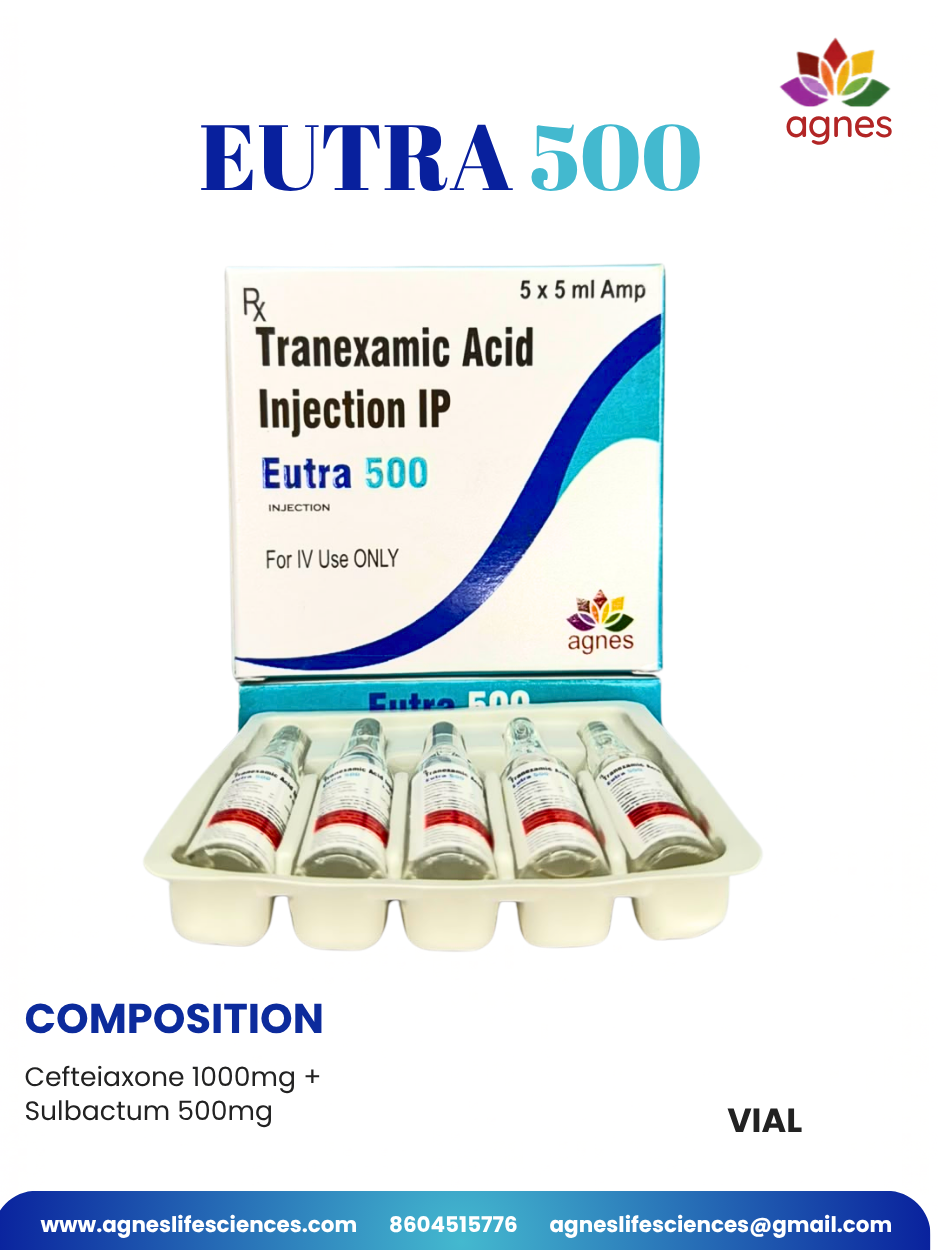
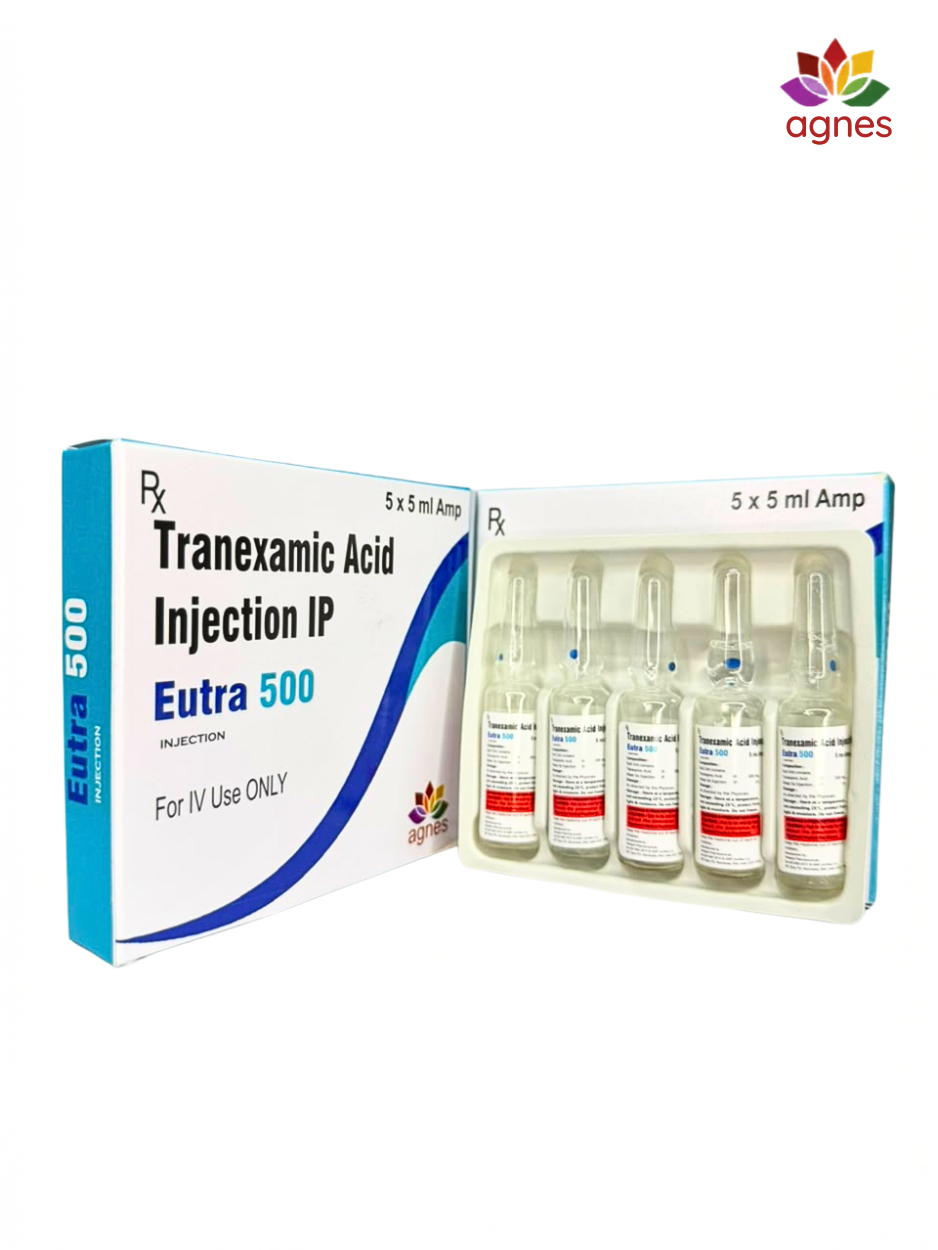
EUTRA-500
COMPOSITION
Tranexamic Acid 500 mg (5ml Inj)
Category
Antifibrinolytic, Hemostatic
| Packing |
|---|
SKU
4d18b5bf5c48
Categories AGNES, INJECTABLES, Injection
ENQUIRY
Indications
EUTRA-500 is a medicine used to stop or reduce excessive bleeding. It works by helping the body hold on to blood clots that have already formed — preventing them from breaking down too soon. In simple terms, it does not make the blood clot faster, but it makes sure the clot that forms stays in place long enough to stop the bleeding properly. It is used in hospitals across India for many situations where blood loss needs to be controlled quickly. It is prescribed for:
Preventing Excess Bleeding During Surgery: One of its most common uses is given before or during operations like hip replacement, heart surgery, or caesarean section to reduce the amount of blood the patient loses on the table.
Heavy Menstrual Bleeding (HMB): Used in women who bleed very heavily during their periods — a common problem in India. It helps reduce the flow and duration of bleeding significantly without affecting hormones.
Trauma and Accident-Related Bleeding: In road accident cases or after major injuries where a patient is losing blood fast, EUTRA-500 is given as part of early emergency treatment to slow down internal or external bleeding.
Supporting Clot Stability: After a clot forms inside a wound or blood vessel, the body naturally starts breaking it down. Tranexamic acid slows this process — keeping the clot in place until the wound heals properly.
Nosebleeds (Epistaxis): Given when nosebleeds are severe or repeated and do not stop with simple pressure — especially in patients with bleeding tendencies.
Dental Procedures: Used before or after tooth extractions and oral surgeries in patients who are on blood thinners or who bleed more than normal.
Post-Partum Haemorrhage (PPH): This is one of the leading causes of maternal death in India. EUTRA-500 is now recommended in the management of PPH to help control bleeding after delivery.
Bleeding in Haemophilia Patients: Used alongside clotting factor therapy to help stabilise clots in patients with haemophilia who are undergoing procedures or dealing with a bleeding episode.
Preventing Excess Bleeding During Surgery: One of its most common uses is given before or during operations like hip replacement, heart surgery, or caesarean section to reduce the amount of blood the patient loses on the table.
Heavy Menstrual Bleeding (HMB): Used in women who bleed very heavily during their periods — a common problem in India. It helps reduce the flow and duration of bleeding significantly without affecting hormones.
Trauma and Accident-Related Bleeding: In road accident cases or after major injuries where a patient is losing blood fast, EUTRA-500 is given as part of early emergency treatment to slow down internal or external bleeding.
Supporting Clot Stability: After a clot forms inside a wound or blood vessel, the body naturally starts breaking it down. Tranexamic acid slows this process — keeping the clot in place until the wound heals properly.
Nosebleeds (Epistaxis): Given when nosebleeds are severe or repeated and do not stop with simple pressure — especially in patients with bleeding tendencies.
Dental Procedures: Used before or after tooth extractions and oral surgeries in patients who are on blood thinners or who bleed more than normal.
Post-Partum Haemorrhage (PPH): This is one of the leading causes of maternal death in India. EUTRA-500 is now recommended in the management of PPH to help control bleeding after delivery.
Bleeding in Haemophilia Patients: Used alongside clotting factor therapy to help stabilise clots in patients with haemophilia who are undergoing procedures or dealing with a bleeding episode.
Uses
To understand how EUTRA-500 works, you need to know that the body uses a substance called plasmin to naturally dissolve blood clots after a wound has healed. This is a normal process. But in some cases — during surgery, heavy periods, or trauma — clots start breaking down too fast, and the person bleeds more than they should. Tranexamic acid blocks plasmin from doing this. By keeping the clot intact for longer, it gives the body the time it needs to stop the bleeding naturally.
Prevents Excessive Bleeding in Surgeries: By stopping premature clot breakdown, it reduces overall blood loss during the operation — which means fewer blood transfusions are needed and recovery is faster.
Used in Heavy Menstrual Bleeding: Helps reduce both the amount and the number of days of bleeding during periods — without changing the menstrual cycle or hormones. Very useful in Indian women with menorrhagia. Effective in Trauma-Related Bleeding: In accident cases and emergency situations, it is given as early as possible to slow down blood loss and improve survival chances — especially in cases of internal bleeding.
Supports Clot Stability: Keeps the body’s natural blood clot from dissolving before the wound has fully closed — a simple but very important function that reduces bleeding time significantly.
Used in Nosebleeds and Dental Procedures: Provides targeted bleeding control in local bleeds — useful for patients who are at higher risk of prolonged bleeding due to existing medical conditions or medicines they are already taking.
Used in Post-Partum Haemorrhage: Helps control life-threatening bleeding after childbirth — a situation where quick intervention is critical for the mother’s survival.
Prevents Excessive Bleeding in Surgeries: By stopping premature clot breakdown, it reduces overall blood loss during the operation — which means fewer blood transfusions are needed and recovery is faster.
Used in Heavy Menstrual Bleeding: Helps reduce both the amount and the number of days of bleeding during periods — without changing the menstrual cycle or hormones. Very useful in Indian women with menorrhagia. Effective in Trauma-Related Bleeding: In accident cases and emergency situations, it is given as early as possible to slow down blood loss and improve survival chances — especially in cases of internal bleeding.
Supports Clot Stability: Keeps the body’s natural blood clot from dissolving before the wound has fully closed — a simple but very important function that reduces bleeding time significantly.
Used in Nosebleeds and Dental Procedures: Provides targeted bleeding control in local bleeds — useful for patients who are at higher risk of prolonged bleeding due to existing medical conditions or medicines they are already taking.
Used in Post-Partum Haemorrhage: Helps control life-threatening bleeding after childbirth — a situation where quick intervention is critical for the mother’s survival.
Dosage & Storage
Dosage: The dose is always decided by the treating doctor depending on the reason it is being given, the severity of bleeding, and the patient’s weight and kidney function. A commonly used adult dose is 500mg to 1g given two to three times a day as a slow IV infusion.
How It Is Given: Only as a slow intravenous (IV) injection or infusion by a doctor or trained nurse in a hospital or clinical setting. Never given as a rapid push — always slowly.
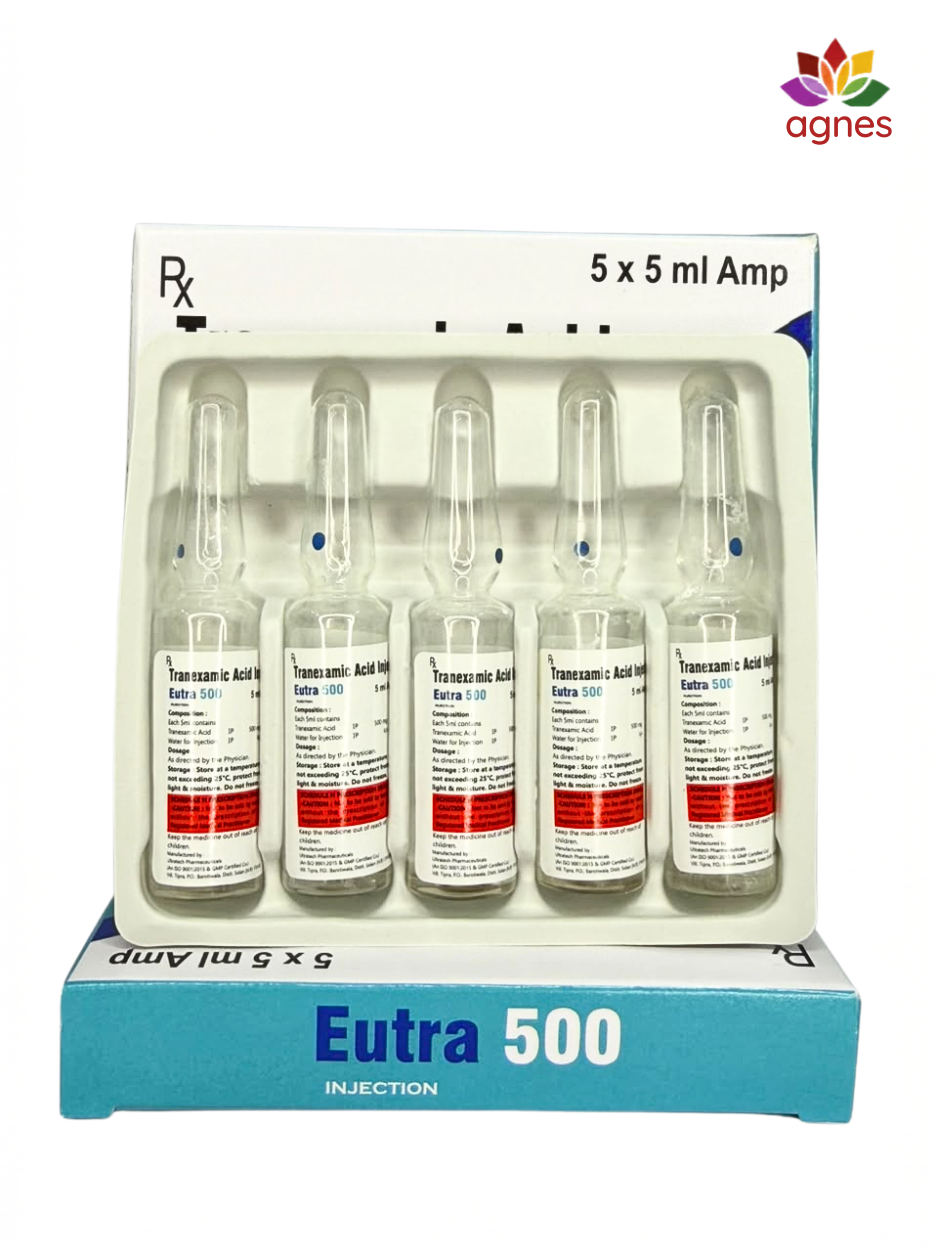
Packing: Available as 5ml ampoules containing 500mg of Tranexamic Acid. Comes in a pack of 5 ampoules.
Storage: Store at room temperature between 15°C and 30°C in a cool, dry place away from direct sunlight and moisture.
Protect from Light: Keep the ampoules in their original tray or packaging. Tranexamic acid can be affected by prolonged light exposure.
Do Not Freeze: Do not refrigerate or freeze the ampoules.
Single Use: Each ampoule is for single use only. Once opened, use immediately and discard any unused solution.
Keep Out of Reach: Always store away from children and pets.
How It Is Given: Only as a slow intravenous (IV) injection or infusion by a doctor or trained nurse in a hospital or clinical setting. Never given as a rapid push — always slowly.
Packing: Available as 5ml ampoules containing 500mg of Tranexamic Acid. Comes in a pack of 5 ampoules.
Storage: Store at room temperature between 15°C and 30°C in a cool, dry place away from direct sunlight and moisture.
Protect from Light: Keep the ampoules in their original tray or packaging. Tranexamic acid can be affected by prolonged light exposure.
Do Not Freeze: Do not refrigerate or freeze the ampoules.
Single Use: Each ampoule is for single use only. Once opened, use immediately and discard any unused solution.
Keep Out of Reach: Always store away from children and pets.
Directions For Use
Hospital or Clinical Setting Only: EUTRA-500 must be given inside a hospital, operation theatre, or clinic. It is not for home use.
Do Not Self-Administer: This injection must always be prepared and given by a qualified doctor or nurse. Never attempt to use it at home.
Give It Slowly: Tranexamic acid must be infused slowly — giving it too fast can cause a sudden drop in blood pressure, dizziness, or nausea. The usual recommended rate is not more than 1ml per minute.
Check the Ampoule Before Use: The solution should be clear and colourless. Do not use if it looks cloudy, has any particles in it, or the ampoule appears damaged.
Use as Directed: Follow the doctor’s instructions exactly regarding dose, number of doses per day, and for how many days to continue.
Timing Matters in Surgery: When given for surgical bleeding prevention, it is usually given shortly before the procedure begins so that it is already working when the operation starts.
Missed Dose: If a scheduled hospital dose is delayed, inform the nurse or doctor right away. Do not give two doses at once.
Do Not Self-Administer: This injection must always be prepared and given by a qualified doctor or nurse. Never attempt to use it at home.
Give It Slowly: Tranexamic acid must be infused slowly — giving it too fast can cause a sudden drop in blood pressure, dizziness, or nausea. The usual recommended rate is not more than 1ml per minute.
Check the Ampoule Before Use: The solution should be clear and colourless. Do not use if it looks cloudy, has any particles in it, or the ampoule appears damaged.
Use as Directed: Follow the doctor’s instructions exactly regarding dose, number of doses per day, and for how many days to continue.
Timing Matters in Surgery: When given for surgical bleeding prevention, it is usually given shortly before the procedure begins so that it is already working when the operation starts.
Missed Dose: If a scheduled hospital dose is delayed, inform the nurse or doctor right away. Do not give two doses at once.
Precautions
Before starting EUTRA-500, the doctor must be informed about the following:
History of Blood Clots: Tranexamic acid should be used very carefully — or avoided — in patients who have had a deep vein thrombosis (DVT), pulmonary embolism, or stroke in the past. Since it slows down clot breakdown, it could increase the risk of clotting in the wrong places.
Kidney Problems: Tranexamic acid is removed from the body through the kidneys. Patients with reduced kidney function need a lower dose and close monitoring during treatment.
Colour Vision Changes: This is an important precaution — if the patient notices any change in their colour vision during treatment, the medicine should be stopped immediately and the doctor informed. This is a rare but known side effect that requires prompt attention.
Haematuria (Blood in Urine from Upper Urinary Tract): Tranexamic acid should be avoided when bleeding is coming from the upper urinary tract — because stopping the clot from dissolving there can block the ureter or kidney, causing serious complications.
Pregnancy: Can be used if clearly needed — it is commonly used in post-partum haemorrhage. However, it should only be given under strict medical supervision during pregnancy.
Breastfeeding: Small amounts may pass into breast milk. Use only if the doctor has weighed the risks and found it necessary.
Blood Clotting Disorders: Inform the doctor about any existing clotting conditions or if the patient is already taking anticoagulants (blood thinners) — as this combination needs careful management.
Seizure History: Use with caution in patients with a history of seizures, as high doses of Tranexamic acid have been associated with triggering fits — particularly after cardiac surgery.
History of Blood Clots: Tranexamic acid should be used very carefully — or avoided — in patients who have had a deep vein thrombosis (DVT), pulmonary embolism, or stroke in the past. Since it slows down clot breakdown, it could increase the risk of clotting in the wrong places.
Kidney Problems: Tranexamic acid is removed from the body through the kidneys. Patients with reduced kidney function need a lower dose and close monitoring during treatment.
Colour Vision Changes: This is an important precaution — if the patient notices any change in their colour vision during treatment, the medicine should be stopped immediately and the doctor informed. This is a rare but known side effect that requires prompt attention.
Haematuria (Blood in Urine from Upper Urinary Tract): Tranexamic acid should be avoided when bleeding is coming from the upper urinary tract — because stopping the clot from dissolving there can block the ureter or kidney, causing serious complications.
Pregnancy: Can be used if clearly needed — it is commonly used in post-partum haemorrhage. However, it should only be given under strict medical supervision during pregnancy.
Breastfeeding: Small amounts may pass into breast milk. Use only if the doctor has weighed the risks and found it necessary.
Blood Clotting Disorders: Inform the doctor about any existing clotting conditions or if the patient is already taking anticoagulants (blood thinners) — as this combination needs careful management.
Seizure History: Use with caution in patients with a history of seizures, as high doses of Tranexamic acid have been associated with triggering fits — particularly after cardiac surgery.
Side Effects
Nausea
Vomiting
Headache
Visual disturbances
Muscle cramps
Vomiting
Headache
Visual disturbances
Muscle cramps
Medical Disclaimer
The information given here is for general understanding and educational purposes only. It is not a substitute for your doctor’s advice or clinical judgement. EUTRA-500 is a prescription-only injectable medicine and must always be used under the direct supervision of a licensed medical professional in a proper clinical setting.
Please consult your doctor for the correct diagnosis and treatment plan. Agnes Life Sciences does not claim that this or any of its products can diagnose, treat, cure, or prevent any disease.
Please consult your doctor for the correct diagnosis and treatment plan. Agnes Life Sciences does not claim that this or any of its products can diagnose, treat, cure, or prevent any disease.
Indications
EUTRA-500 is a medicine used to stop or reduce excessive bleeding. It works by helping the body hold on to blood clots that have already formed — preventing them from breaking down too soon. In simple terms, it does not make the blood clot faster, but it makes sure the clot that forms stays in place long enough to stop the bleeding properly. It is used in hospitals across India for many situations where blood loss needs to be controlled quickly. It is prescribed for:
Preventing Excess Bleeding During Surgery: One of its most common uses is given before or during operations like hip replacement, heart surgery, or caesarean section to reduce the amount of blood the patient loses on the table.
Heavy Menstrual Bleeding (HMB): Used in women who bleed very heavily during their periods — a common problem in India. It helps reduce the flow and duration of bleeding significantly without affecting hormones.
Trauma and Accident-Related Bleeding: In road accident cases or after major injuries where a patient is losing blood fast, EUTRA-500 is given as part of early emergency treatment to slow down internal or external bleeding.
Supporting Clot Stability: After a clot forms inside a wound or blood vessel, the body naturally starts breaking it down. Tranexamic acid slows this process — keeping the clot in place until the wound heals properly.
Nosebleeds (Epistaxis): Given when nosebleeds are severe or repeated and do not stop with simple pressure — especially in patients with bleeding tendencies.
Dental Procedures: Used before or after tooth extractions and oral surgeries in patients who are on blood thinners or who bleed more than normal.
Post-Partum Haemorrhage (PPH): This is one of the leading causes of maternal death in India. EUTRA-500 is now recommended in the management of PPH to help control bleeding after delivery.
Bleeding in Haemophilia Patients: Used alongside clotting factor therapy to help stabilise clots in patients with haemophilia who are undergoing procedures or dealing with a bleeding episode.
Preventing Excess Bleeding During Surgery: One of its most common uses is given before or during operations like hip replacement, heart surgery, or caesarean section to reduce the amount of blood the patient loses on the table.
Heavy Menstrual Bleeding (HMB): Used in women who bleed very heavily during their periods — a common problem in India. It helps reduce the flow and duration of bleeding significantly without affecting hormones.
Trauma and Accident-Related Bleeding: In road accident cases or after major injuries where a patient is losing blood fast, EUTRA-500 is given as part of early emergency treatment to slow down internal or external bleeding.
Supporting Clot Stability: After a clot forms inside a wound or blood vessel, the body naturally starts breaking it down. Tranexamic acid slows this process — keeping the clot in place until the wound heals properly.
Nosebleeds (Epistaxis): Given when nosebleeds are severe or repeated and do not stop with simple pressure — especially in patients with bleeding tendencies.
Dental Procedures: Used before or after tooth extractions and oral surgeries in patients who are on blood thinners or who bleed more than normal.
Post-Partum Haemorrhage (PPH): This is one of the leading causes of maternal death in India. EUTRA-500 is now recommended in the management of PPH to help control bleeding after delivery.
Bleeding in Haemophilia Patients: Used alongside clotting factor therapy to help stabilise clots in patients with haemophilia who are undergoing procedures or dealing with a bleeding episode.
Uses
To understand how EUTRA-500 works, you need to know that the body uses a substance called plasmin to naturally dissolve blood clots after a wound has healed. This is a normal process. But in some cases — during surgery, heavy periods, or trauma — clots start breaking down too fast, and the person bleeds more than they should. Tranexamic acid blocks plasmin from doing this. By keeping the clot intact for longer, it gives the body the time it needs to stop the bleeding naturally.
Prevents Excessive Bleeding in Surgeries: By stopping premature clot breakdown, it reduces overall blood loss during the operation — which means fewer blood transfusions are needed and recovery is faster.
Used in Heavy Menstrual Bleeding: Helps reduce both the amount and the number of days of bleeding during periods — without changing the menstrual cycle or hormones. Very useful in Indian women with menorrhagia. Effective in Trauma-Related Bleeding: In accident cases and emergency situations, it is given as early as possible to slow down blood loss and improve survival chances — especially in cases of internal bleeding.
Supports Clot Stability: Keeps the body’s natural blood clot from dissolving before the wound has fully closed — a simple but very important function that reduces bleeding time significantly.
Used in Nosebleeds and Dental Procedures: Provides targeted bleeding control in local bleeds — useful for patients who are at higher risk of prolonged bleeding due to existing medical conditions or medicines they are already taking.
Used in Post-Partum Haemorrhage: Helps control life-threatening bleeding after childbirth — a situation where quick intervention is critical for the mother’s survival.
Prevents Excessive Bleeding in Surgeries: By stopping premature clot breakdown, it reduces overall blood loss during the operation — which means fewer blood transfusions are needed and recovery is faster.
Used in Heavy Menstrual Bleeding: Helps reduce both the amount and the number of days of bleeding during periods — without changing the menstrual cycle or hormones. Very useful in Indian women with menorrhagia. Effective in Trauma-Related Bleeding: In accident cases and emergency situations, it is given as early as possible to slow down blood loss and improve survival chances — especially in cases of internal bleeding.
Supports Clot Stability: Keeps the body’s natural blood clot from dissolving before the wound has fully closed — a simple but very important function that reduces bleeding time significantly.
Used in Nosebleeds and Dental Procedures: Provides targeted bleeding control in local bleeds — useful for patients who are at higher risk of prolonged bleeding due to existing medical conditions or medicines they are already taking.
Used in Post-Partum Haemorrhage: Helps control life-threatening bleeding after childbirth — a situation where quick intervention is critical for the mother’s survival.
Dosage & Storage
Dosage: The dose is always decided by the treating doctor depending on the reason it is being given, the severity of bleeding, and the patient’s weight and kidney function. A commonly used adult dose is 500mg to 1g given two to three times a day as a slow IV infusion.
How It Is Given: Only as a slow intravenous (IV) injection or infusion by a doctor or trained nurse in a hospital or clinical setting. Never given as a rapid push — always slowly.
Packing: Available as 5ml ampoules containing 500mg of Tranexamic Acid. Comes in a pack of 5 ampoules.
Storage: Store at room temperature between 15°C and 30°C in a cool, dry place away from direct sunlight and moisture.
Protect from Light: Keep the ampoules in their original tray or packaging. Tranexamic acid can be affected by prolonged light exposure.
Do Not Freeze: Do not refrigerate or freeze the ampoules.
Single Use: Each ampoule is for single use only. Once opened, use immediately and discard any unused solution.
Keep Out of Reach: Always store away from children and pets.
How It Is Given: Only as a slow intravenous (IV) injection or infusion by a doctor or trained nurse in a hospital or clinical setting. Never given as a rapid push — always slowly.
Packing: Available as 5ml ampoules containing 500mg of Tranexamic Acid. Comes in a pack of 5 ampoules.
Storage: Store at room temperature between 15°C and 30°C in a cool, dry place away from direct sunlight and moisture.
Protect from Light: Keep the ampoules in their original tray or packaging. Tranexamic acid can be affected by prolonged light exposure.
Do Not Freeze: Do not refrigerate or freeze the ampoules.
Single Use: Each ampoule is for single use only. Once opened, use immediately and discard any unused solution.
Keep Out of Reach: Always store away from children and pets.
Directions For Use
Hospital or Clinical Setting Only: EUTRA-500 must be given inside a hospital, operation theatre, or clinic. It is not for home use.
Do Not Self-Administer: This injection must always be prepared and given by a qualified doctor or nurse. Never attempt to use it at home.
Give It Slowly: Tranexamic acid must be infused slowly — giving it too fast can cause a sudden drop in blood pressure, dizziness, or nausea. The usual recommended rate is not more than 1ml per minute.
Check the Ampoule Before Use: The solution should be clear and colourless. Do not use if it looks cloudy, has any particles in it, or the ampoule appears damaged.
Use as Directed: Follow the doctor’s instructions exactly regarding dose, number of doses per day, and for how many days to continue.
Timing Matters in Surgery: When given for surgical bleeding prevention, it is usually given shortly before the procedure begins so that it is already working when the operation starts.
Missed Dose: If a scheduled hospital dose is delayed, inform the nurse or doctor right away. Do not give two doses at once.
Do Not Self-Administer: This injection must always be prepared and given by a qualified doctor or nurse. Never attempt to use it at home.
Give It Slowly: Tranexamic acid must be infused slowly — giving it too fast can cause a sudden drop in blood pressure, dizziness, or nausea. The usual recommended rate is not more than 1ml per minute.
Check the Ampoule Before Use: The solution should be clear and colourless. Do not use if it looks cloudy, has any particles in it, or the ampoule appears damaged.
Use as Directed: Follow the doctor’s instructions exactly regarding dose, number of doses per day, and for how many days to continue.
Timing Matters in Surgery: When given for surgical bleeding prevention, it is usually given shortly before the procedure begins so that it is already working when the operation starts.
Missed Dose: If a scheduled hospital dose is delayed, inform the nurse or doctor right away. Do not give two doses at once.
Precautions
Before starting EUTRA-500, the doctor must be informed about the following:
History of Blood Clots: Tranexamic acid should be used very carefully — or avoided — in patients who have had a deep vein thrombosis (DVT), pulmonary embolism, or stroke in the past. Since it slows down clot breakdown, it could increase the risk of clotting in the wrong places.
Kidney Problems: Tranexamic acid is removed from the body through the kidneys. Patients with reduced kidney function need a lower dose and close monitoring during treatment.
Colour Vision Changes: This is an important precaution — if the patient notices any change in their colour vision during treatment, the medicine should be stopped immediately and the doctor informed. This is a rare but known side effect that requires prompt attention.
Haematuria (Blood in Urine from Upper Urinary Tract): Tranexamic acid should be avoided when bleeding is coming from the upper urinary tract — because stopping the clot from dissolving there can block the ureter or kidney, causing serious complications.
Pregnancy: Can be used if clearly needed — it is commonly used in post-partum haemorrhage. However, it should only be given under strict medical supervision during pregnancy.
Breastfeeding: Small amounts may pass into breast milk. Use only if the doctor has weighed the risks and found it necessary.
Blood Clotting Disorders: Inform the doctor about any existing clotting conditions or if the patient is already taking anticoagulants (blood thinners) — as this combination needs careful management.
Seizure History: Use with caution in patients with a history of seizures, as high doses of Tranexamic acid have been associated with triggering fits — particularly after cardiac surgery.
History of Blood Clots: Tranexamic acid should be used very carefully — or avoided — in patients who have had a deep vein thrombosis (DVT), pulmonary embolism, or stroke in the past. Since it slows down clot breakdown, it could increase the risk of clotting in the wrong places.
Kidney Problems: Tranexamic acid is removed from the body through the kidneys. Patients with reduced kidney function need a lower dose and close monitoring during treatment.
Colour Vision Changes: This is an important precaution — if the patient notices any change in their colour vision during treatment, the medicine should be stopped immediately and the doctor informed. This is a rare but known side effect that requires prompt attention.
Haematuria (Blood in Urine from Upper Urinary Tract): Tranexamic acid should be avoided when bleeding is coming from the upper urinary tract — because stopping the clot from dissolving there can block the ureter or kidney, causing serious complications.
Pregnancy: Can be used if clearly needed — it is commonly used in post-partum haemorrhage. However, it should only be given under strict medical supervision during pregnancy.
Breastfeeding: Small amounts may pass into breast milk. Use only if the doctor has weighed the risks and found it necessary.
Blood Clotting Disorders: Inform the doctor about any existing clotting conditions or if the patient is already taking anticoagulants (blood thinners) — as this combination needs careful management.
Seizure History: Use with caution in patients with a history of seizures, as high doses of Tranexamic acid have been associated with triggering fits — particularly after cardiac surgery.
Side Effects
Nausea
Vomiting
Headache
Visual disturbances
Muscle cramps
Vomiting
Headache
Visual disturbances
Muscle cramps
Medical Disclaimer
The information given here is for general understanding and educational purposes only. It is not a substitute for your doctor’s advice or clinical judgement. EUTRA-500 is a prescription-only injectable medicine and must always be used under the direct supervision of a licensed medical professional in a proper clinical setting.
Please consult your doctor for the correct diagnosis and treatment plan. Agnes Life Sciences does not claim that this or any of its products can diagnose, treat, cure, or prevent any disease.
Please consult your doctor for the correct diagnosis and treatment plan. Agnes Life Sciences does not claim that this or any of its products can diagnose, treat, cure, or prevent any disease.