
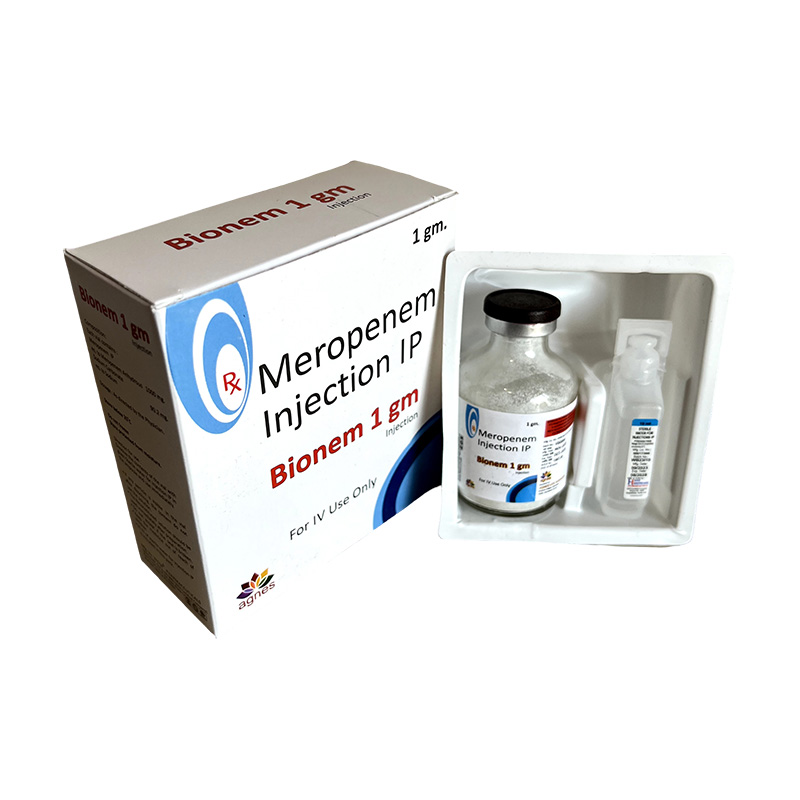
BIONEM
COMPOSITION
Meropenem 1 gram (Injection)
Category
Antibiotic, Carbapenem
| Packing |
|---|
SKU
3d9b1fb09d1d
Categories AGNES, INJECTABLES, Injection
ENQUIRY
Indications
BIONEM is a carbapenem antibiotic injection — one of the strongest classes of antibiotics available in clinical medicine today. It is reserved for serious, difficult-to-treat infections where other antibiotics have either failed or are unlikely to work. It is used exclusively in hospital settings and is prescribed for:
Life-Threatening Bacterial Infections: Used when a bacterial infection is severe, spreading fast, or is putting the patient’s life at risk and needs the most powerful antibiotic coverage available.
Septicemia (Blood Infections): Prescribed in bacterial bloodstream infections where bacteria have entered the blood and are circulating through the body — a condition that needs fast and aggressive treatment.
Bacterial Meningitis: Meropenem penetrates well into the fluid around the brain and spinal cord, making it effective in treating serious infections of the central nervous system.
ESBL-Producing Bacterial Infections: Some bacteria produce special enzymes called ESBLs that make them resistant to the most common antibiotics. BIONEM remains effective against these hard-to-treat strains.
Intra-Abdominal Infections: Used in serious infections inside the stomach cavity, including peritonitis, appendicitis complications, and infections following abdominal surgeries.
Hospital-Acquired Pneumonia: Treats severe lung infections picked up in hospitals or ICUs, especially those caused by multidrug-resistant bacteria.
Complicated Urinary Tract Infections: Used when UTIs are caused by resistant bacteria that have not responded to other antibiotics.
Febrile Neutropenia: A critical situation where cancer patients with very low white blood cell counts develop fever due to a bacterial infection — BIONEM provides the broad coverage needed in such cases.
Life-Threatening Bacterial Infections: Used when a bacterial infection is severe, spreading fast, or is putting the patient’s life at risk and needs the most powerful antibiotic coverage available.
Septicemia (Blood Infections): Prescribed in bacterial bloodstream infections where bacteria have entered the blood and are circulating through the body — a condition that needs fast and aggressive treatment.
Bacterial Meningitis: Meropenem penetrates well into the fluid around the brain and spinal cord, making it effective in treating serious infections of the central nervous system.
ESBL-Producing Bacterial Infections: Some bacteria produce special enzymes called ESBLs that make them resistant to the most common antibiotics. BIONEM remains effective against these hard-to-treat strains.
Intra-Abdominal Infections: Used in serious infections inside the stomach cavity, including peritonitis, appendicitis complications, and infections following abdominal surgeries.
Hospital-Acquired Pneumonia: Treats severe lung infections picked up in hospitals or ICUs, especially those caused by multidrug-resistant bacteria.
Complicated Urinary Tract Infections: Used when UTIs are caused by resistant bacteria that have not responded to other antibiotics.
Febrile Neutropenia: A critical situation where cancer patients with very low white blood cell counts develop fever due to a bacterial infection — BIONEM provides the broad coverage needed in such cases.
Uses
BIONEM contains Meropenem, a carbapenem antibiotic that works by attacking and breaking down the bacterial cell wall. Without a cell wall, bacteria cannot survive. What makes Meropenem stand out is its ultra-broad coverage — it works against gram-positive bacteria, gram-negative bacteria, and anaerobic bacteria all at once. It is also stable against most bacterial resistance enzymes, which is why it is saved for the most serious cases where other antibiotics have run out of options.
Used in Life-Threatening Bacterial Infections: When a patient’s condition is critical, and the infection is severe, Meropenem provides the kind of broad and powerful coverage that doctors can rely on quickly.
Effective in Septicemia and Meningitis: Works fast in the bloodstream and reaches the fluid around the brain — two of the most dangerous places a bacterial infection can be.
Broad-Spectrum Including ESBL-Producing Strains: One of the few antibiotics that remain effective against bacteria that produce ESBL enzymes — a growing problem in hospital settings across India and worldwide.
Treats Intra-Abdominal and Respiratory Infections: Covers the full range of bacteria responsible for stomach cavity infections and serious lung infections in one antibiotic.
ICU-Grade Antibiotic: BIONEM is specifically used in intensive care units where patients are at the highest risk of multi-drug resistant and life-threatening infections. Its reliability in these settings makes it a critical tool in critical care medicine.
Covers Multiple Bacteria at Once: Unlike narrow-spectrum antibiotics that target only one or two types of bacteria, Meropenem covers a very wide range — reducing the need for multiple antibiotics to be given together.
Used in Life-Threatening Bacterial Infections: When a patient’s condition is critical, and the infection is severe, Meropenem provides the kind of broad and powerful coverage that doctors can rely on quickly.
Effective in Septicemia and Meningitis: Works fast in the bloodstream and reaches the fluid around the brain — two of the most dangerous places a bacterial infection can be.
Broad-Spectrum Including ESBL-Producing Strains: One of the few antibiotics that remain effective against bacteria that produce ESBL enzymes — a growing problem in hospital settings across India and worldwide.
Treats Intra-Abdominal and Respiratory Infections: Covers the full range of bacteria responsible for stomach cavity infections and serious lung infections in one antibiotic.
ICU-Grade Antibiotic: BIONEM is specifically used in intensive care units where patients are at the highest risk of multi-drug resistant and life-threatening infections. Its reliability in these settings makes it a critical tool in critical care medicine.
Covers Multiple Bacteria at Once: Unlike narrow-spectrum antibiotics that target only one or two types of bacteria, Meropenem covers a very wide range — reducing the need for multiple antibiotics to be given together.
Dosage & Storage
Dosage: The dose is decided entirely by the treating doctor and varies based on the type of infection, its severity, the patient’s kidney function, body weight, and age. Higher doses are used for meningitis.
Route of Administration: Given only as an intravenous (IV) injection or infusion by a qualified doctor or nurse in a hospital. Never given as an IM injection.
Infusion Method: Usually given as a slow IV infusion over 15 to 30 minutes, or sometimes as a prolonged infusion depending on the doctor’s instructions.
Reconstitution: The powder in the vial must be dissolved in sterile water for injection and then diluted further in a suitable IV fluid before administration. Always follow the preparation instructions from the hospital pharmacy or medical team.
Storage: Store the dry vial at room temperature between 15°C and 30°C, in a cool and dry place away from moisture.
Protect from Light: Keep in the original carton and away from direct sunlight or sources of heat.
After Reconstitution: Use the prepared solution within the recommended time frame. Do not prepare in advance and store for later unless clearly guided by the medical team.
Keep Out of Reach: Always store safely away from children and pets.
Route of Administration: Given only as an intravenous (IV) injection or infusion by a qualified doctor or nurse in a hospital. Never given as an IM injection.
Infusion Method: Usually given as a slow IV infusion over 15 to 30 minutes, or sometimes as a prolonged infusion depending on the doctor’s instructions.
Reconstitution: The powder in the vial must be dissolved in sterile water for injection and then diluted further in a suitable IV fluid before administration. Always follow the preparation instructions from the hospital pharmacy or medical team.
Storage: Store the dry vial at room temperature between 15°C and 30°C, in a cool and dry place away from moisture.
Protect from Light: Keep in the original carton and away from direct sunlight or sources of heat.
After Reconstitution: Use the prepared solution within the recommended time frame. Do not prepare in advance and store for later unless clearly guided by the medical team.
Keep Out of Reach: Always store safely away from children and pets.
Directions For Use
Strictly Hospital Use Only: BIONEM is a critical care antibiotic and must only be used in a hospital or ICU setting under the direct supervision of a doctor. It is absolutely not for home use.
Do Not Self-Administer: This injection must always be prepared and given by a trained nurse or doctor. Never attempt to use it outside a clinical setting.
Check Before Administration: After mixing, inspect the solution carefully. It should be clear and colourless to pale yellow, free from floating particles. Do not use if it appears cloudy, discoloured, or has visible debris.
Give at the Right Rate: Administer at the infusion rate and over the time period prescribed by the doctor. Giving it too fast can increase the risk of side effects.
Complete the Full Course: Always finish the complete treatment course even if the patient starts feeling better. Stopping Meropenem early can allow the infection to come back — often in a more resistant form.
Fixed Dosing Intervals: Doses should be given at evenly spaced intervals, usually every 8 hours, to keep the antibiotic at an effective level in the body throughout the day.
Missed Dose: If a scheduled dose is delayed or missed in the hospital setting, inform the treating doctor or nurse straight away. Do not double the next dose.
Do Not Self-Administer: This injection must always be prepared and given by a trained nurse or doctor. Never attempt to use it outside a clinical setting.
Check Before Administration: After mixing, inspect the solution carefully. It should be clear and colourless to pale yellow, free from floating particles. Do not use if it appears cloudy, discoloured, or has visible debris.
Give at the Right Rate: Administer at the infusion rate and over the time period prescribed by the doctor. Giving it too fast can increase the risk of side effects.
Complete the Full Course: Always finish the complete treatment course even if the patient starts feeling better. Stopping Meropenem early can allow the infection to come back — often in a more resistant form.
Fixed Dosing Intervals: Doses should be given at evenly spaced intervals, usually every 8 hours, to keep the antibiotic at an effective level in the body throughout the day.
Missed Dose: If a scheduled dose is delayed or missed in the hospital setting, inform the treating doctor or nurse straight away. Do not double the next dose.
Precautions
Before starting BIONEM, the doctor must be informed about the following:
Carbapenem or Penicillin Allergy: Do not use if you have a known allergy to Meropenem, any other carbapenem, or penicillin-type antibiotics. Always share your full allergy history with the medical team before starting treatment.
Kidney Problems: Meropenem is mainly removed from the body through the kidneys. Patients with reduced kidney function need careful dose adjustments and regular blood monitoring throughout the course.
History of Seizures: Use with extra caution in patients who have a history of epilepsy or seizures, as Meropenem can occasionally affect the brain — especially at higher doses or in patients with kidney problems.
Liver Disease: While less of a concern than kidney function, patients with serious liver conditions should still be monitored during treatment.
Pregnancy & Breastfeeding: Use only if clearly needed and prescribed by a doctor. The benefits and risks should be carefully considered.
Other Medications: Tell the doctor about all current medicines — especially Valproic acid (used for epilepsy), as Meropenem can significantly reduce its levels in the blood and may lead to seizures.
Prolonged Use: Long-term use of carbapenems can sometimes lead to secondary infections from organisms not covered by this antibiotic, such as certain fungi. Regular monitoring is important during extended treatment.
Superinfection Risk: As with all broad-spectrum antibiotics, BIONEM may allow non-susceptible bacteria or fungi to grow during treatment. The medical team will watch for signs of this.
Carbapenem or Penicillin Allergy: Do not use if you have a known allergy to Meropenem, any other carbapenem, or penicillin-type antibiotics. Always share your full allergy history with the medical team before starting treatment.
Kidney Problems: Meropenem is mainly removed from the body through the kidneys. Patients with reduced kidney function need careful dose adjustments and regular blood monitoring throughout the course.
History of Seizures: Use with extra caution in patients who have a history of epilepsy or seizures, as Meropenem can occasionally affect the brain — especially at higher doses or in patients with kidney problems.
Liver Disease: While less of a concern than kidney function, patients with serious liver conditions should still be monitored during treatment.
Pregnancy & Breastfeeding: Use only if clearly needed and prescribed by a doctor. The benefits and risks should be carefully considered.
Other Medications: Tell the doctor about all current medicines — especially Valproic acid (used for epilepsy), as Meropenem can significantly reduce its levels in the blood and may lead to seizures.
Prolonged Use: Long-term use of carbapenems can sometimes lead to secondary infections from organisms not covered by this antibiotic, such as certain fungi. Regular monitoring is important during extended treatment.
Superinfection Risk: As with all broad-spectrum antibiotics, BIONEM may allow non-susceptible bacteria or fungi to grow during treatment. The medical team will watch for signs of this.
Side Effects
Nausea
Headache
Rash
Diarrhea
Seizures (rare in high doses or renal impairment)
Headache
Rash
Diarrhea
Seizures (rare in high doses or renal impairment)
Medical Disclaimer
The information provided here is for educational and informational purposes only and is not a substitute for professional medical advice. Always consult a healthcare professional for medical advice, diagnosis, or treatment.
BIONEM is a prescription-only, hospital-grade injectable and must be administered strictly under the supervision of a licensed medical professional. Agnes Life Sciences does not claim that this or any of its products can diagnose, treat, cure, or prevent any disease.
BIONEM is a prescription-only, hospital-grade injectable and must be administered strictly under the supervision of a licensed medical professional. Agnes Life Sciences does not claim that this or any of its products can diagnose, treat, cure, or prevent any disease.
Indications
BIONEM is a carbapenem antibiotic injection — one of the strongest classes of antibiotics available in clinical medicine today. It is reserved for serious, difficult-to-treat infections where other antibiotics have either failed or are unlikely to work. It is used exclusively in hospital settings and is prescribed for:
Life-Threatening Bacterial Infections: Used when a bacterial infection is severe, spreading fast, or is putting the patient’s life at risk and needs the most powerful antibiotic coverage available.
Septicemia (Blood Infections): Prescribed in bacterial bloodstream infections where bacteria have entered the blood and are circulating through the body — a condition that needs fast and aggressive treatment.
Bacterial Meningitis: Meropenem penetrates well into the fluid around the brain and spinal cord, making it effective in treating serious infections of the central nervous system.
ESBL-Producing Bacterial Infections: Some bacteria produce special enzymes called ESBLs that make them resistant to the most common antibiotics. BIONEM remains effective against these hard-to-treat strains.
Intra-Abdominal Infections: Used in serious infections inside the stomach cavity, including peritonitis, appendicitis complications, and infections following abdominal surgeries.
Hospital-Acquired Pneumonia: Treats severe lung infections picked up in hospitals or ICUs, especially those caused by multidrug-resistant bacteria.
Complicated Urinary Tract Infections: Used when UTIs are caused by resistant bacteria that have not responded to other antibiotics.
Febrile Neutropenia: A critical situation where cancer patients with very low white blood cell counts develop fever due to a bacterial infection — BIONEM provides the broad coverage needed in such cases.
Life-Threatening Bacterial Infections: Used when a bacterial infection is severe, spreading fast, or is putting the patient’s life at risk and needs the most powerful antibiotic coverage available.
Septicemia (Blood Infections): Prescribed in bacterial bloodstream infections where bacteria have entered the blood and are circulating through the body — a condition that needs fast and aggressive treatment.
Bacterial Meningitis: Meropenem penetrates well into the fluid around the brain and spinal cord, making it effective in treating serious infections of the central nervous system.
ESBL-Producing Bacterial Infections: Some bacteria produce special enzymes called ESBLs that make them resistant to the most common antibiotics. BIONEM remains effective against these hard-to-treat strains.
Intra-Abdominal Infections: Used in serious infections inside the stomach cavity, including peritonitis, appendicitis complications, and infections following abdominal surgeries.
Hospital-Acquired Pneumonia: Treats severe lung infections picked up in hospitals or ICUs, especially those caused by multidrug-resistant bacteria.
Complicated Urinary Tract Infections: Used when UTIs are caused by resistant bacteria that have not responded to other antibiotics.
Febrile Neutropenia: A critical situation where cancer patients with very low white blood cell counts develop fever due to a bacterial infection — BIONEM provides the broad coverage needed in such cases.
Uses
BIONEM contains Meropenem, a carbapenem antibiotic that works by attacking and breaking down the bacterial cell wall. Without a cell wall, bacteria cannot survive. What makes Meropenem stand out is its ultra-broad coverage — it works against gram-positive bacteria, gram-negative bacteria, and anaerobic bacteria all at once. It is also stable against most bacterial resistance enzymes, which is why it is saved for the most serious cases where other antibiotics have run out of options.
Used in Life-Threatening Bacterial Infections: When a patient’s condition is critical, and the infection is severe, Meropenem provides the kind of broad and powerful coverage that doctors can rely on quickly.
Effective in Septicemia and Meningitis: Works fast in the bloodstream and reaches the fluid around the brain — two of the most dangerous places a bacterial infection can be.
Broad-Spectrum Including ESBL-Producing Strains: One of the few antibiotics that remain effective against bacteria that produce ESBL enzymes — a growing problem in hospital settings across India and worldwide.
Treats Intra-Abdominal and Respiratory Infections: Covers the full range of bacteria responsible for stomach cavity infections and serious lung infections in one antibiotic.
ICU-Grade Antibiotic: BIONEM is specifically used in intensive care units where patients are at the highest risk of multi-drug resistant and life-threatening infections. Its reliability in these settings makes it a critical tool in critical care medicine.
Covers Multiple Bacteria at Once: Unlike narrow-spectrum antibiotics that target only one or two types of bacteria, Meropenem covers a very wide range — reducing the need for multiple antibiotics to be given together.
Used in Life-Threatening Bacterial Infections: When a patient’s condition is critical, and the infection is severe, Meropenem provides the kind of broad and powerful coverage that doctors can rely on quickly.
Effective in Septicemia and Meningitis: Works fast in the bloodstream and reaches the fluid around the brain — two of the most dangerous places a bacterial infection can be.
Broad-Spectrum Including ESBL-Producing Strains: One of the few antibiotics that remain effective against bacteria that produce ESBL enzymes — a growing problem in hospital settings across India and worldwide.
Treats Intra-Abdominal and Respiratory Infections: Covers the full range of bacteria responsible for stomach cavity infections and serious lung infections in one antibiotic.
ICU-Grade Antibiotic: BIONEM is specifically used in intensive care units where patients are at the highest risk of multi-drug resistant and life-threatening infections. Its reliability in these settings makes it a critical tool in critical care medicine.
Covers Multiple Bacteria at Once: Unlike narrow-spectrum antibiotics that target only one or two types of bacteria, Meropenem covers a very wide range — reducing the need for multiple antibiotics to be given together.
Dosage & Storage
Dosage: The dose is decided entirely by the treating doctor and varies based on the type of infection, its severity, the patient’s kidney function, body weight, and age. Higher doses are used for meningitis.
Route of Administration: Given only as an intravenous (IV) injection or infusion by a qualified doctor or nurse in a hospital. Never given as an IM injection.
Infusion Method: Usually given as a slow IV infusion over 15 to 30 minutes, or sometimes as a prolonged infusion depending on the doctor’s instructions.
Reconstitution: The powder in the vial must be dissolved in sterile water for injection and then diluted further in a suitable IV fluid before administration. Always follow the preparation instructions from the hospital pharmacy or medical team.
Storage: Store the dry vial at room temperature between 15°C and 30°C, in a cool and dry place away from moisture.
Protect from Light: Keep in the original carton and away from direct sunlight or sources of heat.
After Reconstitution: Use the prepared solution within the recommended time frame. Do not prepare in advance and store for later unless clearly guided by the medical team.
Keep Out of Reach: Always store safely away from children and pets.
Route of Administration: Given only as an intravenous (IV) injection or infusion by a qualified doctor or nurse in a hospital. Never given as an IM injection.
Infusion Method: Usually given as a slow IV infusion over 15 to 30 minutes, or sometimes as a prolonged infusion depending on the doctor’s instructions.
Reconstitution: The powder in the vial must be dissolved in sterile water for injection and then diluted further in a suitable IV fluid before administration. Always follow the preparation instructions from the hospital pharmacy or medical team.
Storage: Store the dry vial at room temperature between 15°C and 30°C, in a cool and dry place away from moisture.
Protect from Light: Keep in the original carton and away from direct sunlight or sources of heat.
After Reconstitution: Use the prepared solution within the recommended time frame. Do not prepare in advance and store for later unless clearly guided by the medical team.
Keep Out of Reach: Always store safely away from children and pets.
Directions For Use
Strictly Hospital Use Only: BIONEM is a critical care antibiotic and must only be used in a hospital or ICU setting under the direct supervision of a doctor. It is absolutely not for home use.
Do Not Self-Administer: This injection must always be prepared and given by a trained nurse or doctor. Never attempt to use it outside a clinical setting.
Check Before Administration: After mixing, inspect the solution carefully. It should be clear and colourless to pale yellow, free from floating particles. Do not use if it appears cloudy, discoloured, or has visible debris.
Give at the Right Rate: Administer at the infusion rate and over the time period prescribed by the doctor. Giving it too fast can increase the risk of side effects.
Complete the Full Course: Always finish the complete treatment course even if the patient starts feeling better. Stopping Meropenem early can allow the infection to come back — often in a more resistant form.
Fixed Dosing Intervals: Doses should be given at evenly spaced intervals, usually every 8 hours, to keep the antibiotic at an effective level in the body throughout the day.
Missed Dose: If a scheduled dose is delayed or missed in the hospital setting, inform the treating doctor or nurse straight away. Do not double the next dose.
Do Not Self-Administer: This injection must always be prepared and given by a trained nurse or doctor. Never attempt to use it outside a clinical setting.
Check Before Administration: After mixing, inspect the solution carefully. It should be clear and colourless to pale yellow, free from floating particles. Do not use if it appears cloudy, discoloured, or has visible debris.
Give at the Right Rate: Administer at the infusion rate and over the time period prescribed by the doctor. Giving it too fast can increase the risk of side effects.
Complete the Full Course: Always finish the complete treatment course even if the patient starts feeling better. Stopping Meropenem early can allow the infection to come back — often in a more resistant form.
Fixed Dosing Intervals: Doses should be given at evenly spaced intervals, usually every 8 hours, to keep the antibiotic at an effective level in the body throughout the day.
Missed Dose: If a scheduled dose is delayed or missed in the hospital setting, inform the treating doctor or nurse straight away. Do not double the next dose.
Precautions
Before starting BIONEM, the doctor must be informed about the following:
Carbapenem or Penicillin Allergy: Do not use if you have a known allergy to Meropenem, any other carbapenem, or penicillin-type antibiotics. Always share your full allergy history with the medical team before starting treatment.
Kidney Problems: Meropenem is mainly removed from the body through the kidneys. Patients with reduced kidney function need careful dose adjustments and regular blood monitoring throughout the course.
History of Seizures: Use with extra caution in patients who have a history of epilepsy or seizures, as Meropenem can occasionally affect the brain — especially at higher doses or in patients with kidney problems.
Liver Disease: While less of a concern than kidney function, patients with serious liver conditions should still be monitored during treatment.
Pregnancy & Breastfeeding: Use only if clearly needed and prescribed by a doctor. The benefits and risks should be carefully considered.
Other Medications: Tell the doctor about all current medicines — especially Valproic acid (used for epilepsy), as Meropenem can significantly reduce its levels in the blood and may lead to seizures.
Prolonged Use: Long-term use of carbapenems can sometimes lead to secondary infections from organisms not covered by this antibiotic, such as certain fungi. Regular monitoring is important during extended treatment.
Superinfection Risk: As with all broad-spectrum antibiotics, BIONEM may allow non-susceptible bacteria or fungi to grow during treatment. The medical team will watch for signs of this.
Carbapenem or Penicillin Allergy: Do not use if you have a known allergy to Meropenem, any other carbapenem, or penicillin-type antibiotics. Always share your full allergy history with the medical team before starting treatment.
Kidney Problems: Meropenem is mainly removed from the body through the kidneys. Patients with reduced kidney function need careful dose adjustments and regular blood monitoring throughout the course.
History of Seizures: Use with extra caution in patients who have a history of epilepsy or seizures, as Meropenem can occasionally affect the brain — especially at higher doses or in patients with kidney problems.
Liver Disease: While less of a concern than kidney function, patients with serious liver conditions should still be monitored during treatment.
Pregnancy & Breastfeeding: Use only if clearly needed and prescribed by a doctor. The benefits and risks should be carefully considered.
Other Medications: Tell the doctor about all current medicines — especially Valproic acid (used for epilepsy), as Meropenem can significantly reduce its levels in the blood and may lead to seizures.
Prolonged Use: Long-term use of carbapenems can sometimes lead to secondary infections from organisms not covered by this antibiotic, such as certain fungi. Regular monitoring is important during extended treatment.
Superinfection Risk: As with all broad-spectrum antibiotics, BIONEM may allow non-susceptible bacteria or fungi to grow during treatment. The medical team will watch for signs of this.
Side Effects
Nausea
Headache
Rash
Diarrhea
Seizures (rare in high doses or renal impairment)
Headache
Rash
Diarrhea
Seizures (rare in high doses or renal impairment)
Medical Disclaimer
The information provided here is for educational and informational purposes only and is not a substitute for professional medical advice. Always consult a healthcare professional for medical advice, diagnosis, or treatment.
BIONEM is a prescription-only, hospital-grade injectable and must be administered strictly under the supervision of a licensed medical professional. Agnes Life Sciences does not claim that this or any of its products can diagnose, treat, cure, or prevent any disease.
BIONEM is a prescription-only, hospital-grade injectable and must be administered strictly under the supervision of a licensed medical professional. Agnes Life Sciences does not claim that this or any of its products can diagnose, treat, cure, or prevent any disease.