
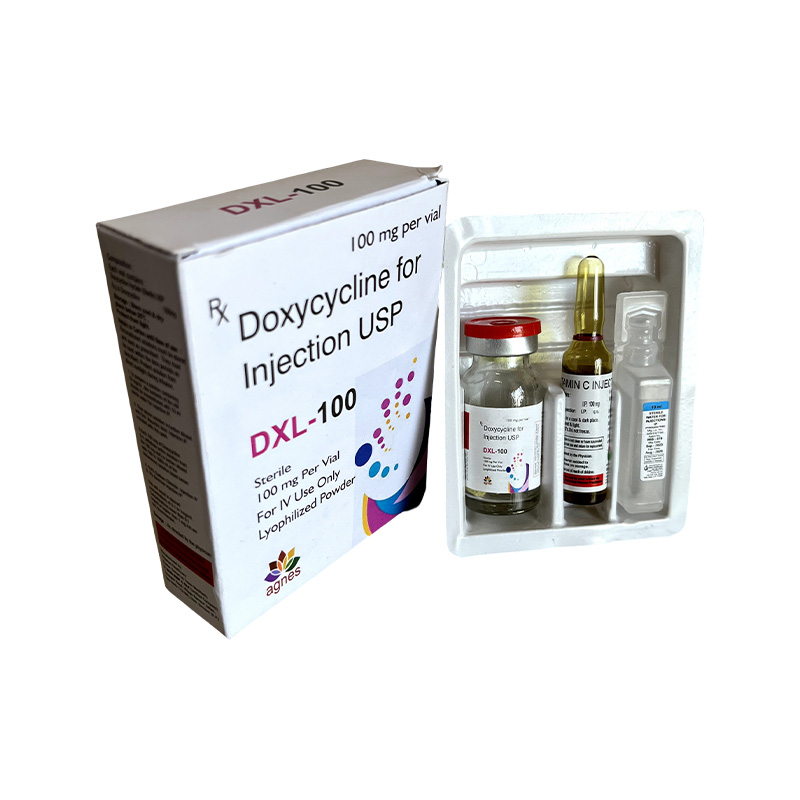
DXL-100 INJ
COMPOSITION
Doxycycline HCl 100 mg + Vitamin C (Injection/Vial)
Category
Antibiotic, Tetracycline class + Supplement
| Packing |
|---|
SKU
b415cafdb7f6
Categories AGNES, INJECTABLES, Injection
ENQUIRY
Indications
DXL-100 INJ is an antibiotic injection that contains Doxycycline along with Vitamin C. Doxycycline belongs to the tetracycline group of antibiotics and works against a very wide range of bacteria and other microorganisms. The addition of Vitamin C helps support the immune system and reduces oxidative stress during infection. This combination is used in hospital settings when oral Doxycycline is not suitable or when the infection needs faster treatment through the IV route. It is prescribed for:
Respiratory Tract Infections: Used in chest infections, community-acquired pneumonia, and bronchitis — especially when the infection is caused by atypical bacteria like Mycoplasma or Chlamydia that do not respond to standard antibiotics.
Sexually Transmitted Infections (STDs): One of the most commonly used antibiotics for infections like chlamydia, gonorrhoea (as part of a combined treatment), and non-gonococcal urethritis.
Acne Treatment: In severe or cystic acne that has not responded to topical creams or gels, injectable Doxycycline helps clear the skin infection from inside.
Malaria Prevention and Support: Doxycycline is widely used as a malaria prophylactic — especially for people travelling to malaria-prone areas — and also as part of malaria treatment alongside other medicines.
Rickettsial Infections: These are infections caused by tick or louse bites — such as typhus and spotted fever. Doxycycline is the drug of choice for these conditions and works very effectively.
Broad-Spectrum Bacterial Infections: Because it works against such a wide variety of bacteria, it is also used in urinary tract infections, skin infections, eye infections, and intestinal infections caused by susceptible organisms.
Vitamin C Support: The included Vitamin C plays a supporting role — it helps the immune cells fight the infection more effectively and also helps with tissue repair during recovery.
Infections Resistant to Penicillin: For patients who are allergic to penicillin or when the bacteria are resistant to beta-lactam antibiotics, Doxycycline is a commonly used alternative.
Respiratory Tract Infections: Used in chest infections, community-acquired pneumonia, and bronchitis — especially when the infection is caused by atypical bacteria like Mycoplasma or Chlamydia that do not respond to standard antibiotics.
Sexually Transmitted Infections (STDs): One of the most commonly used antibiotics for infections like chlamydia, gonorrhoea (as part of a combined treatment), and non-gonococcal urethritis.
Acne Treatment: In severe or cystic acne that has not responded to topical creams or gels, injectable Doxycycline helps clear the skin infection from inside.
Malaria Prevention and Support: Doxycycline is widely used as a malaria prophylactic — especially for people travelling to malaria-prone areas — and also as part of malaria treatment alongside other medicines.
Rickettsial Infections: These are infections caused by tick or louse bites — such as typhus and spotted fever. Doxycycline is the drug of choice for these conditions and works very effectively.
Broad-Spectrum Bacterial Infections: Because it works against such a wide variety of bacteria, it is also used in urinary tract infections, skin infections, eye infections, and intestinal infections caused by susceptible organisms.
Vitamin C Support: The included Vitamin C plays a supporting role — it helps the immune cells fight the infection more effectively and also helps with tissue repair during recovery.
Infections Resistant to Penicillin: For patients who are allergic to penicillin or when the bacteria are resistant to beta-lactam antibiotics, Doxycycline is a commonly used alternative.
Uses
DXL-100 INJ works differently from most other antibiotics. Instead of killing bacteria directly, it stops them from multiplying. Doxycycline enters the bacterial cell and blocks the process that makes the proteins bacteria need to grow and reproduce. Without being able to make new proteins, the bacteria stop growing — and the body’s own immune system then clears them out. This is called bacteriostatic action. The Vitamin C added in this formulation helps the body fight infection better and supports faster recovery.
Treats Respiratory Infections and STDs: Covers a range of bacteria, including atypical organisms like Mycoplasma pneumoniae and Chlamydia, which many other common antibiotics miss entirely.
Used in Acne and Skin Infections: Reaches skin tissue well and helps reduce bacterial growth responsible for acne breakouts, skin abscesses, and infected wounds.
Effective in Malaria Prevention: When used as prophylaxis, it prevents the malaria parasite from completing its life cycle in the body. Widely recommended for people going to high-risk zones.
Useful in Rickettsial Infections: Typhus and other rickettsial illnesses can be very serious. Doxycycline is the first-choice treatment for these conditions and usually shows results within a few days.
Broad-Spectrum Antibiotic: Covers gram-positive bacteria, gram-negative bacteria, atypical organisms, and some parasites — making it one of the most versatile antibiotics available.
Vitamin C Supports Recovery: Helps maintain immune strength during the illness and supports faster healing of tissues damaged by the infection.
Treats Respiratory Infections and STDs: Covers a range of bacteria, including atypical organisms like Mycoplasma pneumoniae and Chlamydia, which many other common antibiotics miss entirely.
Used in Acne and Skin Infections: Reaches skin tissue well and helps reduce bacterial growth responsible for acne breakouts, skin abscesses, and infected wounds.
Effective in Malaria Prevention: When used as prophylaxis, it prevents the malaria parasite from completing its life cycle in the body. Widely recommended for people going to high-risk zones.
Useful in Rickettsial Infections: Typhus and other rickettsial illnesses can be very serious. Doxycycline is the first-choice treatment for these conditions and usually shows results within a few days.
Broad-Spectrum Antibiotic: Covers gram-positive bacteria, gram-negative bacteria, atypical organisms, and some parasites — making it one of the most versatile antibiotics available.
Vitamin C Supports Recovery: Helps maintain immune strength during the illness and supports faster healing of tissues damaged by the infection.
Dosage & Storage
Dosage: The dose is always decided by the treating doctor based on the type of infection, its severity, and the patient’s age and overall health. The standard adult dose is 100mg given once or twice daily.
How It Is Given: As a slow intravenous (IV) infusion only — administered by a doctor or nurse in a hospital or clinic. It should never be given as a rapid IV push or as an IM injection.
Preparation: This is a lyophilized powder (freeze-dried) that needs to be dissolved in sterile water and then diluted further in a suitable IV fluid before use. Hospital pharmacy or nursing staff will handle this.
Infusion Time: Should be given slowly over at least 1 to 4 hours, depending on the concentration and the doctor’s instructions. Giving it too fast can irritate the vein.
Storage: Store the dry vial at room temperature between 15°C and 30°C, in a cool, dry place away from sunlight and moisture.
Protect from Light: Doxycycline is sensitive to light. Keep in the original carton and away from direct sunlight at all times.
After mixing: Use the prepared solution within the recommended time. Do not prepare it in advance and store it for later.
Keep Out of Reach: Always store safely away from children and pets.
How It Is Given: As a slow intravenous (IV) infusion only — administered by a doctor or nurse in a hospital or clinic. It should never be given as a rapid IV push or as an IM injection.
Preparation: This is a lyophilized powder (freeze-dried) that needs to be dissolved in sterile water and then diluted further in a suitable IV fluid before use. Hospital pharmacy or nursing staff will handle this.
Infusion Time: Should be given slowly over at least 1 to 4 hours, depending on the concentration and the doctor’s instructions. Giving it too fast can irritate the vein.
Storage: Store the dry vial at room temperature between 15°C and 30°C, in a cool, dry place away from sunlight and moisture.
Protect from Light: Doxycycline is sensitive to light. Keep in the original carton and away from direct sunlight at all times.
After mixing: Use the prepared solution within the recommended time. Do not prepare it in advance and store it for later.
Keep Out of Reach: Always store safely away from children and pets.
Directions For Use
Hospital Use Only: DXL-100 INJ is for use inside a hospital or clinic only. It must be prepared and administered by a trained medical professional and is not suitable for home use.
Never Self-Administer: This injection should never be attempted at home or without proper medical supervision. Slow Infusion is Important: Doxycycline must always be given as a slow drip. Fast administration can cause severe irritation to the vein and surrounding tissue, and in some cases can cause pain and damage at the IV site.
Check Before Use: After mixing, the solution should be clear. If it looks cloudy, has particles, or has an unusual colour, do not use it — inform the nurse or pharmacist right away.
Avoid Sun Exposure: Doxycycline makes the skin more sensitive to sunlight. Patients should avoid going out in the sun without proper protection during and for a few days after the treatment. Wear sunscreen or cover up when going outside.
Complete the Full Course: Always finish the full prescribed course, even if symptoms improve quickly. Stopping the antibiotic early is one of the main reasons infections return or bacteria become resistant.
Missed Dose: If a dose is delayed or missed in the hospital, inform the nurse or doctor straight away. Never give two doses together.
Never Self-Administer: This injection should never be attempted at home or without proper medical supervision. Slow Infusion is Important: Doxycycline must always be given as a slow drip. Fast administration can cause severe irritation to the vein and surrounding tissue, and in some cases can cause pain and damage at the IV site.
Check Before Use: After mixing, the solution should be clear. If it looks cloudy, has particles, or has an unusual colour, do not use it — inform the nurse or pharmacist right away.
Avoid Sun Exposure: Doxycycline makes the skin more sensitive to sunlight. Patients should avoid going out in the sun without proper protection during and for a few days after the treatment. Wear sunscreen or cover up when going outside.
Complete the Full Course: Always finish the full prescribed course, even if symptoms improve quickly. Stopping the antibiotic early is one of the main reasons infections return or bacteria become resistant.
Missed Dose: If a dose is delayed or missed in the hospital, inform the nurse or doctor straight away. Never give two doses together.
Precautions
Before starting DXL-100 INJ, the doctor needs to know the following:
Tetracycline Allergy: Do not use if the patient is allergic to Doxycycline or any other tetracycline antibiotic, like Minocycline or Tetracycline. Always share full allergy history before starting treatment.
Pregnancy: Doxycycline must NOT be used during pregnancy. It can harm the developing baby, particularly the bones and teeth. This is a strict contraindication.
Children Below 8 Years: Doxycycline should not be given to children under 8 years of age as it can cause permanent discolouration of developing teeth and affect bone growth.
Breastfeeding: Doxycycline passes into breast milk and should be avoided during breastfeeding unless specifically directed by a doctor who has weighed the risks carefully.
Liver Problems: Patients with severe liver disease need dose reduction and regular monitoring, as Doxycycline is processed by the liver.
Kidney Disease: Generally well-tolerated in kidney patients — one of the advantages of Doxycycline over many other antibiotics.
Sun Sensitivity Warning: Patients must be clearly told to avoid direct sunlight and UV exposure during treatment. Even a short time in the sun can cause a painful sunburn-like reaction on the skin.
Antacids and Dairy: Calcium-containing foods like milk, curd, or antacids containing calcium, magnesium, or aluminium should not be taken close to the dose time — they reduce the absorption of Doxycycline significantly.
Blood Thinners: Doxycycline can increase the effect of blood-thinning medicines like Warfarin — the doctor may need to adjust the dose of the blood thinner.
Oral Contraceptives: Doxycycline may reduce the effectiveness of oral contraceptive pills — female patients should be informed about this and advised accordingly.
Tetracycline Allergy: Do not use if the patient is allergic to Doxycycline or any other tetracycline antibiotic, like Minocycline or Tetracycline. Always share full allergy history before starting treatment.
Pregnancy: Doxycycline must NOT be used during pregnancy. It can harm the developing baby, particularly the bones and teeth. This is a strict contraindication.
Children Below 8 Years: Doxycycline should not be given to children under 8 years of age as it can cause permanent discolouration of developing teeth and affect bone growth.
Breastfeeding: Doxycycline passes into breast milk and should be avoided during breastfeeding unless specifically directed by a doctor who has weighed the risks carefully.
Liver Problems: Patients with severe liver disease need dose reduction and regular monitoring, as Doxycycline is processed by the liver.
Kidney Disease: Generally well-tolerated in kidney patients — one of the advantages of Doxycycline over many other antibiotics.
Sun Sensitivity Warning: Patients must be clearly told to avoid direct sunlight and UV exposure during treatment. Even a short time in the sun can cause a painful sunburn-like reaction on the skin.
Antacids and Dairy: Calcium-containing foods like milk, curd, or antacids containing calcium, magnesium, or aluminium should not be taken close to the dose time — they reduce the absorption of Doxycycline significantly.
Blood Thinners: Doxycycline can increase the effect of blood-thinning medicines like Warfarin — the doctor may need to adjust the dose of the blood thinner.
Oral Contraceptives: Doxycycline may reduce the effectiveness of oral contraceptive pills — female patients should be informed about this and advised accordingly.
Side Effects
GI upset
Sun sensitivity
Dizziness
Injection site irritation
Diarrhea
Sun sensitivity
Dizziness
Injection site irritation
Diarrhea
Medical Disclaimer
The information given here is only for general understanding and educational purposes. It is not a replacement for your doctor’s advice.
DXL-100 INJ is a prescription-only injectable medicine and must always be used under the supervision of a licensed medical professional in a hospital or clinical setting. Please consult your doctor for the right diagnosis and treatment plan. Agnes Life Sciences does not claim that this or any of its products can diagnose, treat, cure, or prevent any disease.
DXL-100 INJ is a prescription-only injectable medicine and must always be used under the supervision of a licensed medical professional in a hospital or clinical setting. Please consult your doctor for the right diagnosis and treatment plan. Agnes Life Sciences does not claim that this or any of its products can diagnose, treat, cure, or prevent any disease.
Indications
DXL-100 INJ is an antibiotic injection that contains Doxycycline along with Vitamin C. Doxycycline belongs to the tetracycline group of antibiotics and works against a very wide range of bacteria and other microorganisms. The addition of Vitamin C helps support the immune system and reduces oxidative stress during infection. This combination is used in hospital settings when oral Doxycycline is not suitable or when the infection needs faster treatment through the IV route. It is prescribed for:
Respiratory Tract Infections: Used in chest infections, community-acquired pneumonia, and bronchitis — especially when the infection is caused by atypical bacteria like Mycoplasma or Chlamydia that do not respond to standard antibiotics.
Sexually Transmitted Infections (STDs): One of the most commonly used antibiotics for infections like chlamydia, gonorrhoea (as part of a combined treatment), and non-gonococcal urethritis.
Acne Treatment: In severe or cystic acne that has not responded to topical creams or gels, injectable Doxycycline helps clear the skin infection from inside.
Malaria Prevention and Support: Doxycycline is widely used as a malaria prophylactic — especially for people travelling to malaria-prone areas — and also as part of malaria treatment alongside other medicines.
Rickettsial Infections: These are infections caused by tick or louse bites — such as typhus and spotted fever. Doxycycline is the drug of choice for these conditions and works very effectively.
Broad-Spectrum Bacterial Infections: Because it works against such a wide variety of bacteria, it is also used in urinary tract infections, skin infections, eye infections, and intestinal infections caused by susceptible organisms.
Vitamin C Support: The included Vitamin C plays a supporting role — it helps the immune cells fight the infection more effectively and also helps with tissue repair during recovery.
Infections Resistant to Penicillin: For patients who are allergic to penicillin or when the bacteria are resistant to beta-lactam antibiotics, Doxycycline is a commonly used alternative.
Respiratory Tract Infections: Used in chest infections, community-acquired pneumonia, and bronchitis — especially when the infection is caused by atypical bacteria like Mycoplasma or Chlamydia that do not respond to standard antibiotics.
Sexually Transmitted Infections (STDs): One of the most commonly used antibiotics for infections like chlamydia, gonorrhoea (as part of a combined treatment), and non-gonococcal urethritis.
Acne Treatment: In severe or cystic acne that has not responded to topical creams or gels, injectable Doxycycline helps clear the skin infection from inside.
Malaria Prevention and Support: Doxycycline is widely used as a malaria prophylactic — especially for people travelling to malaria-prone areas — and also as part of malaria treatment alongside other medicines.
Rickettsial Infections: These are infections caused by tick or louse bites — such as typhus and spotted fever. Doxycycline is the drug of choice for these conditions and works very effectively.
Broad-Spectrum Bacterial Infections: Because it works against such a wide variety of bacteria, it is also used in urinary tract infections, skin infections, eye infections, and intestinal infections caused by susceptible organisms.
Vitamin C Support: The included Vitamin C plays a supporting role — it helps the immune cells fight the infection more effectively and also helps with tissue repair during recovery.
Infections Resistant to Penicillin: For patients who are allergic to penicillin or when the bacteria are resistant to beta-lactam antibiotics, Doxycycline is a commonly used alternative.
Uses
DXL-100 INJ works differently from most other antibiotics. Instead of killing bacteria directly, it stops them from multiplying. Doxycycline enters the bacterial cell and blocks the process that makes the proteins bacteria need to grow and reproduce. Without being able to make new proteins, the bacteria stop growing — and the body’s own immune system then clears them out. This is called bacteriostatic action. The Vitamin C added in this formulation helps the body fight infection better and supports faster recovery.
Treats Respiratory Infections and STDs: Covers a range of bacteria, including atypical organisms like Mycoplasma pneumoniae and Chlamydia, which many other common antibiotics miss entirely.
Used in Acne and Skin Infections: Reaches skin tissue well and helps reduce bacterial growth responsible for acne breakouts, skin abscesses, and infected wounds.
Effective in Malaria Prevention: When used as prophylaxis, it prevents the malaria parasite from completing its life cycle in the body. Widely recommended for people going to high-risk zones.
Useful in Rickettsial Infections: Typhus and other rickettsial illnesses can be very serious. Doxycycline is the first-choice treatment for these conditions and usually shows results within a few days.
Broad-Spectrum Antibiotic: Covers gram-positive bacteria, gram-negative bacteria, atypical organisms, and some parasites — making it one of the most versatile antibiotics available.
Vitamin C Supports Recovery: Helps maintain immune strength during the illness and supports faster healing of tissues damaged by the infection.
Treats Respiratory Infections and STDs: Covers a range of bacteria, including atypical organisms like Mycoplasma pneumoniae and Chlamydia, which many other common antibiotics miss entirely.
Used in Acne and Skin Infections: Reaches skin tissue well and helps reduce bacterial growth responsible for acne breakouts, skin abscesses, and infected wounds.
Effective in Malaria Prevention: When used as prophylaxis, it prevents the malaria parasite from completing its life cycle in the body. Widely recommended for people going to high-risk zones.
Useful in Rickettsial Infections: Typhus and other rickettsial illnesses can be very serious. Doxycycline is the first-choice treatment for these conditions and usually shows results within a few days.
Broad-Spectrum Antibiotic: Covers gram-positive bacteria, gram-negative bacteria, atypical organisms, and some parasites — making it one of the most versatile antibiotics available.
Vitamin C Supports Recovery: Helps maintain immune strength during the illness and supports faster healing of tissues damaged by the infection.
Dosage & Storage
Dosage: The dose is always decided by the treating doctor based on the type of infection, its severity, and the patient’s age and overall health. The standard adult dose is 100mg given once or twice daily.
How It Is Given: As a slow intravenous (IV) infusion only — administered by a doctor or nurse in a hospital or clinic. It should never be given as a rapid IV push or as an IM injection.
Preparation: This is a lyophilized powder (freeze-dried) that needs to be dissolved in sterile water and then diluted further in a suitable IV fluid before use. Hospital pharmacy or nursing staff will handle this.
Infusion Time: Should be given slowly over at least 1 to 4 hours, depending on the concentration and the doctor’s instructions. Giving it too fast can irritate the vein.
Storage: Store the dry vial at room temperature between 15°C and 30°C, in a cool, dry place away from sunlight and moisture.
Protect from Light: Doxycycline is sensitive to light. Keep in the original carton and away from direct sunlight at all times.
After mixing: Use the prepared solution within the recommended time. Do not prepare it in advance and store it for later.
Keep Out of Reach: Always store safely away from children and pets.
How It Is Given: As a slow intravenous (IV) infusion only — administered by a doctor or nurse in a hospital or clinic. It should never be given as a rapid IV push or as an IM injection.
Preparation: This is a lyophilized powder (freeze-dried) that needs to be dissolved in sterile water and then diluted further in a suitable IV fluid before use. Hospital pharmacy or nursing staff will handle this.
Infusion Time: Should be given slowly over at least 1 to 4 hours, depending on the concentration and the doctor’s instructions. Giving it too fast can irritate the vein.
Storage: Store the dry vial at room temperature between 15°C and 30°C, in a cool, dry place away from sunlight and moisture.
Protect from Light: Doxycycline is sensitive to light. Keep in the original carton and away from direct sunlight at all times.
After mixing: Use the prepared solution within the recommended time. Do not prepare it in advance and store it for later.
Keep Out of Reach: Always store safely away from children and pets.
Directions For Use
Hospital Use Only: DXL-100 INJ is for use inside a hospital or clinic only. It must be prepared and administered by a trained medical professional and is not suitable for home use.
Never Self-Administer: This injection should never be attempted at home or without proper medical supervision. Slow Infusion is Important: Doxycycline must always be given as a slow drip. Fast administration can cause severe irritation to the vein and surrounding tissue, and in some cases can cause pain and damage at the IV site.
Check Before Use: After mixing, the solution should be clear. If it looks cloudy, has particles, or has an unusual colour, do not use it — inform the nurse or pharmacist right away.
Avoid Sun Exposure: Doxycycline makes the skin more sensitive to sunlight. Patients should avoid going out in the sun without proper protection during and for a few days after the treatment. Wear sunscreen or cover up when going outside.
Complete the Full Course: Always finish the full prescribed course, even if symptoms improve quickly. Stopping the antibiotic early is one of the main reasons infections return or bacteria become resistant.
Missed Dose: If a dose is delayed or missed in the hospital, inform the nurse or doctor straight away. Never give two doses together.
Never Self-Administer: This injection should never be attempted at home or without proper medical supervision. Slow Infusion is Important: Doxycycline must always be given as a slow drip. Fast administration can cause severe irritation to the vein and surrounding tissue, and in some cases can cause pain and damage at the IV site.
Check Before Use: After mixing, the solution should be clear. If it looks cloudy, has particles, or has an unusual colour, do not use it — inform the nurse or pharmacist right away.
Avoid Sun Exposure: Doxycycline makes the skin more sensitive to sunlight. Patients should avoid going out in the sun without proper protection during and for a few days after the treatment. Wear sunscreen or cover up when going outside.
Complete the Full Course: Always finish the full prescribed course, even if symptoms improve quickly. Stopping the antibiotic early is one of the main reasons infections return or bacteria become resistant.
Missed Dose: If a dose is delayed or missed in the hospital, inform the nurse or doctor straight away. Never give two doses together.
Precautions
Before starting DXL-100 INJ, the doctor needs to know the following:
Tetracycline Allergy: Do not use if the patient is allergic to Doxycycline or any other tetracycline antibiotic, like Minocycline or Tetracycline. Always share full allergy history before starting treatment.
Pregnancy: Doxycycline must NOT be used during pregnancy. It can harm the developing baby, particularly the bones and teeth. This is a strict contraindication.
Children Below 8 Years: Doxycycline should not be given to children under 8 years of age as it can cause permanent discolouration of developing teeth and affect bone growth.
Breastfeeding: Doxycycline passes into breast milk and should be avoided during breastfeeding unless specifically directed by a doctor who has weighed the risks carefully.
Liver Problems: Patients with severe liver disease need dose reduction and regular monitoring, as Doxycycline is processed by the liver.
Kidney Disease: Generally well-tolerated in kidney patients — one of the advantages of Doxycycline over many other antibiotics.
Sun Sensitivity Warning: Patients must be clearly told to avoid direct sunlight and UV exposure during treatment. Even a short time in the sun can cause a painful sunburn-like reaction on the skin.
Antacids and Dairy: Calcium-containing foods like milk, curd, or antacids containing calcium, magnesium, or aluminium should not be taken close to the dose time — they reduce the absorption of Doxycycline significantly.
Blood Thinners: Doxycycline can increase the effect of blood-thinning medicines like Warfarin — the doctor may need to adjust the dose of the blood thinner.
Oral Contraceptives: Doxycycline may reduce the effectiveness of oral contraceptive pills — female patients should be informed about this and advised accordingly.
Tetracycline Allergy: Do not use if the patient is allergic to Doxycycline or any other tetracycline antibiotic, like Minocycline or Tetracycline. Always share full allergy history before starting treatment.
Pregnancy: Doxycycline must NOT be used during pregnancy. It can harm the developing baby, particularly the bones and teeth. This is a strict contraindication.
Children Below 8 Years: Doxycycline should not be given to children under 8 years of age as it can cause permanent discolouration of developing teeth and affect bone growth.
Breastfeeding: Doxycycline passes into breast milk and should be avoided during breastfeeding unless specifically directed by a doctor who has weighed the risks carefully.
Liver Problems: Patients with severe liver disease need dose reduction and regular monitoring, as Doxycycline is processed by the liver.
Kidney Disease: Generally well-tolerated in kidney patients — one of the advantages of Doxycycline over many other antibiotics.
Sun Sensitivity Warning: Patients must be clearly told to avoid direct sunlight and UV exposure during treatment. Even a short time in the sun can cause a painful sunburn-like reaction on the skin.
Antacids and Dairy: Calcium-containing foods like milk, curd, or antacids containing calcium, magnesium, or aluminium should not be taken close to the dose time — they reduce the absorption of Doxycycline significantly.
Blood Thinners: Doxycycline can increase the effect of blood-thinning medicines like Warfarin — the doctor may need to adjust the dose of the blood thinner.
Oral Contraceptives: Doxycycline may reduce the effectiveness of oral contraceptive pills — female patients should be informed about this and advised accordingly.
Side Effects
GI upset
Sun sensitivity
Dizziness
Injection site irritation
Diarrhea
Sun sensitivity
Dizziness
Injection site irritation
Diarrhea
Medical Disclaimer
The information given here is only for general understanding and educational purposes. It is not a replacement for your doctor’s advice.
DXL-100 INJ is a prescription-only injectable medicine and must always be used under the supervision of a licensed medical professional in a hospital or clinical setting. Please consult your doctor for the right diagnosis and treatment plan. Agnes Life Sciences does not claim that this or any of its products can diagnose, treat, cure, or prevent any disease.
DXL-100 INJ is a prescription-only injectable medicine and must always be used under the supervision of a licensed medical professional in a hospital or clinical setting. Please consult your doctor for the right diagnosis and treatment plan. Agnes Life Sciences does not claim that this or any of its products can diagnose, treat, cure, or prevent any disease.