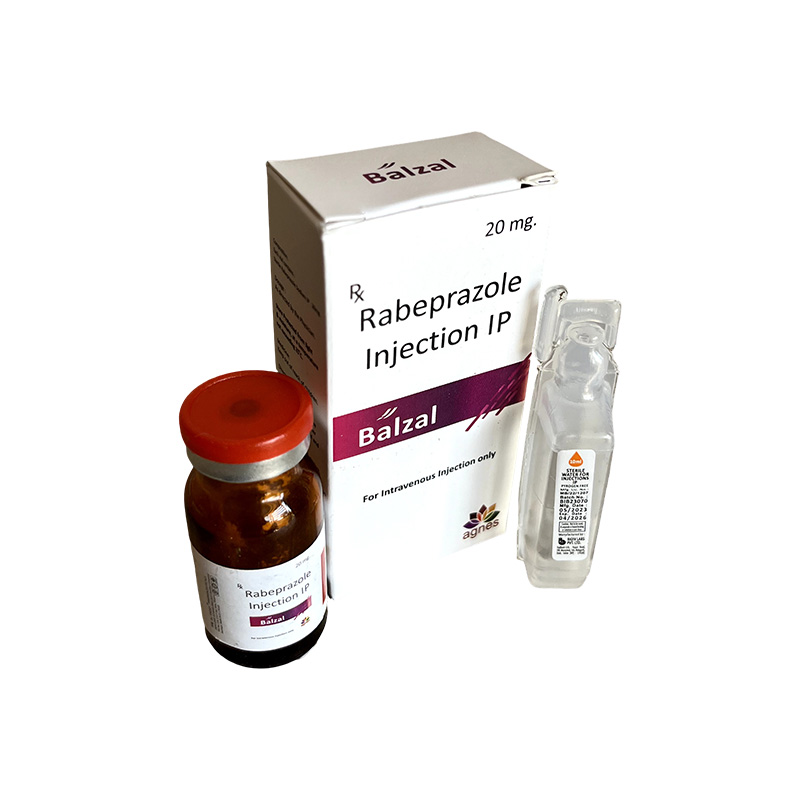
BALZAL-20
COMPOSITION
Rabeprazole sodium 20 mg (Injection)
Category
Antacid, Proton Pump Inhibitor
| Packing |
|---|
SKU
c32c775e6cb6
Categories AGNES, INJECTABLES, Injection
ENQUIRY
Indications
BALZAL-20 is an intravenous antacid injection that works by reducing the amount of acid the stomach produces. It belongs to a group of medicines called proton pump inhibitors (PPIs). It is used in hospitals when patients need fast acid control and cannot take medicine by mouth. It is prescribed for:
Acute Gastric Ulcers: Treats active ulcers in the stomach by lowering acid levels and giving the damaged stomach lining a chance to heal properly.
GERD (Acid Reflux Disease): Used when gastroesophageal reflux is causing serious symptoms and oral medication is either not possible or not working fast enough.
Stress Ulcer Prevention: Critically ill patients, those in the ICU, or patients recovering from major surgery are at risk of developing stomach ulcers due to physical stress. BALZAL-20 is used to prevent this.
Acid Control in Critically Ill Patients: Keeps stomach acid levels under control in patients who are on ventilators, receiving IV nutrition, or dealing with serious health conditions.
NSAID-Induced Gastritis: Patients who need to take pain killers or anti-inflammatory medicines for long periods can develop stomach irritation. BALZAL-20 protects the stomach lining in such cases.
Quick IV Acidity Control: Used when fast-acting acid suppression is needed — the injection form works much quicker than oral tablets, making it the preferred choice in urgent or hospital settings.
Erosive Esophagitis: Treats damage to the food pipe lining caused by repeated acid exposure over time.
Zollinger-Ellison Syndrome: A rare condition where the stomach makes far too much acid — BALZAL-20 helps bring it under control effectively.
Acute Gastric Ulcers: Treats active ulcers in the stomach by lowering acid levels and giving the damaged stomach lining a chance to heal properly.
GERD (Acid Reflux Disease): Used when gastroesophageal reflux is causing serious symptoms and oral medication is either not possible or not working fast enough.
Stress Ulcer Prevention: Critically ill patients, those in the ICU, or patients recovering from major surgery are at risk of developing stomach ulcers due to physical stress. BALZAL-20 is used to prevent this.
Acid Control in Critically Ill Patients: Keeps stomach acid levels under control in patients who are on ventilators, receiving IV nutrition, or dealing with serious health conditions.
NSAID-Induced Gastritis: Patients who need to take pain killers or anti-inflammatory medicines for long periods can develop stomach irritation. BALZAL-20 protects the stomach lining in such cases.
Quick IV Acidity Control: Used when fast-acting acid suppression is needed — the injection form works much quicker than oral tablets, making it the preferred choice in urgent or hospital settings.
Erosive Esophagitis: Treats damage to the food pipe lining caused by repeated acid exposure over time.
Zollinger-Ellison Syndrome: A rare condition where the stomach makes far too much acid — BALZAL-20 helps bring it under control effectively.
Uses
BALZAL-20 contains Rabeprazole Sodium, a proton pump inhibitor that works by blocking the acid-producing pumps in the stomach lining. Think of it as switching off the main source of acid — the stomach simply stops producing as much, which gives ulcers and irritated tissue the chance to heal. As an injection, it gets into the system faster than tablets and is especially useful in hospital situations where every hour matters.
Treats Acute Gastric Ulcers and GERD: By cutting down acid production, it relieves burning, pain, and discomfort and allows the gut lining to recover.
Used in Stress Ulcer Prevention: Protects the stomach of critically ill patients from developing new ulcers during their hospital stay.
Controls Acid in Critically Ill Patients: Helps maintain safe stomach acid levels in patients who are too unwell to eat or take oral medicines.
Used in NSAID-Induced Gastritis: Provides a protective effect for patients who are on regular anti-inflammatory or pain-relief medicines that can irritate the gut.
Quick IV Acid Control: The injectable form acts faster than oral tablets — important when symptoms are severe or the patient is not able to swallow medicines.
Supports Healing: Lower acid levels create a better environment for the stomach and food pipe lining to repair itself naturally without ongoing damage.
Treats Acute Gastric Ulcers and GERD: By cutting down acid production, it relieves burning, pain, and discomfort and allows the gut lining to recover.
Used in Stress Ulcer Prevention: Protects the stomach of critically ill patients from developing new ulcers during their hospital stay.
Controls Acid in Critically Ill Patients: Helps maintain safe stomach acid levels in patients who are too unwell to eat or take oral medicines.
Used in NSAID-Induced Gastritis: Provides a protective effect for patients who are on regular anti-inflammatory or pain-relief medicines that can irritate the gut.
Quick IV Acid Control: The injectable form acts faster than oral tablets — important when symptoms are severe or the patient is not able to swallow medicines.
Supports Healing: Lower acid levels create a better environment for the stomach and food pipe lining to repair itself naturally without ongoing damage.
Dosage & Storage
Dosage: The dose and how often it is given are decided by the treating doctor based on the patient’s condition, diagnosis, and how they are responding to treatment.
Route of Administration: Given only as a slow intravenous (IV) injection by a qualified doctor or nurse. Must not be given by IM injection or taken orally.
Reconstitution: The vial contains a dry powder that needs to be dissolved in the right amount of sterile water for injection before it is given. Always follow the preparation instructions from the healthcare team.
Storage: Store the dry vial at room temperature between 15°C and 30°C, in a cool and dry place away from moisture.
Protect from Light: Keep in the original packaging and away from direct sunlight or heat.
After Mixing: Use the prepared solution right away. Do not prepare in advance and store for later use.
Single Use Only: Each vial is for one-time use. Discard any remaining solution after the prescribed dose has been given.
Keep Away from Children: Store in a safe place out of the reach of children and pets at all times.
Route of Administration: Given only as a slow intravenous (IV) injection by a qualified doctor or nurse. Must not be given by IM injection or taken orally.
Reconstitution: The vial contains a dry powder that needs to be dissolved in the right amount of sterile water for injection before it is given. Always follow the preparation instructions from the healthcare team.
Storage: Store the dry vial at room temperature between 15°C and 30°C, in a cool and dry place away from moisture.
Protect from Light: Keep in the original packaging and away from direct sunlight or heat.
After Mixing: Use the prepared solution right away. Do not prepare in advance and store for later use.
Single Use Only: Each vial is for one-time use. Discard any remaining solution after the prescribed dose has been given.
Keep Away from Children: Store in a safe place out of the reach of children and pets at all times.
Directions For Use
Hospital or Clinical Setting Only: BALZAL-20 must be prepared and administered by a trained medical professional in a hospital or clinical environment. It is not for home use.
Do Not Self-Administer: Never attempt to give this injection at home or without medical supervision.
Check Before Administration: After mixing, the solution should be clear and free from any floating particles or unusual color. Do not use if it looks cloudy or discolored.
Administer Slowly: Give the injection as a slow IV push or infusion over the time period recommended by the doctor. Rushing the administration can cause unwanted reactions.
Follow the Full Course: Do not stop the treatment on your own, even if you start feeling better. Your doctor will decide when to stop or switch to oral medicine.
Switching to Oral Tablets: Once the patient is well enough to swallow medicines, the doctor will usually move them from the injection to an oral Rabeprazole tablet to continue treatment.
Missed Dose: If a hospital dose is missed or delayed, inform the nurse or doctor. Do not try to make up for it by giving two doses at once.
Do Not Self-Administer: Never attempt to give this injection at home or without medical supervision.
Check Before Administration: After mixing, the solution should be clear and free from any floating particles or unusual color. Do not use if it looks cloudy or discolored.
Administer Slowly: Give the injection as a slow IV push or infusion over the time period recommended by the doctor. Rushing the administration can cause unwanted reactions.
Follow the Full Course: Do not stop the treatment on your own, even if you start feeling better. Your doctor will decide when to stop or switch to oral medicine.
Switching to Oral Tablets: Once the patient is well enough to swallow medicines, the doctor will usually move them from the injection to an oral Rabeprazole tablet to continue treatment.
Missed Dose: If a hospital dose is missed or delayed, inform the nurse or doctor. Do not try to make up for it by giving two doses at once.
Precautions
Before starting BALZAL-20, your doctor should know about the following:
Allergy to PPIs: Do not use if you have had a reaction to Rabeprazole or any other proton pump inhibitor like Omeprazole, Pantoprazole, or Lansoprazole.
Liver Problems: Rabeprazole is processed by the liver. Patients with serious liver conditions need dose adjustments and regular monitoring during treatment.
Low Magnesium Levels: Long-term use of proton pump inhibitors can gradually reduce magnesium levels in the blood. Your doctor may check this with a blood test if treatment continues for a long time.
Bone Health: Extended use of PPIs may slightly increase the risk of fractures, especially in older patients or those with weak bones. Inform your doctor if this is a concern.
Vitamin B12 Absorption: Long-term acid suppression can make it harder for the body to absorb Vitamin B12 from food. This will be monitored if treatment is extended.
Gut Infections: Reducing stomach acid over a long period can raise the risk of certain bacterial infections in the gut. Report any prolonged or severe diarrhea to your doctor immediately.
Pregnancy & Breastfeeding: Use only if the doctor considers it clearly necessary and prescribes it during pregnancy or while nursing.
Other Medicines: Tell your doctor about all medicines you are taking, especially blood thinners, antifungal medicines, or HIV drugs, as Rabeprazole can interact with some of them.
Allergy to PPIs: Do not use if you have had a reaction to Rabeprazole or any other proton pump inhibitor like Omeprazole, Pantoprazole, or Lansoprazole.
Liver Problems: Rabeprazole is processed by the liver. Patients with serious liver conditions need dose adjustments and regular monitoring during treatment.
Low Magnesium Levels: Long-term use of proton pump inhibitors can gradually reduce magnesium levels in the blood. Your doctor may check this with a blood test if treatment continues for a long time.
Bone Health: Extended use of PPIs may slightly increase the risk of fractures, especially in older patients or those with weak bones. Inform your doctor if this is a concern.
Vitamin B12 Absorption: Long-term acid suppression can make it harder for the body to absorb Vitamin B12 from food. This will be monitored if treatment is extended.
Gut Infections: Reducing stomach acid over a long period can raise the risk of certain bacterial infections in the gut. Report any prolonged or severe diarrhea to your doctor immediately.
Pregnancy & Breastfeeding: Use only if the doctor considers it clearly necessary and prescribes it during pregnancy or while nursing.
Other Medicines: Tell your doctor about all medicines you are taking, especially blood thinners, antifungal medicines, or HIV drugs, as Rabeprazole can interact with some of them.
Side Effects
Headache
Diarrhea
Dizziness
Injection site irritation
Flatulence
Diarrhea
Dizziness
Injection site irritation
Flatulence
Medical Disclaimer
The information provided here is for educational and informational purposes only and is not a substitute for professional medical advice.
Always consult a healthcare professional for medical advice, diagnosis, or treatment.
BALZAL-20 is a prescription-only injectable and must be used strictly under the supervision of a licensed medical professional. Agnes Life Sciences does not claim that this or any of its products can diagnose, treat, cure, or prevent any disease.
Always consult a healthcare professional for medical advice, diagnosis, or treatment.
BALZAL-20 is a prescription-only injectable and must be used strictly under the supervision of a licensed medical professional. Agnes Life Sciences does not claim that this or any of its products can diagnose, treat, cure, or prevent any disease.
Indications
BALZAL-20 is an intravenous antacid injection that works by reducing the amount of acid the stomach produces. It belongs to a group of medicines called proton pump inhibitors (PPIs). It is used in hospitals when patients need fast acid control and cannot take medicine by mouth. It is prescribed for:
Acute Gastric Ulcers: Treats active ulcers in the stomach by lowering acid levels and giving the damaged stomach lining a chance to heal properly.
GERD (Acid Reflux Disease): Used when gastroesophageal reflux is causing serious symptoms and oral medication is either not possible or not working fast enough.
Stress Ulcer Prevention: Critically ill patients, those in the ICU, or patients recovering from major surgery are at risk of developing stomach ulcers due to physical stress. BALZAL-20 is used to prevent this.
Acid Control in Critically Ill Patients: Keeps stomach acid levels under control in patients who are on ventilators, receiving IV nutrition, or dealing with serious health conditions.
NSAID-Induced Gastritis: Patients who need to take pain killers or anti-inflammatory medicines for long periods can develop stomach irritation. BALZAL-20 protects the stomach lining in such cases.
Quick IV Acidity Control: Used when fast-acting acid suppression is needed — the injection form works much quicker than oral tablets, making it the preferred choice in urgent or hospital settings.
Erosive Esophagitis: Treats damage to the food pipe lining caused by repeated acid exposure over time.
Zollinger-Ellison Syndrome: A rare condition where the stomach makes far too much acid — BALZAL-20 helps bring it under control effectively.
Acute Gastric Ulcers: Treats active ulcers in the stomach by lowering acid levels and giving the damaged stomach lining a chance to heal properly.
GERD (Acid Reflux Disease): Used when gastroesophageal reflux is causing serious symptoms and oral medication is either not possible or not working fast enough.
Stress Ulcer Prevention: Critically ill patients, those in the ICU, or patients recovering from major surgery are at risk of developing stomach ulcers due to physical stress. BALZAL-20 is used to prevent this.
Acid Control in Critically Ill Patients: Keeps stomach acid levels under control in patients who are on ventilators, receiving IV nutrition, or dealing with serious health conditions.
NSAID-Induced Gastritis: Patients who need to take pain killers or anti-inflammatory medicines for long periods can develop stomach irritation. BALZAL-20 protects the stomach lining in such cases.
Quick IV Acidity Control: Used when fast-acting acid suppression is needed — the injection form works much quicker than oral tablets, making it the preferred choice in urgent or hospital settings.
Erosive Esophagitis: Treats damage to the food pipe lining caused by repeated acid exposure over time.
Zollinger-Ellison Syndrome: A rare condition where the stomach makes far too much acid — BALZAL-20 helps bring it under control effectively.
Uses
BALZAL-20 contains Rabeprazole Sodium, a proton pump inhibitor that works by blocking the acid-producing pumps in the stomach lining. Think of it as switching off the main source of acid — the stomach simply stops producing as much, which gives ulcers and irritated tissue the chance to heal. As an injection, it gets into the system faster than tablets and is especially useful in hospital situations where every hour matters.
Treats Acute Gastric Ulcers and GERD: By cutting down acid production, it relieves burning, pain, and discomfort and allows the gut lining to recover.
Used in Stress Ulcer Prevention: Protects the stomach of critically ill patients from developing new ulcers during their hospital stay.
Controls Acid in Critically Ill Patients: Helps maintain safe stomach acid levels in patients who are too unwell to eat or take oral medicines.
Used in NSAID-Induced Gastritis: Provides a protective effect for patients who are on regular anti-inflammatory or pain-relief medicines that can irritate the gut.
Quick IV Acid Control: The injectable form acts faster than oral tablets — important when symptoms are severe or the patient is not able to swallow medicines.
Supports Healing: Lower acid levels create a better environment for the stomach and food pipe lining to repair itself naturally without ongoing damage.
Treats Acute Gastric Ulcers and GERD: By cutting down acid production, it relieves burning, pain, and discomfort and allows the gut lining to recover.
Used in Stress Ulcer Prevention: Protects the stomach of critically ill patients from developing new ulcers during their hospital stay.
Controls Acid in Critically Ill Patients: Helps maintain safe stomach acid levels in patients who are too unwell to eat or take oral medicines.
Used in NSAID-Induced Gastritis: Provides a protective effect for patients who are on regular anti-inflammatory or pain-relief medicines that can irritate the gut.
Quick IV Acid Control: The injectable form acts faster than oral tablets — important when symptoms are severe or the patient is not able to swallow medicines.
Supports Healing: Lower acid levels create a better environment for the stomach and food pipe lining to repair itself naturally without ongoing damage.
Dosage & Storage
Dosage: The dose and how often it is given are decided by the treating doctor based on the patient’s condition, diagnosis, and how they are responding to treatment.
Route of Administration: Given only as a slow intravenous (IV) injection by a qualified doctor or nurse. Must not be given by IM injection or taken orally.
Reconstitution: The vial contains a dry powder that needs to be dissolved in the right amount of sterile water for injection before it is given. Always follow the preparation instructions from the healthcare team.
Storage: Store the dry vial at room temperature between 15°C and 30°C, in a cool and dry place away from moisture.
Protect from Light: Keep in the original packaging and away from direct sunlight or heat.
After Mixing: Use the prepared solution right away. Do not prepare in advance and store for later use.
Single Use Only: Each vial is for one-time use. Discard any remaining solution after the prescribed dose has been given.
Keep Away from Children: Store in a safe place out of the reach of children and pets at all times.
Route of Administration: Given only as a slow intravenous (IV) injection by a qualified doctor or nurse. Must not be given by IM injection or taken orally.
Reconstitution: The vial contains a dry powder that needs to be dissolved in the right amount of sterile water for injection before it is given. Always follow the preparation instructions from the healthcare team.
Storage: Store the dry vial at room temperature between 15°C and 30°C, in a cool and dry place away from moisture.
Protect from Light: Keep in the original packaging and away from direct sunlight or heat.
After Mixing: Use the prepared solution right away. Do not prepare in advance and store for later use.
Single Use Only: Each vial is for one-time use. Discard any remaining solution after the prescribed dose has been given.
Keep Away from Children: Store in a safe place out of the reach of children and pets at all times.
Directions For Use
Hospital or Clinical Setting Only: BALZAL-20 must be prepared and administered by a trained medical professional in a hospital or clinical environment. It is not for home use.
Do Not Self-Administer: Never attempt to give this injection at home or without medical supervision.
Check Before Administration: After mixing, the solution should be clear and free from any floating particles or unusual color. Do not use if it looks cloudy or discolored.
Administer Slowly: Give the injection as a slow IV push or infusion over the time period recommended by the doctor. Rushing the administration can cause unwanted reactions.
Follow the Full Course: Do not stop the treatment on your own, even if you start feeling better. Your doctor will decide when to stop or switch to oral medicine.
Switching to Oral Tablets: Once the patient is well enough to swallow medicines, the doctor will usually move them from the injection to an oral Rabeprazole tablet to continue treatment.
Missed Dose: If a hospital dose is missed or delayed, inform the nurse or doctor. Do not try to make up for it by giving two doses at once.
Do Not Self-Administer: Never attempt to give this injection at home or without medical supervision.
Check Before Administration: After mixing, the solution should be clear and free from any floating particles or unusual color. Do not use if it looks cloudy or discolored.
Administer Slowly: Give the injection as a slow IV push or infusion over the time period recommended by the doctor. Rushing the administration can cause unwanted reactions.
Follow the Full Course: Do not stop the treatment on your own, even if you start feeling better. Your doctor will decide when to stop or switch to oral medicine.
Switching to Oral Tablets: Once the patient is well enough to swallow medicines, the doctor will usually move them from the injection to an oral Rabeprazole tablet to continue treatment.
Missed Dose: If a hospital dose is missed or delayed, inform the nurse or doctor. Do not try to make up for it by giving two doses at once.
Precautions
Before starting BALZAL-20, your doctor should know about the following:
Allergy to PPIs: Do not use if you have had a reaction to Rabeprazole or any other proton pump inhibitor like Omeprazole, Pantoprazole, or Lansoprazole.
Liver Problems: Rabeprazole is processed by the liver. Patients with serious liver conditions need dose adjustments and regular monitoring during treatment.
Low Magnesium Levels: Long-term use of proton pump inhibitors can gradually reduce magnesium levels in the blood. Your doctor may check this with a blood test if treatment continues for a long time.
Bone Health: Extended use of PPIs may slightly increase the risk of fractures, especially in older patients or those with weak bones. Inform your doctor if this is a concern.
Vitamin B12 Absorption: Long-term acid suppression can make it harder for the body to absorb Vitamin B12 from food. This will be monitored if treatment is extended.
Gut Infections: Reducing stomach acid over a long period can raise the risk of certain bacterial infections in the gut. Report any prolonged or severe diarrhea to your doctor immediately.
Pregnancy & Breastfeeding: Use only if the doctor considers it clearly necessary and prescribes it during pregnancy or while nursing.
Other Medicines: Tell your doctor about all medicines you are taking, especially blood thinners, antifungal medicines, or HIV drugs, as Rabeprazole can interact with some of them.
Allergy to PPIs: Do not use if you have had a reaction to Rabeprazole or any other proton pump inhibitor like Omeprazole, Pantoprazole, or Lansoprazole.
Liver Problems: Rabeprazole is processed by the liver. Patients with serious liver conditions need dose adjustments and regular monitoring during treatment.
Low Magnesium Levels: Long-term use of proton pump inhibitors can gradually reduce magnesium levels in the blood. Your doctor may check this with a blood test if treatment continues for a long time.
Bone Health: Extended use of PPIs may slightly increase the risk of fractures, especially in older patients or those with weak bones. Inform your doctor if this is a concern.
Vitamin B12 Absorption: Long-term acid suppression can make it harder for the body to absorb Vitamin B12 from food. This will be monitored if treatment is extended.
Gut Infections: Reducing stomach acid over a long period can raise the risk of certain bacterial infections in the gut. Report any prolonged or severe diarrhea to your doctor immediately.
Pregnancy & Breastfeeding: Use only if the doctor considers it clearly necessary and prescribes it during pregnancy or while nursing.
Other Medicines: Tell your doctor about all medicines you are taking, especially blood thinners, antifungal medicines, or HIV drugs, as Rabeprazole can interact with some of them.
Side Effects
Headache
Diarrhea
Dizziness
Injection site irritation
Flatulence
Diarrhea
Dizziness
Injection site irritation
Flatulence
Medical Disclaimer
The information provided here is for educational and informational purposes only and is not a substitute for professional medical advice.
Always consult a healthcare professional for medical advice, diagnosis, or treatment.
BALZAL-20 is a prescription-only injectable and must be used strictly under the supervision of a licensed medical professional. Agnes Life Sciences does not claim that this or any of its products can diagnose, treat, cure, or prevent any disease.
Always consult a healthcare professional for medical advice, diagnosis, or treatment.
BALZAL-20 is a prescription-only injectable and must be used strictly under the supervision of a licensed medical professional. Agnes Life Sciences does not claim that this or any of its products can diagnose, treat, cure, or prevent any disease.