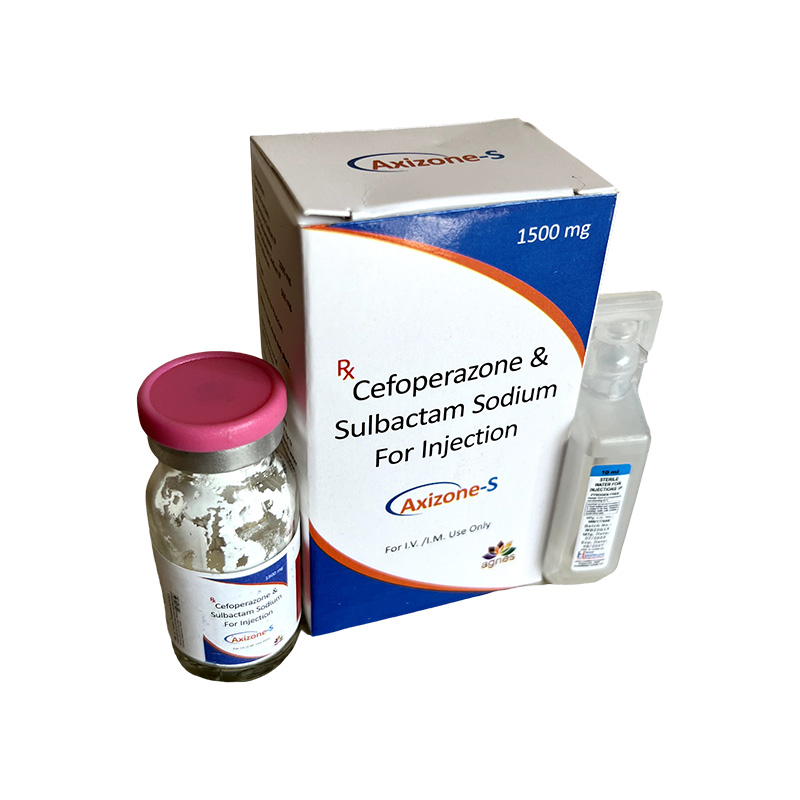
AXIZONE-S
COMPOSITION
Cefoperazone 1000 mg + Sulbactam 500 mg (Injection)
Category
Antibiotic, Cephalosporin +lactamase Inhibitor
| Packing |
|---|
SKU
b7b664236200
Categories AGNES, INJECTABLES, Injection
ENQUIRY
Indications
AXIZONE-S is a combination antibiotic injection that doctors use when the infection is serious and the bacteria causing it have already started to resist standard treatment. What makes this combination special is Sulbactam — it takes away the one thing bacteria rely on to protect themselves from antibiotics. Once that defence is gone, Cefoperazone can get in and do its work. This injection is used only in hospitals and is prescribed for:
Multi-Drug Resistant Infections: When bacteria have stopped responding to most of the antibiotics that doctors would normally try first, this combination is one of the options they turn to next. It is specifically designed for situations where resistance is already a problem.
Stomach and Abdominal Infections: Infections inside the abdomen, whether it is after a surgery, peritonitis, a gut infection, or any bacterial problem in the stomach area. AXIZONE-S covers the bacteria commonly responsible for these conditions.
Gynaecological Infections: Pelvic inflammatory disease, infections of the uterus or fallopian tubes, and bacterial infections that develop after gynaecological surgeries. Commonly prescribed by gynaecologists in hospital settings.
Serious Lung Infections: Severe pneumonia and lower respiratory tract infections — especially in patients who are already admitted in hospital and have already been given simpler antibiotics that have not helped enough. Skin and Soft Tissue Infections: Deep wound infections, complicated skin infections, and tissue infections caused by resistant bacteria that did not clear with first-line treatment.
Complicated Urinary Tract Infections: Used when the bacteria in the urinary tract have already become resistant to the antibiotics usually prescribed for UTIs.
Septicemia (Blood Infection): When bacteria get into the bloodstream, the patient needs fast and effective antibiotic coverage. AXIZONE-S is used as part of the treatment in these serious situations.
ICU Infections: Patients in the ICU are dealing with some of the most resistant bacteria found anywhere in a hospital. This combination is a trusted option in critical care settings across India and worldwide.
Multi-Drug Resistant Infections: When bacteria have stopped responding to most of the antibiotics that doctors would normally try first, this combination is one of the options they turn to next. It is specifically designed for situations where resistance is already a problem.
Stomach and Abdominal Infections: Infections inside the abdomen, whether it is after a surgery, peritonitis, a gut infection, or any bacterial problem in the stomach area. AXIZONE-S covers the bacteria commonly responsible for these conditions.
Gynaecological Infections: Pelvic inflammatory disease, infections of the uterus or fallopian tubes, and bacterial infections that develop after gynaecological surgeries. Commonly prescribed by gynaecologists in hospital settings.
Serious Lung Infections: Severe pneumonia and lower respiratory tract infections — especially in patients who are already admitted in hospital and have already been given simpler antibiotics that have not helped enough. Skin and Soft Tissue Infections: Deep wound infections, complicated skin infections, and tissue infections caused by resistant bacteria that did not clear with first-line treatment.
Complicated Urinary Tract Infections: Used when the bacteria in the urinary tract have already become resistant to the antibiotics usually prescribed for UTIs.
Septicemia (Blood Infection): When bacteria get into the bloodstream, the patient needs fast and effective antibiotic coverage. AXIZONE-S is used as part of the treatment in these serious situations.
ICU Infections: Patients in the ICU are dealing with some of the most resistant bacteria found anywhere in a hospital. This combination is a trusted option in critical care settings across India and worldwide.
Uses
AXIZONE-S puts two medicines to work at the same time — Cefoperazone and Sulbactam. Each one plays its own role. Cefoperazone goes after the outer wall of the bacteria. Once that wall is broken, the bacteria cannot survive or reproduce. But some bacteria have learned to protect themselves by producing enzymes that break down antibiotics before they can reach the wall. That is where Sulbactam comes in — it blocks those enzymes completely. And Sulbactam does not just sit there as a protector — it also has some antibacterial activity of its own. So this combination hits the bacteria from two directions at once.
Works When Other Antibiotics Have Failed: The combination covers bacteria that have developed resistance to many common antibiotics. That is exactly the kind of situation this medicine was built for — and why it is found in ICUs and critical care wards.
Covers Abdominal and Gynaecological Infections: The bacteria most commonly responsible for stomach infections and infections in the female reproductive system are well within the coverage of this combination.
Wide Bacterial Coverage: Works against gram-negative bacteria, gram-positive bacteria, and anaerobic bacteria — including organisms that survive without oxygen. This matters in deep or mixed infections where more than one type of bacteria is present at the same time.
Trusted in Critical Care: Because of its strength and wide coverage, AXIZONE-S is regularly used in ICUs and hospital wards where patients are the sickest, and the bacteria are the most resistant.
Reaches Infected Tissue Well: Gets deep into soft tissue and wound areas, helping clear out bacterial infection in complicated skin and wound cases.
Sulbactam’s Double Role: Most people think of Sulbactam only as something that protects the antibiotic. But it also has its own antibacterial action, which means this combination is stronger together than either medicine would ever be when used alone.
Works When Other Antibiotics Have Failed: The combination covers bacteria that have developed resistance to many common antibiotics. That is exactly the kind of situation this medicine was built for — and why it is found in ICUs and critical care wards.
Covers Abdominal and Gynaecological Infections: The bacteria most commonly responsible for stomach infections and infections in the female reproductive system are well within the coverage of this combination.
Wide Bacterial Coverage: Works against gram-negative bacteria, gram-positive bacteria, and anaerobic bacteria — including organisms that survive without oxygen. This matters in deep or mixed infections where more than one type of bacteria is present at the same time.
Trusted in Critical Care: Because of its strength and wide coverage, AXIZONE-S is regularly used in ICUs and hospital wards where patients are the sickest, and the bacteria are the most resistant.
Reaches Infected Tissue Well: Gets deep into soft tissue and wound areas, helping clear out bacterial infection in complicated skin and wound cases.
Sulbactam’s Double Role: Most people think of Sulbactam only as something that protects the antibiotic. But it also has its own antibacterial action, which means this combination is stronger together than either medicine would ever be when used alone.
Dosage & Storage
Dosage: The treating doctor works out the right dose based on the type of infection, how bad it is, and the patient’s age, weight, and how well their kidneys and liver are functioning. The dose is not the same for every patient.
How It Is Given: Through a vein (IV) or into a muscle (IM) by a qualified doctor or nurse in a hospital or clinic. This injection is never given at home.
Preparation: The powder in the vial needs to be mixed with the right liquid before it is given. The hospital pharmacy or nursing team handles the preparation — always following the exact steps for that specific vial.
Storage: Store the dry vial at room temperature — between 15°C and 30°C — in a cool, dry place away from moisture and damp.
Light Protection: Keep in the original carton. Direct sunlight and heat can degrade the medicine over time.
After mixing: Once prepared, use the solution within the time recommended. Do not mix it ahead of time and store it for later unless specifically told to do so.
Keep Away from Children and Pets: Store in a place that is completely out of their reach at all times.
How It Is Given: Through a vein (IV) or into a muscle (IM) by a qualified doctor or nurse in a hospital or clinic. This injection is never given at home.
Preparation: The powder in the vial needs to be mixed with the right liquid before it is given. The hospital pharmacy or nursing team handles the preparation — always following the exact steps for that specific vial.
Storage: Store the dry vial at room temperature — between 15°C and 30°C — in a cool, dry place away from moisture and damp.
Light Protection: Keep in the original carton. Direct sunlight and heat can degrade the medicine over time.
After mixing: Once prepared, use the solution within the time recommended. Do not mix it ahead of time and store it for later unless specifically told to do so.
Keep Away from Children and Pets: Store in a place that is completely out of their reach at all times.
Directions For Use
For Hospital Use Only: AXIZONE-S is given only inside a hospital or clinical setting by a trained medical professional. This is not something that can be done at home — not under any circumstances.
Never Try to Give It Yourself: The injection is always prepared and administered by a qualified nurse or doctor. A patient should never attempt to do this on their own.
Always Check the Solution First: After the powder is mixed and ready, look at the solution carefully before giving it. It should be completely clear — no cloudiness, no particles floating in it, no colour that looks wrong. If anything looks different from what it should, do not use it. Inform the nurse or pharmacist right away.
Finish Everything the Doctor Prescribed: Patients often start feeling better after just two or three doses — and that is a good sign. But feeling better does not mean the bacteria are fully gone. The ones that are still alive inside the body have just gone quiet. Stop the injection early, and they come back — often in a form that is much harder to treat the second time. Always complete the full course.
Keep the Doses at Regular Times: Doses should be spaced evenly through the day. This keeps the level of antibiotic in the bloodstream steady — which is what makes the treatment effective. Irregular timing reduces how well it works.
If a Dose Is Missed: Tell the doctor or nurse immediately. Never try to give two doses together to make up for one that was skipped. That can cause problems.
Alcohol Is Strictly Off-Limits: No alcohol during the treatment course and for at least 72 hours — that is 3 full days — after the last dose. Cefoperazone reacts with alcohol inside the body and can cause face flushing, fast heartbeat, nausea, and a sudden dangerous drop in blood pressure. This is not just a mild warning. It is a reaction patients and their families need to know about and take seriously.
Never Try to Give It Yourself: The injection is always prepared and administered by a qualified nurse or doctor. A patient should never attempt to do this on their own.
Always Check the Solution First: After the powder is mixed and ready, look at the solution carefully before giving it. It should be completely clear — no cloudiness, no particles floating in it, no colour that looks wrong. If anything looks different from what it should, do not use it. Inform the nurse or pharmacist right away.
Finish Everything the Doctor Prescribed: Patients often start feeling better after just two or three doses — and that is a good sign. But feeling better does not mean the bacteria are fully gone. The ones that are still alive inside the body have just gone quiet. Stop the injection early, and they come back — often in a form that is much harder to treat the second time. Always complete the full course.
Keep the Doses at Regular Times: Doses should be spaced evenly through the day. This keeps the level of antibiotic in the bloodstream steady — which is what makes the treatment effective. Irregular timing reduces how well it works.
If a Dose Is Missed: Tell the doctor or nurse immediately. Never try to give two doses together to make up for one that was skipped. That can cause problems.
Alcohol Is Strictly Off-Limits: No alcohol during the treatment course and for at least 72 hours — that is 3 full days — after the last dose. Cefoperazone reacts with alcohol inside the body and can cause face flushing, fast heartbeat, nausea, and a sudden dangerous drop in blood pressure. This is not just a mild warning. It is a reaction patients and their families need to know about and take seriously.
Precautions
Before starting AXIZONE-S, the treating doctor needs to know the following:
Allergy to Antibiotics: Do not start this injection in anyone who is allergic to Cefoperazone, Sulbactam, cephalosporins, penicillin, or any beta-lactam antibiotic. The full allergy history — every reaction the patient has ever had to antibiotics — must be shared before the first dose.
Liver Disease: Cefoperazone is mainly removed from the body through the liver via bile — not through the kidneys. This means patients with liver disease or a blocked bile duct need a reduced dose and regular liver monitoring throughout the treatment. The liver is doing more work with this medicine than it does with most others.
Kidney Problems: Compared to several other antibiotics, AXIZONE-S is actually easier on the kidneys because it does not depend mainly on them for removal. Still, patients with kidney conditions should be kept under medical observation during the course.
Bleeding Risk: In some patients — particularly those who are not eating well or who are on a restricted diet — Cefoperazone can affect how Vitamin K functions in the body. This can slow down blood clotting. Patients who are already on blood thinners need careful and regular monitoring. Any sign of unusual bruising or bleeding should be reported immediately.
Pregnancy and Breastfeeding: Given only when the doctor clearly decides the benefit is greater than the risk. This is never a routine or casual decision — it requires proper medical judgment.
Other Medicines Being Taken: Tell the doctor about everything the patient is currently taking — especially blood thinners, as Cefoperazone can increase their effect and raise bleeding risk. No medicines should be hidden from the treating team.
Sodium in the Injection: AXIZONE-S contains sodium. For patients on a low-sodium diet, or those with heart failure or kidney problems where sodium intake matters, the doctor needs to account for this when planning the treatment.
Allergy to Antibiotics: Do not start this injection in anyone who is allergic to Cefoperazone, Sulbactam, cephalosporins, penicillin, or any beta-lactam antibiotic. The full allergy history — every reaction the patient has ever had to antibiotics — must be shared before the first dose.
Liver Disease: Cefoperazone is mainly removed from the body through the liver via bile — not through the kidneys. This means patients with liver disease or a blocked bile duct need a reduced dose and regular liver monitoring throughout the treatment. The liver is doing more work with this medicine than it does with most others.
Kidney Problems: Compared to several other antibiotics, AXIZONE-S is actually easier on the kidneys because it does not depend mainly on them for removal. Still, patients with kidney conditions should be kept under medical observation during the course.
Bleeding Risk: In some patients — particularly those who are not eating well or who are on a restricted diet — Cefoperazone can affect how Vitamin K functions in the body. This can slow down blood clotting. Patients who are already on blood thinners need careful and regular monitoring. Any sign of unusual bruising or bleeding should be reported immediately.
Pregnancy and Breastfeeding: Given only when the doctor clearly decides the benefit is greater than the risk. This is never a routine or casual decision — it requires proper medical judgment.
Other Medicines Being Taken: Tell the doctor about everything the patient is currently taking — especially blood thinners, as Cefoperazone can increase their effect and raise bleeding risk. No medicines should be hidden from the treating team.
Sodium in the Injection: AXIZONE-S contains sodium. For patients on a low-sodium diet, or those with heart failure or kidney problems where sodium intake matters, the doctor needs to account for this when planning the treatment.
Side Effects
Pain at injection site
Diarrhea
Skin rash
Elevated liver enzymes
Nausea
Diarrhea
Skin rash
Elevated liver enzymes
Nausea
Medical Disclaimer
This page is here to give you a basic understanding of the medicine — nothing more than that. It does not replace your doctor’s advice and it was never meant to.
AXIZONE-S is a prescription-only injectable and must be given only in a proper hospital or clinical setting by a licensed medical professional.
Agnes Life Sciences does not claim that this or any of its products can diagnose, treat, cure, or prevent any disease. For the right diagnosis and treatment plan, please speak directly to your doctor.
AXIZONE-S is a prescription-only injectable and must be given only in a proper hospital or clinical setting by a licensed medical professional.
Agnes Life Sciences does not claim that this or any of its products can diagnose, treat, cure, or prevent any disease. For the right diagnosis and treatment plan, please speak directly to your doctor.
Indications
AXIZONE-S is a combination antibiotic injection that doctors use when the infection is serious and the bacteria causing it have already started to resist standard treatment. What makes this combination special is Sulbactam — it takes away the one thing bacteria rely on to protect themselves from antibiotics. Once that defence is gone, Cefoperazone can get in and do its work. This injection is used only in hospitals and is prescribed for:
Multi-Drug Resistant Infections: When bacteria have stopped responding to most of the antibiotics that doctors would normally try first, this combination is one of the options they turn to next. It is specifically designed for situations where resistance is already a problem.
Stomach and Abdominal Infections: Infections inside the abdomen, whether it is after a surgery, peritonitis, a gut infection, or any bacterial problem in the stomach area. AXIZONE-S covers the bacteria commonly responsible for these conditions.
Gynaecological Infections: Pelvic inflammatory disease, infections of the uterus or fallopian tubes, and bacterial infections that develop after gynaecological surgeries. Commonly prescribed by gynaecologists in hospital settings.
Serious Lung Infections: Severe pneumonia and lower respiratory tract infections — especially in patients who are already admitted in hospital and have already been given simpler antibiotics that have not helped enough. Skin and Soft Tissue Infections: Deep wound infections, complicated skin infections, and tissue infections caused by resistant bacteria that did not clear with first-line treatment.
Complicated Urinary Tract Infections: Used when the bacteria in the urinary tract have already become resistant to the antibiotics usually prescribed for UTIs.
Septicemia (Blood Infection): When bacteria get into the bloodstream, the patient needs fast and effective antibiotic coverage. AXIZONE-S is used as part of the treatment in these serious situations.
ICU Infections: Patients in the ICU are dealing with some of the most resistant bacteria found anywhere in a hospital. This combination is a trusted option in critical care settings across India and worldwide.
Multi-Drug Resistant Infections: When bacteria have stopped responding to most of the antibiotics that doctors would normally try first, this combination is one of the options they turn to next. It is specifically designed for situations where resistance is already a problem.
Stomach and Abdominal Infections: Infections inside the abdomen, whether it is after a surgery, peritonitis, a gut infection, or any bacterial problem in the stomach area. AXIZONE-S covers the bacteria commonly responsible for these conditions.
Gynaecological Infections: Pelvic inflammatory disease, infections of the uterus or fallopian tubes, and bacterial infections that develop after gynaecological surgeries. Commonly prescribed by gynaecologists in hospital settings.
Serious Lung Infections: Severe pneumonia and lower respiratory tract infections — especially in patients who are already admitted in hospital and have already been given simpler antibiotics that have not helped enough. Skin and Soft Tissue Infections: Deep wound infections, complicated skin infections, and tissue infections caused by resistant bacteria that did not clear with first-line treatment.
Complicated Urinary Tract Infections: Used when the bacteria in the urinary tract have already become resistant to the antibiotics usually prescribed for UTIs.
Septicemia (Blood Infection): When bacteria get into the bloodstream, the patient needs fast and effective antibiotic coverage. AXIZONE-S is used as part of the treatment in these serious situations.
ICU Infections: Patients in the ICU are dealing with some of the most resistant bacteria found anywhere in a hospital. This combination is a trusted option in critical care settings across India and worldwide.
Uses
AXIZONE-S puts two medicines to work at the same time — Cefoperazone and Sulbactam. Each one plays its own role. Cefoperazone goes after the outer wall of the bacteria. Once that wall is broken, the bacteria cannot survive or reproduce. But some bacteria have learned to protect themselves by producing enzymes that break down antibiotics before they can reach the wall. That is where Sulbactam comes in — it blocks those enzymes completely. And Sulbactam does not just sit there as a protector — it also has some antibacterial activity of its own. So this combination hits the bacteria from two directions at once.
Works When Other Antibiotics Have Failed: The combination covers bacteria that have developed resistance to many common antibiotics. That is exactly the kind of situation this medicine was built for — and why it is found in ICUs and critical care wards.
Covers Abdominal and Gynaecological Infections: The bacteria most commonly responsible for stomach infections and infections in the female reproductive system are well within the coverage of this combination.
Wide Bacterial Coverage: Works against gram-negative bacteria, gram-positive bacteria, and anaerobic bacteria — including organisms that survive without oxygen. This matters in deep or mixed infections where more than one type of bacteria is present at the same time.
Trusted in Critical Care: Because of its strength and wide coverage, AXIZONE-S is regularly used in ICUs and hospital wards where patients are the sickest, and the bacteria are the most resistant.
Reaches Infected Tissue Well: Gets deep into soft tissue and wound areas, helping clear out bacterial infection in complicated skin and wound cases.
Sulbactam’s Double Role: Most people think of Sulbactam only as something that protects the antibiotic. But it also has its own antibacterial action, which means this combination is stronger together than either medicine would ever be when used alone.
Works When Other Antibiotics Have Failed: The combination covers bacteria that have developed resistance to many common antibiotics. That is exactly the kind of situation this medicine was built for — and why it is found in ICUs and critical care wards.
Covers Abdominal and Gynaecological Infections: The bacteria most commonly responsible for stomach infections and infections in the female reproductive system are well within the coverage of this combination.
Wide Bacterial Coverage: Works against gram-negative bacteria, gram-positive bacteria, and anaerobic bacteria — including organisms that survive without oxygen. This matters in deep or mixed infections where more than one type of bacteria is present at the same time.
Trusted in Critical Care: Because of its strength and wide coverage, AXIZONE-S is regularly used in ICUs and hospital wards where patients are the sickest, and the bacteria are the most resistant.
Reaches Infected Tissue Well: Gets deep into soft tissue and wound areas, helping clear out bacterial infection in complicated skin and wound cases.
Sulbactam’s Double Role: Most people think of Sulbactam only as something that protects the antibiotic. But it also has its own antibacterial action, which means this combination is stronger together than either medicine would ever be when used alone.
Dosage & Storage
Dosage: The treating doctor works out the right dose based on the type of infection, how bad it is, and the patient’s age, weight, and how well their kidneys and liver are functioning. The dose is not the same for every patient.
How It Is Given: Through a vein (IV) or into a muscle (IM) by a qualified doctor or nurse in a hospital or clinic. This injection is never given at home.
Preparation: The powder in the vial needs to be mixed with the right liquid before it is given. The hospital pharmacy or nursing team handles the preparation — always following the exact steps for that specific vial.
Storage: Store the dry vial at room temperature — between 15°C and 30°C — in a cool, dry place away from moisture and damp.
Light Protection: Keep in the original carton. Direct sunlight and heat can degrade the medicine over time.
After mixing: Once prepared, use the solution within the time recommended. Do not mix it ahead of time and store it for later unless specifically told to do so.
Keep Away from Children and Pets: Store in a place that is completely out of their reach at all times.
How It Is Given: Through a vein (IV) or into a muscle (IM) by a qualified doctor or nurse in a hospital or clinic. This injection is never given at home.
Preparation: The powder in the vial needs to be mixed with the right liquid before it is given. The hospital pharmacy or nursing team handles the preparation — always following the exact steps for that specific vial.
Storage: Store the dry vial at room temperature — between 15°C and 30°C — in a cool, dry place away from moisture and damp.
Light Protection: Keep in the original carton. Direct sunlight and heat can degrade the medicine over time.
After mixing: Once prepared, use the solution within the time recommended. Do not mix it ahead of time and store it for later unless specifically told to do so.
Keep Away from Children and Pets: Store in a place that is completely out of their reach at all times.
Directions For Use
For Hospital Use Only: AXIZONE-S is given only inside a hospital or clinical setting by a trained medical professional. This is not something that can be done at home — not under any circumstances.
Never Try to Give It Yourself: The injection is always prepared and administered by a qualified nurse or doctor. A patient should never attempt to do this on their own.
Always Check the Solution First: After the powder is mixed and ready, look at the solution carefully before giving it. It should be completely clear — no cloudiness, no particles floating in it, no colour that looks wrong. If anything looks different from what it should, do not use it. Inform the nurse or pharmacist right away.
Finish Everything the Doctor Prescribed: Patients often start feeling better after just two or three doses — and that is a good sign. But feeling better does not mean the bacteria are fully gone. The ones that are still alive inside the body have just gone quiet. Stop the injection early, and they come back — often in a form that is much harder to treat the second time. Always complete the full course.
Keep the Doses at Regular Times: Doses should be spaced evenly through the day. This keeps the level of antibiotic in the bloodstream steady — which is what makes the treatment effective. Irregular timing reduces how well it works.
If a Dose Is Missed: Tell the doctor or nurse immediately. Never try to give two doses together to make up for one that was skipped. That can cause problems.
Alcohol Is Strictly Off-Limits: No alcohol during the treatment course and for at least 72 hours — that is 3 full days — after the last dose. Cefoperazone reacts with alcohol inside the body and can cause face flushing, fast heartbeat, nausea, and a sudden dangerous drop in blood pressure. This is not just a mild warning. It is a reaction patients and their families need to know about and take seriously.
Never Try to Give It Yourself: The injection is always prepared and administered by a qualified nurse or doctor. A patient should never attempt to do this on their own.
Always Check the Solution First: After the powder is mixed and ready, look at the solution carefully before giving it. It should be completely clear — no cloudiness, no particles floating in it, no colour that looks wrong. If anything looks different from what it should, do not use it. Inform the nurse or pharmacist right away.
Finish Everything the Doctor Prescribed: Patients often start feeling better after just two or three doses — and that is a good sign. But feeling better does not mean the bacteria are fully gone. The ones that are still alive inside the body have just gone quiet. Stop the injection early, and they come back — often in a form that is much harder to treat the second time. Always complete the full course.
Keep the Doses at Regular Times: Doses should be spaced evenly through the day. This keeps the level of antibiotic in the bloodstream steady — which is what makes the treatment effective. Irregular timing reduces how well it works.
If a Dose Is Missed: Tell the doctor or nurse immediately. Never try to give two doses together to make up for one that was skipped. That can cause problems.
Alcohol Is Strictly Off-Limits: No alcohol during the treatment course and for at least 72 hours — that is 3 full days — after the last dose. Cefoperazone reacts with alcohol inside the body and can cause face flushing, fast heartbeat, nausea, and a sudden dangerous drop in blood pressure. This is not just a mild warning. It is a reaction patients and their families need to know about and take seriously.
Precautions
Before starting AXIZONE-S, the treating doctor needs to know the following:
Allergy to Antibiotics: Do not start this injection in anyone who is allergic to Cefoperazone, Sulbactam, cephalosporins, penicillin, or any beta-lactam antibiotic. The full allergy history — every reaction the patient has ever had to antibiotics — must be shared before the first dose.
Liver Disease: Cefoperazone is mainly removed from the body through the liver via bile — not through the kidneys. This means patients with liver disease or a blocked bile duct need a reduced dose and regular liver monitoring throughout the treatment. The liver is doing more work with this medicine than it does with most others.
Kidney Problems: Compared to several other antibiotics, AXIZONE-S is actually easier on the kidneys because it does not depend mainly on them for removal. Still, patients with kidney conditions should be kept under medical observation during the course.
Bleeding Risk: In some patients — particularly those who are not eating well or who are on a restricted diet — Cefoperazone can affect how Vitamin K functions in the body. This can slow down blood clotting. Patients who are already on blood thinners need careful and regular monitoring. Any sign of unusual bruising or bleeding should be reported immediately.
Pregnancy and Breastfeeding: Given only when the doctor clearly decides the benefit is greater than the risk. This is never a routine or casual decision — it requires proper medical judgment.
Other Medicines Being Taken: Tell the doctor about everything the patient is currently taking — especially blood thinners, as Cefoperazone can increase their effect and raise bleeding risk. No medicines should be hidden from the treating team.
Sodium in the Injection: AXIZONE-S contains sodium. For patients on a low-sodium diet, or those with heart failure or kidney problems where sodium intake matters, the doctor needs to account for this when planning the treatment.
Allergy to Antibiotics: Do not start this injection in anyone who is allergic to Cefoperazone, Sulbactam, cephalosporins, penicillin, or any beta-lactam antibiotic. The full allergy history — every reaction the patient has ever had to antibiotics — must be shared before the first dose.
Liver Disease: Cefoperazone is mainly removed from the body through the liver via bile — not through the kidneys. This means patients with liver disease or a blocked bile duct need a reduced dose and regular liver monitoring throughout the treatment. The liver is doing more work with this medicine than it does with most others.
Kidney Problems: Compared to several other antibiotics, AXIZONE-S is actually easier on the kidneys because it does not depend mainly on them for removal. Still, patients with kidney conditions should be kept under medical observation during the course.
Bleeding Risk: In some patients — particularly those who are not eating well or who are on a restricted diet — Cefoperazone can affect how Vitamin K functions in the body. This can slow down blood clotting. Patients who are already on blood thinners need careful and regular monitoring. Any sign of unusual bruising or bleeding should be reported immediately.
Pregnancy and Breastfeeding: Given only when the doctor clearly decides the benefit is greater than the risk. This is never a routine or casual decision — it requires proper medical judgment.
Other Medicines Being Taken: Tell the doctor about everything the patient is currently taking — especially blood thinners, as Cefoperazone can increase their effect and raise bleeding risk. No medicines should be hidden from the treating team.
Sodium in the Injection: AXIZONE-S contains sodium. For patients on a low-sodium diet, or those with heart failure or kidney problems where sodium intake matters, the doctor needs to account for this when planning the treatment.
Side Effects
Pain at injection site
Diarrhea
Skin rash
Elevated liver enzymes
Nausea
Diarrhea
Skin rash
Elevated liver enzymes
Nausea
Medical Disclaimer
This page is here to give you a basic understanding of the medicine — nothing more than that. It does not replace your doctor’s advice and it was never meant to.
AXIZONE-S is a prescription-only injectable and must be given only in a proper hospital or clinical setting by a licensed medical professional.
Agnes Life Sciences does not claim that this or any of its products can diagnose, treat, cure, or prevent any disease. For the right diagnosis and treatment plan, please speak directly to your doctor.
AXIZONE-S is a prescription-only injectable and must be given only in a proper hospital or clinical setting by a licensed medical professional.
Agnes Life Sciences does not claim that this or any of its products can diagnose, treat, cure, or prevent any disease. For the right diagnosis and treatment plan, please speak directly to your doctor.