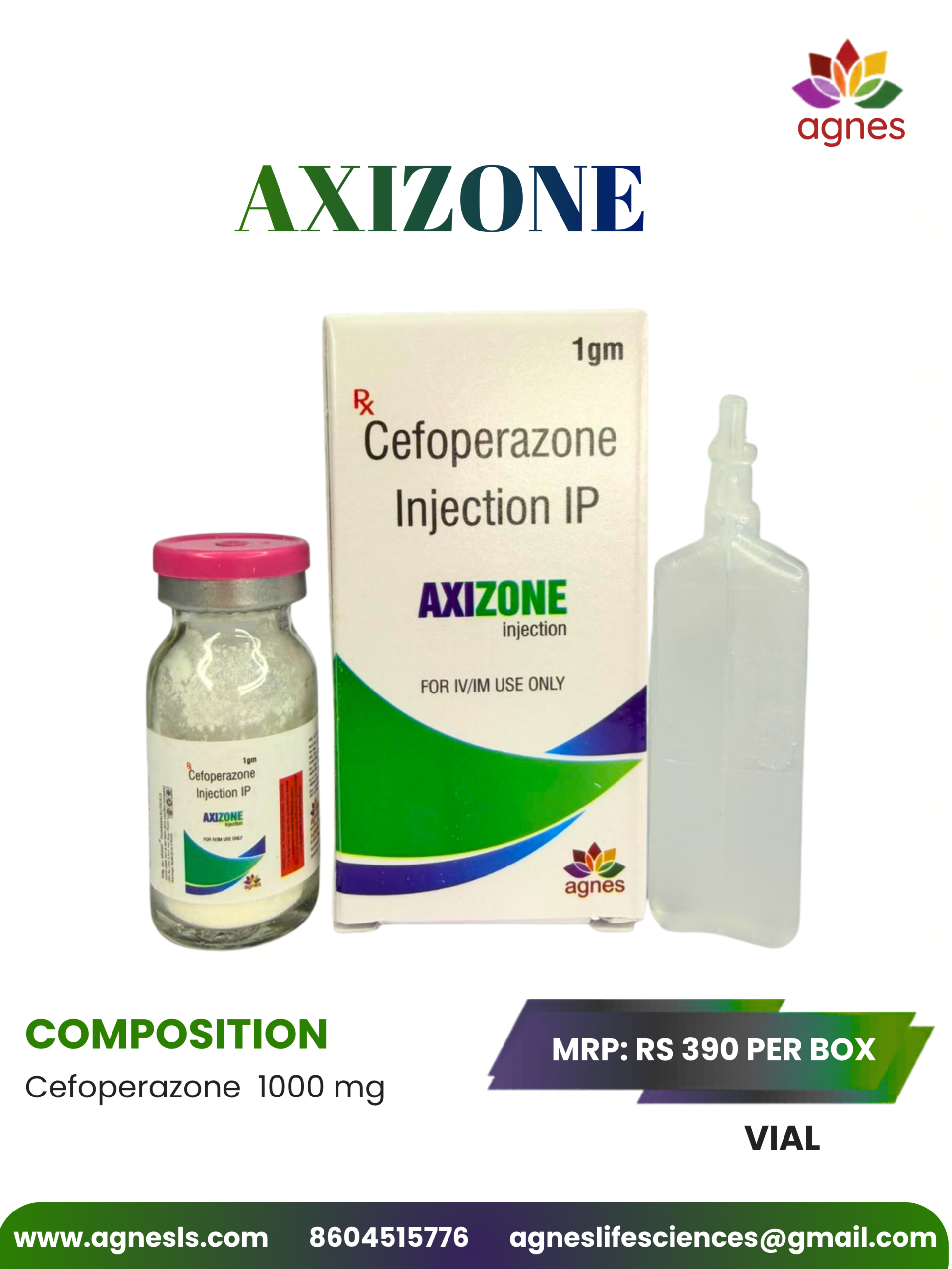
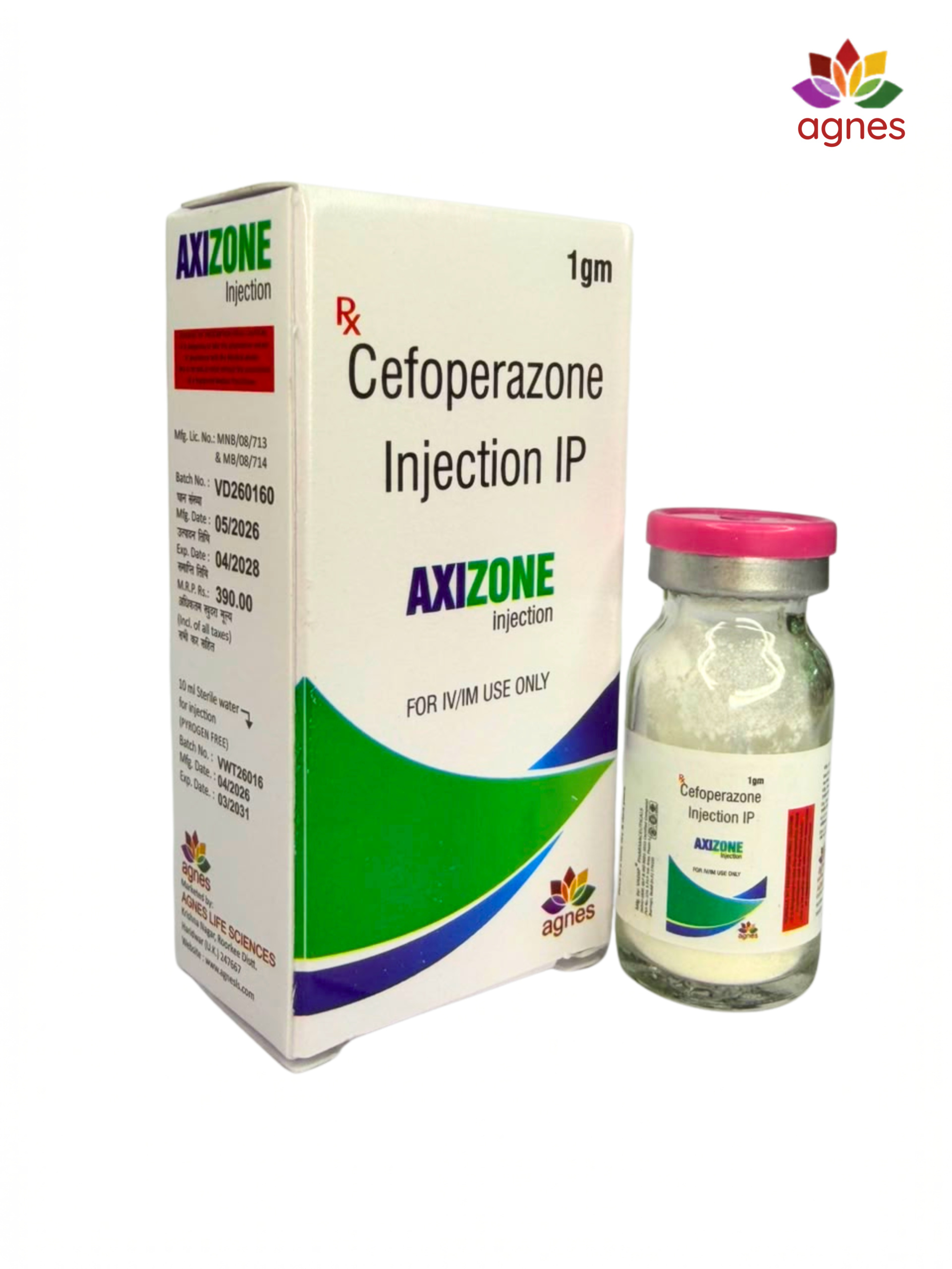
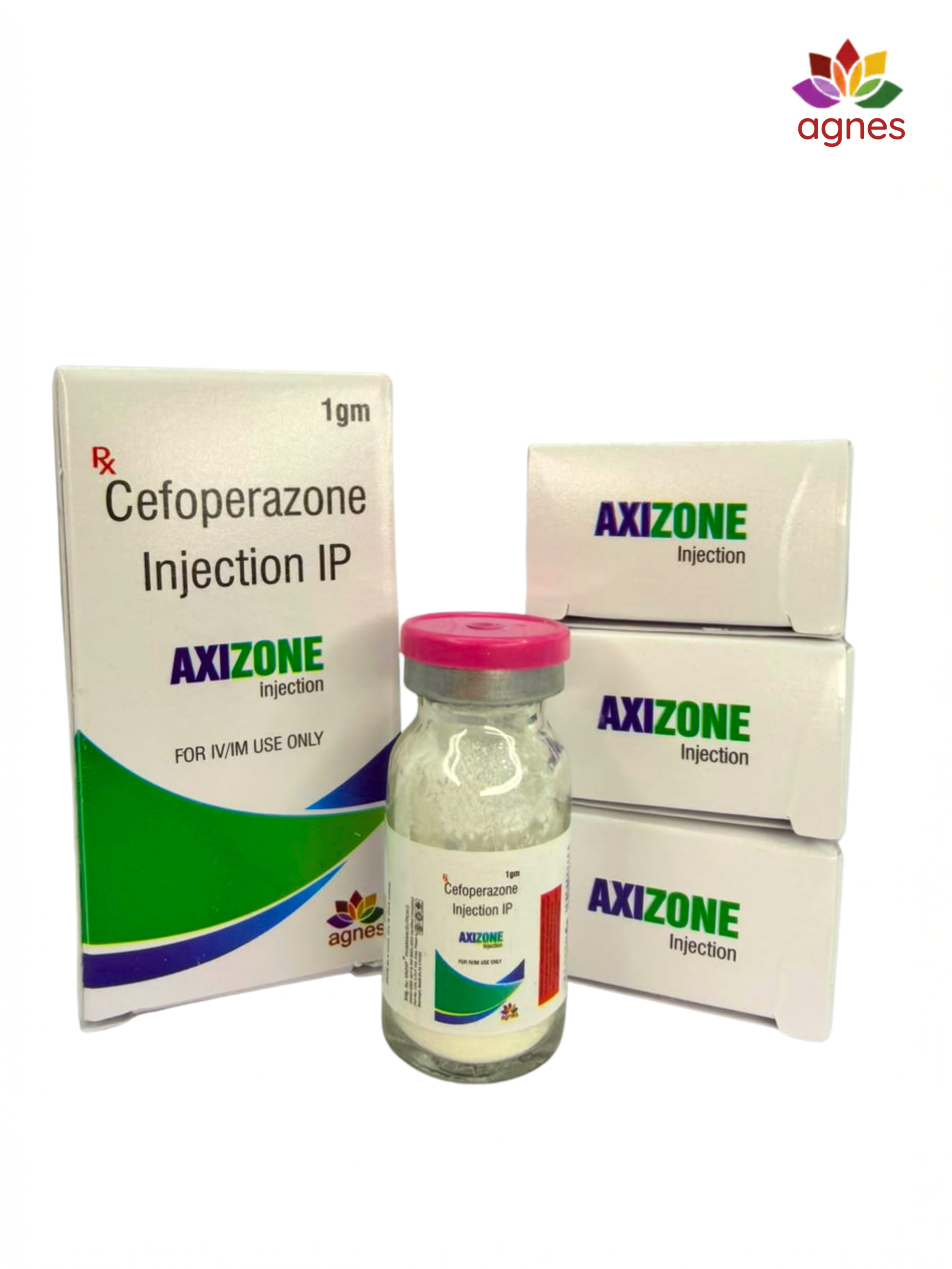
AXIZONE
COMPOSITION
Cefoperazone 1000 mg (Injection)
Category
Antibiotic, Cephalosporin
| Packing |
|---|
SKU
7094e22585de
Categories AGNES, INJECTABLES, Injection
ENQUIRY
Indications
AXIZONE is a third-generation cephalosporin antibiotic injection meant for hospital use. Doctors prescribe it when the infection is serious, when it is caused by gram-negative bacteria, or when simpler antibiotics have already been tried and have not worked. It is not a first-choice antibiotic for mild infections — it is kept for cases that need stronger, more targeted treatment. It is prescribed for:
Serious Gram-Negative Infections: Targets the tougher gram-negative bacteria that tend to cause hospital infections and are harder to clear with standard treatment.
Chest and Lung Infections: Used in severe pneumonia and serious lower respiratory tract infections where tablets are not enough and injectable antibiotic treatment is needed.
Urinary Tract Infections: Prescribed for complicated UTIs, particularly when the bacteria causing the infection have already stopped responding to the antibiotics normally used for UTIs.
Bile Duct and Gallbladder Infections: This is where AXIZONE has a clear advantage over most other antibiotics. Because Cefoperazone is removed from the body mainly through bile — not the kidneys — it reaches the bile duct and gallbladder in much higher amounts. This makes it one of the better choices for biliary tract infections.
Blood Infections (Septicemia): When bacteria enter the bloodstream, the body’s condition can go downhill fast. AXIZONE is used in these cases to bring down the bacterial load quickly before the situation becomes life-threatening.
Hospital-Acquired Infections: Bacteria picked up inside a hospital, ICU, or after invasive procedures tend to be more resistant than the ones you encounter outside. AXIZONE covers many of these tougher organisms.
Brain and Spinal Cord Infections: Reaches the fluid around the central nervous system well enough to treat certain serious infections there — used only under specialist supervision.
Stomach Cavity Infections: Bacterial infections inside the abdomen, including peritonitis — sometimes used alongside other antibiotics in more complex cases.
Uses
AXIZONE contains Cefoperazone, which works by attacking the outer wall of bacteria. Every bacterium needs this wall to stay alive and keep multiplying. When Cefoperazone damages it, the bacterium falls apart. What makes Cefoperazone stand apart from many other antibiotics in its class is the way it exits the body — mostly through bile rather than only through the kidneys. This gives it a natural advantage in biliary and abdominal infections, and also makes it a more suitable choice for patients who have reduced kidney function.
Works Against Serious Gram-Negative Bacteria: Covers a broad range of gram-negative pathogens — the type most commonly seen in hospital-acquired infections that do not respond well to standard antibiotics.
Three Infection Sites in One Antibiotic: Respiratory tract, urinary tract, and biliary tract — AXIZONE covers all three, which makes it a practical and versatile choice in a hospital setting.
Controls Blood Infections Fast: Enters the bloodstream directly and starts working quickly — reducing bacterial load in septicemia cases where time is the most important factor.
Good for Hospital-Acquired Infections: Covers bacteria that thrive inside hospital environments — organisms that have often developed resistance to the antibiotics used more commonly outside.
Reaches the Brain and Spinal Fluid: Penetrates into the central nervous system sufficiently to treat bacterial infections affecting the brain lining or spinal cord — something many antibiotics cannot do effectively.
Biliary Route Advantage: Since Cefoperazone mainly leaves through bile rather than urine, it builds up in the bile duct and surrounding area naturally — making it both effective for biliary infections and safer for patients with kidney problems.
Works Against Serious Gram-Negative Bacteria: Covers a broad range of gram-negative pathogens — the type most commonly seen in hospital-acquired infections that do not respond well to standard antibiotics.
Three Infection Sites in One Antibiotic: Respiratory tract, urinary tract, and biliary tract — AXIZONE covers all three, which makes it a practical and versatile choice in a hospital setting.
Controls Blood Infections Fast: Enters the bloodstream directly and starts working quickly — reducing bacterial load in septicemia cases where time is the most important factor.
Good for Hospital-Acquired Infections: Covers bacteria that thrive inside hospital environments — organisms that have often developed resistance to the antibiotics used more commonly outside.
Reaches the Brain and Spinal Fluid: Penetrates into the central nervous system sufficiently to treat bacterial infections affecting the brain lining or spinal cord — something many antibiotics cannot do effectively.
Biliary Route Advantage: Since Cefoperazone mainly leaves through bile rather than urine, it builds up in the bile duct and surrounding area naturally — making it both effective for biliary infections and safer for patients with kidney problems.
Dosage & Storage
Dosage: The treating doctor works out the right dose based on the type of infection, how serious it is, and the patient’s age, weight, and kidney or liver condition. There is no fixed dose that fits every patient.
How It Is Given: Through a vein (IV) or into a muscle (IM) by a qualified doctor or nurse in a hospital or clinic setting. Not for home use at any point.
Preparation: The powder in the vial is mixed with the right liquid before use. The exact steps for preparation and dilution are followed by the medical team or hospital pharmacy.
Storage: Store the dry vial at room temperature between 15°C and 30°C — in a cool, dry place away from moisture.
Protect from Light: Keep in the original carton. Direct sunlight or excess heat can affect the quality of the medicine.
After mixing: Use the prepared solution promptly. Do not leave the mixed solution sitting for longer than the recommended time unless specifically instructed.
Out of Reach: Keep stored safely away from children and pets at all times.
How It Is Given: Through a vein (IV) or into a muscle (IM) by a qualified doctor or nurse in a hospital or clinic setting. Not for home use at any point.
Preparation: The powder in the vial is mixed with the right liquid before use. The exact steps for preparation and dilution are followed by the medical team or hospital pharmacy.
Storage: Store the dry vial at room temperature between 15°C and 30°C — in a cool, dry place away from moisture.
Protect from Light: Keep in the original carton. Direct sunlight or excess heat can affect the quality of the medicine.
After mixing: Use the prepared solution promptly. Do not leave the mixed solution sitting for longer than the recommended time unless specifically instructed.
Out of Reach: Keep stored safely away from children and pets at all times.
Directions For Use
Hospital Use Only: AXIZONE is given only inside a hospital or clinical setting by a trained medical professional. It is not suitable for home use under any circumstances.
Never Self-Administer: This injection is always prepared and given by a doctor or nurse. The patient should never attempt to give it to themselves.
Look Before You Use: After mixing, check the solution carefully. It should be clear, with no floating particles, cloudiness, or change in colour. If it does not look right, stop and tell the nurse or pharmacist right away. Do not use a solution that looks abnormal.
Complete the Full Course: Starting to feel better after a few doses is normal — but it does not mean the bacteria are fully gone. Stopping the injection early allows the remaining bacteria to survive and come back — and the second time around, they tend to be harder to treat. Always finish the complete course the doctor has prescribed.
Regular Dose Intervals: Doses are given at evenly spaced times through the day. This keeps the antibiotic at a steady level in the blood — which is what makes it work properly.
Missed Dose: If a dose gets skipped in the hospital, tell the doctor or nurse straight away. Never give two doses together to make up for the one that was missed.
No Alcohol — This Is Important: Do not consume alcohol during the treatment and for at least 72 hours after the last dose. Cefoperazone reacts with alcohol in the body and can cause a very unpleasant reaction — face flushing, nausea, fast heartbeat, and a sudden drop in blood pressure. This is not a mild caution — it needs to be taken seriously.
Never Self-Administer: This injection is always prepared and given by a doctor or nurse. The patient should never attempt to give it to themselves.
Look Before You Use: After mixing, check the solution carefully. It should be clear, with no floating particles, cloudiness, or change in colour. If it does not look right, stop and tell the nurse or pharmacist right away. Do not use a solution that looks abnormal.
Complete the Full Course: Starting to feel better after a few doses is normal — but it does not mean the bacteria are fully gone. Stopping the injection early allows the remaining bacteria to survive and come back — and the second time around, they tend to be harder to treat. Always finish the complete course the doctor has prescribed.
Regular Dose Intervals: Doses are given at evenly spaced times through the day. This keeps the antibiotic at a steady level in the blood — which is what makes it work properly.
Missed Dose: If a dose gets skipped in the hospital, tell the doctor or nurse straight away. Never give two doses together to make up for the one that was missed.
No Alcohol — This Is Important: Do not consume alcohol during the treatment and for at least 72 hours after the last dose. Cefoperazone reacts with alcohol in the body and can cause a very unpleasant reaction — face flushing, nausea, fast heartbeat, and a sudden drop in blood pressure. This is not a mild caution — it needs to be taken seriously.
Precautions
The doctor must know the following before AXIZONE is started:
Antibiotic Allergy: Do not use in patients who are allergic to Cefoperazone, any cephalosporin, penicillin, or beta-lactam antibiotic. The complete allergy history — not just the most recent one — must be shared before starting treatment.
Liver Disease: Since Cefoperazone exits through bile rather than the kidneys, patients with liver disease or a blocked bile duct need careful dose adjustment. The liver handles this medicine more than usual, so closer monitoring is needed throughout the course.
Kidney Problems: AXIZONE is actually easier on the kidneys than many other antibiotics because it does not depend mainly on them for removal. Still, patients with kidney conditions should be monitored during treatment.
Bleeding Risk: In some patients — especially those who are not eating well or are on restricted diets — Cefoperazone can affect how Vitamin K works in the body. This can make the blood take longer to clot. Patients on blood thinners need especially careful watching during the course.
Strict No Alcohol Rule: Already mentioned above — but important enough to say again. No alcohol from the first dose until at least 3 full days after the last dose. The reaction between Cefoperazone and alcohol is a known and real risk.
Pregnancy and Breastfeeding: Used only when the doctor clearly decides the benefit outweighs any risk — not given routinely.
Other Medicines: Tell the doctor about everything the patient is currently taking — especially blood thinners. Some medicines do not mix well with Cefoperazone and the doctor needs the full list to plan safely.
Antibiotic Allergy: Do not use in patients who are allergic to Cefoperazone, any cephalosporin, penicillin, or beta-lactam antibiotic. The complete allergy history — not just the most recent one — must be shared before starting treatment.
Liver Disease: Since Cefoperazone exits through bile rather than the kidneys, patients with liver disease or a blocked bile duct need careful dose adjustment. The liver handles this medicine more than usual, so closer monitoring is needed throughout the course.
Kidney Problems: AXIZONE is actually easier on the kidneys than many other antibiotics because it does not depend mainly on them for removal. Still, patients with kidney conditions should be monitored during treatment.
Bleeding Risk: In some patients — especially those who are not eating well or are on restricted diets — Cefoperazone can affect how Vitamin K works in the body. This can make the blood take longer to clot. Patients on blood thinners need especially careful watching during the course.
Strict No Alcohol Rule: Already mentioned above — but important enough to say again. No alcohol from the first dose until at least 3 full days after the last dose. The reaction between Cefoperazone and alcohol is a known and real risk.
Pregnancy and Breastfeeding: Used only when the doctor clearly decides the benefit outweighs any risk — not given routinely.
Other Medicines: Tell the doctor about everything the patient is currently taking — especially blood thinners. Some medicines do not mix well with Cefoperazone and the doctor needs the full list to plan safely.
Side Effects
GI upset
Local pain at injection site
Skin rash
Elevated liver enzymes
Hypersensitivity reactions
Local pain at injection site
Skin rash
Elevated liver enzymes
Hypersensitivity reactions
Medical Disclaimer
This page is here to help you understand what this medicine is and how it is used — that is all it is. It is not a substitute for your doctor’s guidance and was never meant to be.
AXIZONE is a prescription-only injection and must be given in a proper hospital or clinical setting by a licensed medical professional.
Agnes Life Sciences does not claim that this or any of its products can diagnose, treat, cure, or prevent any disease.
For any diagnosis or treatment decision, please speak to your doctor directly.
AXIZONE is a prescription-only injection and must be given in a proper hospital or clinical setting by a licensed medical professional.
Agnes Life Sciences does not claim that this or any of its products can diagnose, treat, cure, or prevent any disease.
For any diagnosis or treatment decision, please speak to your doctor directly.
Indications
AXIZONE is a third-generation cephalosporin antibiotic injection meant for hospital use. Doctors prescribe it when the infection is serious, when it is caused by gram-negative bacteria, or when simpler antibiotics have already been tried and have not worked. It is not a first-choice antibiotic for mild infections — it is kept for cases that need stronger, more targeted treatment. It is prescribed for:
Serious Gram-Negative Infections: Targets the tougher gram-negative bacteria that tend to cause hospital infections and are harder to clear with standard treatment.
Chest and Lung Infections: Used in severe pneumonia and serious lower respiratory tract infections where tablets are not enough and injectable antibiotic treatment is needed.
Urinary Tract Infections: Prescribed for complicated UTIs, particularly when the bacteria causing the infection have already stopped responding to the antibiotics normally used for UTIs.
Bile Duct and Gallbladder Infections: This is where AXIZONE has a clear advantage over most other antibiotics. Because Cefoperazone is removed from the body mainly through bile — not the kidneys — it reaches the bile duct and gallbladder in much higher amounts. This makes it one of the better choices for biliary tract infections.
Blood Infections (Septicemia): When bacteria enter the bloodstream, the body’s condition can go downhill fast. AXIZONE is used in these cases to bring down the bacterial load quickly before the situation becomes life-threatening.
Hospital-Acquired Infections: Bacteria picked up inside a hospital, ICU, or after invasive procedures tend to be more resistant than the ones you encounter outside. AXIZONE covers many of these tougher organisms.
Brain and Spinal Cord Infections: Reaches the fluid around the central nervous system well enough to treat certain serious infections there — used only under specialist supervision.
Stomach Cavity Infections: Bacterial infections inside the abdomen, including peritonitis — sometimes used alongside other antibiotics in more complex cases.
Uses
AXIZONE contains Cefoperazone, which works by attacking the outer wall of bacteria. Every bacterium needs this wall to stay alive and keep multiplying. When Cefoperazone damages it, the bacterium falls apart. What makes Cefoperazone stand apart from many other antibiotics in its class is the way it exits the body — mostly through bile rather than only through the kidneys. This gives it a natural advantage in biliary and abdominal infections, and also makes it a more suitable choice for patients who have reduced kidney function.
Works Against Serious Gram-Negative Bacteria: Covers a broad range of gram-negative pathogens — the type most commonly seen in hospital-acquired infections that do not respond well to standard antibiotics.
Three Infection Sites in One Antibiotic: Respiratory tract, urinary tract, and biliary tract — AXIZONE covers all three, which makes it a practical and versatile choice in a hospital setting.
Controls Blood Infections Fast: Enters the bloodstream directly and starts working quickly — reducing bacterial load in septicemia cases where time is the most important factor.
Good for Hospital-Acquired Infections: Covers bacteria that thrive inside hospital environments — organisms that have often developed resistance to the antibiotics used more commonly outside.
Reaches the Brain and Spinal Fluid: Penetrates into the central nervous system sufficiently to treat bacterial infections affecting the brain lining or spinal cord — something many antibiotics cannot do effectively.
Biliary Route Advantage: Since Cefoperazone mainly leaves through bile rather than urine, it builds up in the bile duct and surrounding area naturally — making it both effective for biliary infections and safer for patients with kidney problems.
Works Against Serious Gram-Negative Bacteria: Covers a broad range of gram-negative pathogens — the type most commonly seen in hospital-acquired infections that do not respond well to standard antibiotics.
Three Infection Sites in One Antibiotic: Respiratory tract, urinary tract, and biliary tract — AXIZONE covers all three, which makes it a practical and versatile choice in a hospital setting.
Controls Blood Infections Fast: Enters the bloodstream directly and starts working quickly — reducing bacterial load in septicemia cases where time is the most important factor.
Good for Hospital-Acquired Infections: Covers bacteria that thrive inside hospital environments — organisms that have often developed resistance to the antibiotics used more commonly outside.
Reaches the Brain and Spinal Fluid: Penetrates into the central nervous system sufficiently to treat bacterial infections affecting the brain lining or spinal cord — something many antibiotics cannot do effectively.
Biliary Route Advantage: Since Cefoperazone mainly leaves through bile rather than urine, it builds up in the bile duct and surrounding area naturally — making it both effective for biliary infections and safer for patients with kidney problems.
Dosage & Storage
Dosage: The treating doctor works out the right dose based on the type of infection, how serious it is, and the patient’s age, weight, and kidney or liver condition. There is no fixed dose that fits every patient.
How It Is Given: Through a vein (IV) or into a muscle (IM) by a qualified doctor or nurse in a hospital or clinic setting. Not for home use at any point.
Preparation: The powder in the vial is mixed with the right liquid before use. The exact steps for preparation and dilution are followed by the medical team or hospital pharmacy.
Storage: Store the dry vial at room temperature between 15°C and 30°C — in a cool, dry place away from moisture.
Protect from Light: Keep in the original carton. Direct sunlight or excess heat can affect the quality of the medicine.
After mixing: Use the prepared solution promptly. Do not leave the mixed solution sitting for longer than the recommended time unless specifically instructed.
Out of Reach: Keep stored safely away from children and pets at all times.
How It Is Given: Through a vein (IV) or into a muscle (IM) by a qualified doctor or nurse in a hospital or clinic setting. Not for home use at any point.
Preparation: The powder in the vial is mixed with the right liquid before use. The exact steps for preparation and dilution are followed by the medical team or hospital pharmacy.
Storage: Store the dry vial at room temperature between 15°C and 30°C — in a cool, dry place away from moisture.
Protect from Light: Keep in the original carton. Direct sunlight or excess heat can affect the quality of the medicine.
After mixing: Use the prepared solution promptly. Do not leave the mixed solution sitting for longer than the recommended time unless specifically instructed.
Out of Reach: Keep stored safely away from children and pets at all times.
Directions For Use
Hospital Use Only: AXIZONE is given only inside a hospital or clinical setting by a trained medical professional. It is not suitable for home use under any circumstances.
Never Self-Administer: This injection is always prepared and given by a doctor or nurse. The patient should never attempt to give it to themselves.
Look Before You Use: After mixing, check the solution carefully. It should be clear, with no floating particles, cloudiness, or change in colour. If it does not look right, stop and tell the nurse or pharmacist right away. Do not use a solution that looks abnormal.
Complete the Full Course: Starting to feel better after a few doses is normal — but it does not mean the bacteria are fully gone. Stopping the injection early allows the remaining bacteria to survive and come back — and the second time around, they tend to be harder to treat. Always finish the complete course the doctor has prescribed.
Regular Dose Intervals: Doses are given at evenly spaced times through the day. This keeps the antibiotic at a steady level in the blood — which is what makes it work properly.
Missed Dose: If a dose gets skipped in the hospital, tell the doctor or nurse straight away. Never give two doses together to make up for the one that was missed.
No Alcohol — This Is Important: Do not consume alcohol during the treatment and for at least 72 hours after the last dose. Cefoperazone reacts with alcohol in the body and can cause a very unpleasant reaction — face flushing, nausea, fast heartbeat, and a sudden drop in blood pressure. This is not a mild caution — it needs to be taken seriously.
Never Self-Administer: This injection is always prepared and given by a doctor or nurse. The patient should never attempt to give it to themselves.
Look Before You Use: After mixing, check the solution carefully. It should be clear, with no floating particles, cloudiness, or change in colour. If it does not look right, stop and tell the nurse or pharmacist right away. Do not use a solution that looks abnormal.
Complete the Full Course: Starting to feel better after a few doses is normal — but it does not mean the bacteria are fully gone. Stopping the injection early allows the remaining bacteria to survive and come back — and the second time around, they tend to be harder to treat. Always finish the complete course the doctor has prescribed.
Regular Dose Intervals: Doses are given at evenly spaced times through the day. This keeps the antibiotic at a steady level in the blood — which is what makes it work properly.
Missed Dose: If a dose gets skipped in the hospital, tell the doctor or nurse straight away. Never give two doses together to make up for the one that was missed.
No Alcohol — This Is Important: Do not consume alcohol during the treatment and for at least 72 hours after the last dose. Cefoperazone reacts with alcohol in the body and can cause a very unpleasant reaction — face flushing, nausea, fast heartbeat, and a sudden drop in blood pressure. This is not a mild caution — it needs to be taken seriously.
Precautions
The doctor must know the following before AXIZONE is started:
Antibiotic Allergy: Do not use in patients who are allergic to Cefoperazone, any cephalosporin, penicillin, or beta-lactam antibiotic. The complete allergy history — not just the most recent one — must be shared before starting treatment.
Liver Disease: Since Cefoperazone exits through bile rather than the kidneys, patients with liver disease or a blocked bile duct need careful dose adjustment. The liver handles this medicine more than usual, so closer monitoring is needed throughout the course.
Kidney Problems: AXIZONE is actually easier on the kidneys than many other antibiotics because it does not depend mainly on them for removal. Still, patients with kidney conditions should be monitored during treatment.
Bleeding Risk: In some patients — especially those who are not eating well or are on restricted diets — Cefoperazone can affect how Vitamin K works in the body. This can make the blood take longer to clot. Patients on blood thinners need especially careful watching during the course.
Strict No Alcohol Rule: Already mentioned above — but important enough to say again. No alcohol from the first dose until at least 3 full days after the last dose. The reaction between Cefoperazone and alcohol is a known and real risk.
Pregnancy and Breastfeeding: Used only when the doctor clearly decides the benefit outweighs any risk — not given routinely.
Other Medicines: Tell the doctor about everything the patient is currently taking — especially blood thinners. Some medicines do not mix well with Cefoperazone and the doctor needs the full list to plan safely.
Antibiotic Allergy: Do not use in patients who are allergic to Cefoperazone, any cephalosporin, penicillin, or beta-lactam antibiotic. The complete allergy history — not just the most recent one — must be shared before starting treatment.
Liver Disease: Since Cefoperazone exits through bile rather than the kidneys, patients with liver disease or a blocked bile duct need careful dose adjustment. The liver handles this medicine more than usual, so closer monitoring is needed throughout the course.
Kidney Problems: AXIZONE is actually easier on the kidneys than many other antibiotics because it does not depend mainly on them for removal. Still, patients with kidney conditions should be monitored during treatment.
Bleeding Risk: In some patients — especially those who are not eating well or are on restricted diets — Cefoperazone can affect how Vitamin K works in the body. This can make the blood take longer to clot. Patients on blood thinners need especially careful watching during the course.
Strict No Alcohol Rule: Already mentioned above — but important enough to say again. No alcohol from the first dose until at least 3 full days after the last dose. The reaction between Cefoperazone and alcohol is a known and real risk.
Pregnancy and Breastfeeding: Used only when the doctor clearly decides the benefit outweighs any risk — not given routinely.
Other Medicines: Tell the doctor about everything the patient is currently taking — especially blood thinners. Some medicines do not mix well with Cefoperazone and the doctor needs the full list to plan safely.
Side Effects
GI upset
Local pain at injection site
Skin rash
Elevated liver enzymes
Hypersensitivity reactions
Local pain at injection site
Skin rash
Elevated liver enzymes
Hypersensitivity reactions
Medical Disclaimer
This page is here to help you understand what this medicine is and how it is used — that is all it is. It is not a substitute for your doctor’s guidance and was never meant to be.
AXIZONE is a prescription-only injection and must be given in a proper hospital or clinical setting by a licensed medical professional.
Agnes Life Sciences does not claim that this or any of its products can diagnose, treat, cure, or prevent any disease.
For any diagnosis or treatment decision, please speak to your doctor directly.
AXIZONE is a prescription-only injection and must be given in a proper hospital or clinical setting by a licensed medical professional.
Agnes Life Sciences does not claim that this or any of its products can diagnose, treat, cure, or prevent any disease.
For any diagnosis or treatment decision, please speak to your doctor directly.