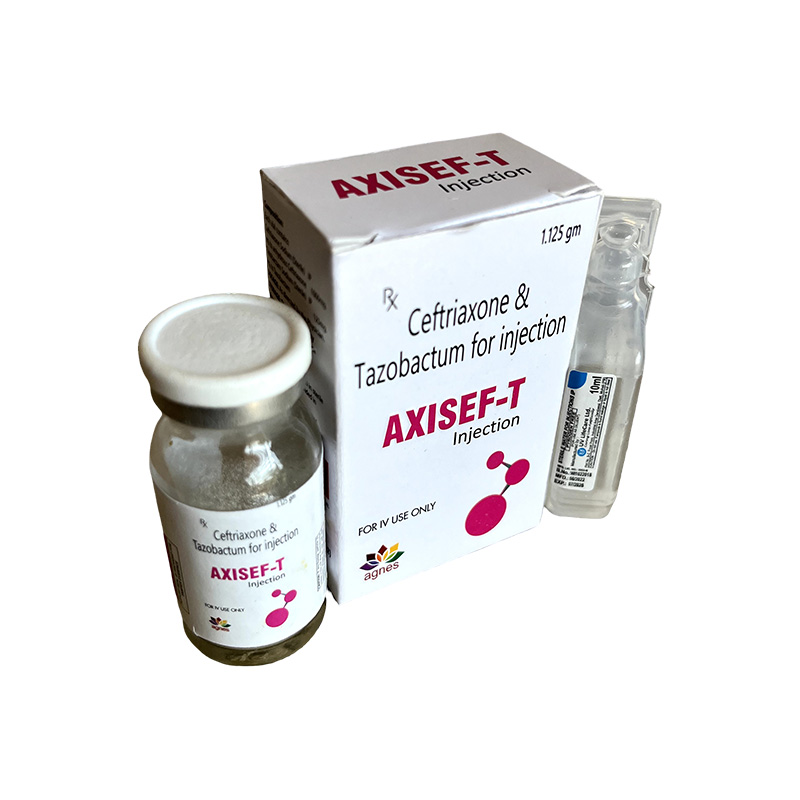
AXISEF-T
COMPOSITION
Ceftriaxone 1000 mg + Tazobactam 125 mg (Injection)
Category
Antibiotic, Cephalosporin + lactamase Inhibitor
| Packing |
|---|
SKU
0be7168a5290
Categories AGNES, INJECTABLES, Injection
ENQUIRY
Indications
AXISEF-T is a hospital antibiotic injection used when the infection is serious and ordinary antibiotics are not giving results. Doctors usually reach for this when they know the bacteria involved are strong, resistant, or when the patient’s condition cannot wait for weaker treatment to slowly show results. It is given for:
Pneumonia: For lung infections that developed inside the hospital or in the community — particularly when common antibiotics were tried first and did not work, or when drug-resistant bacteria are suspected.
Sepsis: When bacteria make their way into the blood, the body’s condition can worsen very quickly. AXISEF-T is used in these emergencies because it acts fast and covers a wide range of bacteria at the same time.
Abdominal Infections: Infections inside the stomach area — whether it is peritonitis, gut infections, or anything affecting the abdominal organs and the tissue around them.
Complicated UTIs: Urinary tract infections that have not responded to standard antibiotic treatment and need something stronger to clear the resistant bacteria causing the problem.
Polymicrobial Infections: Sometimes more than one type of bacteria is responsible for a single infection at the same time. This is called a polymicrobial infection and it is harder to treat — AXISEF-T’s wide coverage makes it a suitable choice in these cases.
Post-Surgical Infections: Bacterial infections that appear at or near the surgical site after an operation — whether it is a routine procedure or a major surgery. These need quick and effective antibiotic treatment to avoid complications.
Skin and Soft Tissue Infections: Deep wound infections, complicated skin infections, and tissue infections caused by resistant bacteria that do not respond to simpler treatment.
Resistant Infections: When culture and sensitivity reports show that the bacteria are resistant to most commonly used antibiotics, doctors choose a combination like this one that can still get through the bacteria’s defences.
Pneumonia: For lung infections that developed inside the hospital or in the community — particularly when common antibiotics were tried first and did not work, or when drug-resistant bacteria are suspected.
Sepsis: When bacteria make their way into the blood, the body’s condition can worsen very quickly. AXISEF-T is used in these emergencies because it acts fast and covers a wide range of bacteria at the same time.
Abdominal Infections: Infections inside the stomach area — whether it is peritonitis, gut infections, or anything affecting the abdominal organs and the tissue around them.
Complicated UTIs: Urinary tract infections that have not responded to standard antibiotic treatment and need something stronger to clear the resistant bacteria causing the problem.
Polymicrobial Infections: Sometimes more than one type of bacteria is responsible for a single infection at the same time. This is called a polymicrobial infection and it is harder to treat — AXISEF-T’s wide coverage makes it a suitable choice in these cases.
Post-Surgical Infections: Bacterial infections that appear at or near the surgical site after an operation — whether it is a routine procedure or a major surgery. These need quick and effective antibiotic treatment to avoid complications.
Skin and Soft Tissue Infections: Deep wound infections, complicated skin infections, and tissue infections caused by resistant bacteria that do not respond to simpler treatment.
Resistant Infections: When culture and sensitivity reports show that the bacteria are resistant to most commonly used antibiotics, doctors choose a combination like this one that can still get through the bacteria’s defences.
Uses
AXISEF-T brings two medicines together — Ceftriaxone and Tazobactam.
Each one plays a different role. Ceftriaxone is the antibiotic that actually kills the bacteria. Tazobactam is not an antibiotic on its own — its job is to stop the bacteria from destroying Ceftriaxone before it can work. Some bacteria produce special enzymes that break down antibiotics the moment they enter the body. Tazobactam shuts those enzymes down. This means Ceftriaxone survives, reaches the bacteria, and does what it is supposed to do.
Broad Coverage Including Resistant Bacteria: Works against gram-positive, gram-negative, and anaerobic bacteria — including strains that have already stopped responding to third-generation cephalosporins used alone.
Pneumonia, Sepsis, and Abdominal Infections: All three are fast-moving and serious. This combination gives doctors a treatment strong enough for all three situations — where delays or weak treatment can cost the patient.
Complicated Urinary Infections: Gets through to resistant bacteria in the urinary tract that have outgrown simpler antibiotic options.
Mixed Bacterial Infections: Because it covers so many different types of bacteria, it is effective even when the lab report shows two or three different organisms are responsible for the same infection.
Post-Surgical Recovery: Clears bacteria that settle in surgical wounds or nearby tissue after an operation, reducing the risk of the infection spreading and delaying healing.
Keeps the Antibiotic Working: Tazobactam’s role is to protect Ceftriaxone inside the body — blocking the resistance enzymes that would otherwise destroy it before it reaches the infection site.
Each one plays a different role. Ceftriaxone is the antibiotic that actually kills the bacteria. Tazobactam is not an antibiotic on its own — its job is to stop the bacteria from destroying Ceftriaxone before it can work. Some bacteria produce special enzymes that break down antibiotics the moment they enter the body. Tazobactam shuts those enzymes down. This means Ceftriaxone survives, reaches the bacteria, and does what it is supposed to do.
Broad Coverage Including Resistant Bacteria: Works against gram-positive, gram-negative, and anaerobic bacteria — including strains that have already stopped responding to third-generation cephalosporins used alone.
Pneumonia, Sepsis, and Abdominal Infections: All three are fast-moving and serious. This combination gives doctors a treatment strong enough for all three situations — where delays or weak treatment can cost the patient.
Complicated Urinary Infections: Gets through to resistant bacteria in the urinary tract that have outgrown simpler antibiotic options.
Mixed Bacterial Infections: Because it covers so many different types of bacteria, it is effective even when the lab report shows two or three different organisms are responsible for the same infection.
Post-Surgical Recovery: Clears bacteria that settle in surgical wounds or nearby tissue after an operation, reducing the risk of the infection spreading and delaying healing.
Keeps the Antibiotic Working: Tazobactam’s role is to protect Ceftriaxone inside the body — blocking the resistance enzymes that would otherwise destroy it before it reaches the infection site.
Dosage & Storage
Dosage: Decided entirely by the treating doctor based on the severity of the infection, the patient’s age, weight, and how well the kidneys are functioning. There is no standard dose that works for every patient — the doctor customises it.
How It Is Given: Only through a vein (IV infusion) by a qualified doctor or nurse in a hospital or clinic. Never given as an IM injection or taken by mouth.
Preparation: The powder in the vial is mixed with a suitable liquid before the injection is given. The hospital pharmacy or nursing staff handles this. Always follow the exact preparation steps given by the medical team
. Storage: Store the dry vial in a cool, dry place at room temperature — between 15°C and 30°C.
Keep Away from Light: Store away from direct sunlight and heat at all times. Keep in the original carton until use.
After Mixing: Once the powder is dissolved and ready, use it promptly. Do not prepare it in advance and leave it sitting unless specifically instructed to do so.
Keep Away from Children: Store in a location that children and pets cannot reach.
How It Is Given: Only through a vein (IV infusion) by a qualified doctor or nurse in a hospital or clinic. Never given as an IM injection or taken by mouth.
Preparation: The powder in the vial is mixed with a suitable liquid before the injection is given. The hospital pharmacy or nursing staff handles this. Always follow the exact preparation steps given by the medical team
. Storage: Store the dry vial in a cool, dry place at room temperature — between 15°C and 30°C.
Keep Away from Light: Store away from direct sunlight and heat at all times. Keep in the original carton until use.
After Mixing: Once the powder is dissolved and ready, use it promptly. Do not prepare it in advance and leave it sitting unless specifically instructed to do so.
Keep Away from Children: Store in a location that children and pets cannot reach.
Directions For Use
For Hospital Use Only: AXISEF-T is given inside a hospital or clinic by a trained medical professional. This is not something that can or should be done at home — under any circumstances.
Always Given by a Professional: The patient never administers this injection themselves. A qualified nurse or doctor prepares it and gives it every single time.
Check Before Giving: Once the vial is mixed, look at the solution carefully. It should be completely clear — no cloudiness, no floating particles, no change in colour. If anything looks off, do not use it. Inform the nurse or pharmacist immediately.
Finish the Full Course: Feeling better after two or three doses is actually a good sign — but it does not mean the job is done. The bacteria that are still alive in the body have simply gone quiet. If the course is stopped early, they can come back — and the second time, they are often harder to treat. Always complete what the doctor prescribed.
Even Spacing Between Doses: Doses should be given at evenly spaced intervals throughout the day. This keeps the level of antibiotic in the body steady — which is what makes it effective.
Missed Dose: If a dose has been missed in the hospital, tell the doctor or nurse right away. Never give two doses together to make up for one that was skipped.
Always Given by a Professional: The patient never administers this injection themselves. A qualified nurse or doctor prepares it and gives it every single time.
Check Before Giving: Once the vial is mixed, look at the solution carefully. It should be completely clear — no cloudiness, no floating particles, no change in colour. If anything looks off, do not use it. Inform the nurse or pharmacist immediately.
Finish the Full Course: Feeling better after two or three doses is actually a good sign — but it does not mean the job is done. The bacteria that are still alive in the body have simply gone quiet. If the course is stopped early, they can come back — and the second time, they are often harder to treat. Always complete what the doctor prescribed.
Even Spacing Between Doses: Doses should be given at evenly spaced intervals throughout the day. This keeps the level of antibiotic in the body steady — which is what makes it effective.
Missed Dose: If a dose has been missed in the hospital, tell the doctor or nurse right away. Never give two doses together to make up for one that was skipped.
Precautions
The doctor must know the following before starting AXISEF-T:
Antibiotic Allergy: If the patient has ever had a reaction to cephalosporins, penicillin, tazobactam, or any beta-lactam antibiotic — this must be shared before anything else. Full allergy history, not just the most recent one.
Kidney or Liver Conditions: Both organs are involved in how this medicine is processed and removed from the body. Patients with weaker kidneys or liver problems may need a different dose and more frequent blood monitoring during the course.
Pregnancy and Breastfeeding: Only used when the treating doctor has clearly decided that the benefit to the patient outweighs the risk. Not a routine or casual decision.
Other Medicines: Blood thinners, water tablets (diuretics), other antibiotics — tell the doctor about everything the patient is currently taking. Interactions are possible, and the doctor needs the complete picture before starting.
Long Treatment Courses: When antibiotics are given for a long time, there is sometimes a chance that other organisms not covered by the antibiotic can grow in the body. Regular check-ups and monitoring during extended treatment help catch this before it becomes a problem.
Sodium in the Injection: This medicine contains some sodium. For patients on a low-sodium diet or those with heart or kidney conditions, the doctor needs to factor this into the overall treatment plan.
Antibiotic Allergy: If the patient has ever had a reaction to cephalosporins, penicillin, tazobactam, or any beta-lactam antibiotic — this must be shared before anything else. Full allergy history, not just the most recent one.
Kidney or Liver Conditions: Both organs are involved in how this medicine is processed and removed from the body. Patients with weaker kidneys or liver problems may need a different dose and more frequent blood monitoring during the course.
Pregnancy and Breastfeeding: Only used when the treating doctor has clearly decided that the benefit to the patient outweighs the risk. Not a routine or casual decision.
Other Medicines: Blood thinners, water tablets (diuretics), other antibiotics — tell the doctor about everything the patient is currently taking. Interactions are possible, and the doctor needs the complete picture before starting.
Long Treatment Courses: When antibiotics are given for a long time, there is sometimes a chance that other organisms not covered by the antibiotic can grow in the body. Regular check-ups and monitoring during extended treatment help catch this before it becomes a problem.
Sodium in the Injection: This medicine contains some sodium. For patients on a low-sodium diet or those with heart or kidney conditions, the doctor needs to factor this into the overall treatment plan.
Side Effects
Rash
Diarrhea
Injection site pain
Nausea
Increased liver enzymes
Diarrhea
Injection site pain
Nausea
Increased liver enzymes
Medical Disclaimer
This page gives you a basic understanding of the medicine and nothing more.
It is not a replacement for your doctor’s advice and was never intended to be one.
AXISEF-T is a prescription-only injection and must be given in a proper hospital or clinical setting by a licensed medical professional.
Agnes Life Sciences does not claim that this or any of its products can diagnose, treat, cure, or prevent any disease.
For diagnosis and treatment decisions, your doctor is the only right person to consult.
It is not a replacement for your doctor’s advice and was never intended to be one.
AXISEF-T is a prescription-only injection and must be given in a proper hospital or clinical setting by a licensed medical professional.
Agnes Life Sciences does not claim that this or any of its products can diagnose, treat, cure, or prevent any disease.
For diagnosis and treatment decisions, your doctor is the only right person to consult.
Indications
AXISEF-T is a hospital antibiotic injection used when the infection is serious and ordinary antibiotics are not giving results. Doctors usually reach for this when they know the bacteria involved are strong, resistant, or when the patient’s condition cannot wait for weaker treatment to slowly show results. It is given for:
Pneumonia: For lung infections that developed inside the hospital or in the community — particularly when common antibiotics were tried first and did not work, or when drug-resistant bacteria are suspected.
Sepsis: When bacteria make their way into the blood, the body’s condition can worsen very quickly. AXISEF-T is used in these emergencies because it acts fast and covers a wide range of bacteria at the same time.
Abdominal Infections: Infections inside the stomach area — whether it is peritonitis, gut infections, or anything affecting the abdominal organs and the tissue around them.
Complicated UTIs: Urinary tract infections that have not responded to standard antibiotic treatment and need something stronger to clear the resistant bacteria causing the problem.
Polymicrobial Infections: Sometimes more than one type of bacteria is responsible for a single infection at the same time. This is called a polymicrobial infection and it is harder to treat — AXISEF-T’s wide coverage makes it a suitable choice in these cases.
Post-Surgical Infections: Bacterial infections that appear at or near the surgical site after an operation — whether it is a routine procedure or a major surgery. These need quick and effective antibiotic treatment to avoid complications.
Skin and Soft Tissue Infections: Deep wound infections, complicated skin infections, and tissue infections caused by resistant bacteria that do not respond to simpler treatment.
Resistant Infections: When culture and sensitivity reports show that the bacteria are resistant to most commonly used antibiotics, doctors choose a combination like this one that can still get through the bacteria’s defences.
Pneumonia: For lung infections that developed inside the hospital or in the community — particularly when common antibiotics were tried first and did not work, or when drug-resistant bacteria are suspected.
Sepsis: When bacteria make their way into the blood, the body’s condition can worsen very quickly. AXISEF-T is used in these emergencies because it acts fast and covers a wide range of bacteria at the same time.
Abdominal Infections: Infections inside the stomach area — whether it is peritonitis, gut infections, or anything affecting the abdominal organs and the tissue around them.
Complicated UTIs: Urinary tract infections that have not responded to standard antibiotic treatment and need something stronger to clear the resistant bacteria causing the problem.
Polymicrobial Infections: Sometimes more than one type of bacteria is responsible for a single infection at the same time. This is called a polymicrobial infection and it is harder to treat — AXISEF-T’s wide coverage makes it a suitable choice in these cases.
Post-Surgical Infections: Bacterial infections that appear at or near the surgical site after an operation — whether it is a routine procedure or a major surgery. These need quick and effective antibiotic treatment to avoid complications.
Skin and Soft Tissue Infections: Deep wound infections, complicated skin infections, and tissue infections caused by resistant bacteria that do not respond to simpler treatment.
Resistant Infections: When culture and sensitivity reports show that the bacteria are resistant to most commonly used antibiotics, doctors choose a combination like this one that can still get through the bacteria’s defences.
Uses
AXISEF-T brings two medicines together — Ceftriaxone and Tazobactam.
Each one plays a different role. Ceftriaxone is the antibiotic that actually kills the bacteria. Tazobactam is not an antibiotic on its own — its job is to stop the bacteria from destroying Ceftriaxone before it can work. Some bacteria produce special enzymes that break down antibiotics the moment they enter the body. Tazobactam shuts those enzymes down. This means Ceftriaxone survives, reaches the bacteria, and does what it is supposed to do.
Broad Coverage Including Resistant Bacteria: Works against gram-positive, gram-negative, and anaerobic bacteria — including strains that have already stopped responding to third-generation cephalosporins used alone.
Pneumonia, Sepsis, and Abdominal Infections: All three are fast-moving and serious. This combination gives doctors a treatment strong enough for all three situations — where delays or weak treatment can cost the patient.
Complicated Urinary Infections: Gets through to resistant bacteria in the urinary tract that have outgrown simpler antibiotic options.
Mixed Bacterial Infections: Because it covers so many different types of bacteria, it is effective even when the lab report shows two or three different organisms are responsible for the same infection.
Post-Surgical Recovery: Clears bacteria that settle in surgical wounds or nearby tissue after an operation, reducing the risk of the infection spreading and delaying healing.
Keeps the Antibiotic Working: Tazobactam’s role is to protect Ceftriaxone inside the body — blocking the resistance enzymes that would otherwise destroy it before it reaches the infection site.
Each one plays a different role. Ceftriaxone is the antibiotic that actually kills the bacteria. Tazobactam is not an antibiotic on its own — its job is to stop the bacteria from destroying Ceftriaxone before it can work. Some bacteria produce special enzymes that break down antibiotics the moment they enter the body. Tazobactam shuts those enzymes down. This means Ceftriaxone survives, reaches the bacteria, and does what it is supposed to do.
Broad Coverage Including Resistant Bacteria: Works against gram-positive, gram-negative, and anaerobic bacteria — including strains that have already stopped responding to third-generation cephalosporins used alone.
Pneumonia, Sepsis, and Abdominal Infections: All three are fast-moving and serious. This combination gives doctors a treatment strong enough for all three situations — where delays or weak treatment can cost the patient.
Complicated Urinary Infections: Gets through to resistant bacteria in the urinary tract that have outgrown simpler antibiotic options.
Mixed Bacterial Infections: Because it covers so many different types of bacteria, it is effective even when the lab report shows two or three different organisms are responsible for the same infection.
Post-Surgical Recovery: Clears bacteria that settle in surgical wounds or nearby tissue after an operation, reducing the risk of the infection spreading and delaying healing.
Keeps the Antibiotic Working: Tazobactam’s role is to protect Ceftriaxone inside the body — blocking the resistance enzymes that would otherwise destroy it before it reaches the infection site.
Dosage & Storage
Dosage: Decided entirely by the treating doctor based on the severity of the infection, the patient’s age, weight, and how well the kidneys are functioning. There is no standard dose that works for every patient — the doctor customises it.
How It Is Given: Only through a vein (IV infusion) by a qualified doctor or nurse in a hospital or clinic. Never given as an IM injection or taken by mouth.
Preparation: The powder in the vial is mixed with a suitable liquid before the injection is given. The hospital pharmacy or nursing staff handles this. Always follow the exact preparation steps given by the medical team
. Storage: Store the dry vial in a cool, dry place at room temperature — between 15°C and 30°C.
Keep Away from Light: Store away from direct sunlight and heat at all times. Keep in the original carton until use.
After Mixing: Once the powder is dissolved and ready, use it promptly. Do not prepare it in advance and leave it sitting unless specifically instructed to do so.
Keep Away from Children: Store in a location that children and pets cannot reach.
How It Is Given: Only through a vein (IV infusion) by a qualified doctor or nurse in a hospital or clinic. Never given as an IM injection or taken by mouth.
Preparation: The powder in the vial is mixed with a suitable liquid before the injection is given. The hospital pharmacy or nursing staff handles this. Always follow the exact preparation steps given by the medical team
. Storage: Store the dry vial in a cool, dry place at room temperature — between 15°C and 30°C.
Keep Away from Light: Store away from direct sunlight and heat at all times. Keep in the original carton until use.
After Mixing: Once the powder is dissolved and ready, use it promptly. Do not prepare it in advance and leave it sitting unless specifically instructed to do so.
Keep Away from Children: Store in a location that children and pets cannot reach.
Directions For Use
For Hospital Use Only: AXISEF-T is given inside a hospital or clinic by a trained medical professional. This is not something that can or should be done at home — under any circumstances.
Always Given by a Professional: The patient never administers this injection themselves. A qualified nurse or doctor prepares it and gives it every single time.
Check Before Giving: Once the vial is mixed, look at the solution carefully. It should be completely clear — no cloudiness, no floating particles, no change in colour. If anything looks off, do not use it. Inform the nurse or pharmacist immediately.
Finish the Full Course: Feeling better after two or three doses is actually a good sign — but it does not mean the job is done. The bacteria that are still alive in the body have simply gone quiet. If the course is stopped early, they can come back — and the second time, they are often harder to treat. Always complete what the doctor prescribed.
Even Spacing Between Doses: Doses should be given at evenly spaced intervals throughout the day. This keeps the level of antibiotic in the body steady — which is what makes it effective.
Missed Dose: If a dose has been missed in the hospital, tell the doctor or nurse right away. Never give two doses together to make up for one that was skipped.
Always Given by a Professional: The patient never administers this injection themselves. A qualified nurse or doctor prepares it and gives it every single time.
Check Before Giving: Once the vial is mixed, look at the solution carefully. It should be completely clear — no cloudiness, no floating particles, no change in colour. If anything looks off, do not use it. Inform the nurse or pharmacist immediately.
Finish the Full Course: Feeling better after two or three doses is actually a good sign — but it does not mean the job is done. The bacteria that are still alive in the body have simply gone quiet. If the course is stopped early, they can come back — and the second time, they are often harder to treat. Always complete what the doctor prescribed.
Even Spacing Between Doses: Doses should be given at evenly spaced intervals throughout the day. This keeps the level of antibiotic in the body steady — which is what makes it effective.
Missed Dose: If a dose has been missed in the hospital, tell the doctor or nurse right away. Never give two doses together to make up for one that was skipped.
Precautions
The doctor must know the following before starting AXISEF-T:
Antibiotic Allergy: If the patient has ever had a reaction to cephalosporins, penicillin, tazobactam, or any beta-lactam antibiotic — this must be shared before anything else. Full allergy history, not just the most recent one.
Kidney or Liver Conditions: Both organs are involved in how this medicine is processed and removed from the body. Patients with weaker kidneys or liver problems may need a different dose and more frequent blood monitoring during the course.
Pregnancy and Breastfeeding: Only used when the treating doctor has clearly decided that the benefit to the patient outweighs the risk. Not a routine or casual decision.
Other Medicines: Blood thinners, water tablets (diuretics), other antibiotics — tell the doctor about everything the patient is currently taking. Interactions are possible, and the doctor needs the complete picture before starting.
Long Treatment Courses: When antibiotics are given for a long time, there is sometimes a chance that other organisms not covered by the antibiotic can grow in the body. Regular check-ups and monitoring during extended treatment help catch this before it becomes a problem.
Sodium in the Injection: This medicine contains some sodium. For patients on a low-sodium diet or those with heart or kidney conditions, the doctor needs to factor this into the overall treatment plan.
Antibiotic Allergy: If the patient has ever had a reaction to cephalosporins, penicillin, tazobactam, or any beta-lactam antibiotic — this must be shared before anything else. Full allergy history, not just the most recent one.
Kidney or Liver Conditions: Both organs are involved in how this medicine is processed and removed from the body. Patients with weaker kidneys or liver problems may need a different dose and more frequent blood monitoring during the course.
Pregnancy and Breastfeeding: Only used when the treating doctor has clearly decided that the benefit to the patient outweighs the risk. Not a routine or casual decision.
Other Medicines: Blood thinners, water tablets (diuretics), other antibiotics — tell the doctor about everything the patient is currently taking. Interactions are possible, and the doctor needs the complete picture before starting.
Long Treatment Courses: When antibiotics are given for a long time, there is sometimes a chance that other organisms not covered by the antibiotic can grow in the body. Regular check-ups and monitoring during extended treatment help catch this before it becomes a problem.
Sodium in the Injection: This medicine contains some sodium. For patients on a low-sodium diet or those with heart or kidney conditions, the doctor needs to factor this into the overall treatment plan.
Side Effects
Rash
Diarrhea
Injection site pain
Nausea
Increased liver enzymes
Diarrhea
Injection site pain
Nausea
Increased liver enzymes
Medical Disclaimer
This page gives you a basic understanding of the medicine and nothing more.
It is not a replacement for your doctor’s advice and was never intended to be one.
AXISEF-T is a prescription-only injection and must be given in a proper hospital or clinical setting by a licensed medical professional.
Agnes Life Sciences does not claim that this or any of its products can diagnose, treat, cure, or prevent any disease.
For diagnosis and treatment decisions, your doctor is the only right person to consult.
It is not a replacement for your doctor’s advice and was never intended to be one.
AXISEF-T is a prescription-only injection and must be given in a proper hospital or clinical setting by a licensed medical professional.
Agnes Life Sciences does not claim that this or any of its products can diagnose, treat, cure, or prevent any disease.
For diagnosis and treatment decisions, your doctor is the only right person to consult.